

Last Updated on October 20, 2026 by Umar Farooq
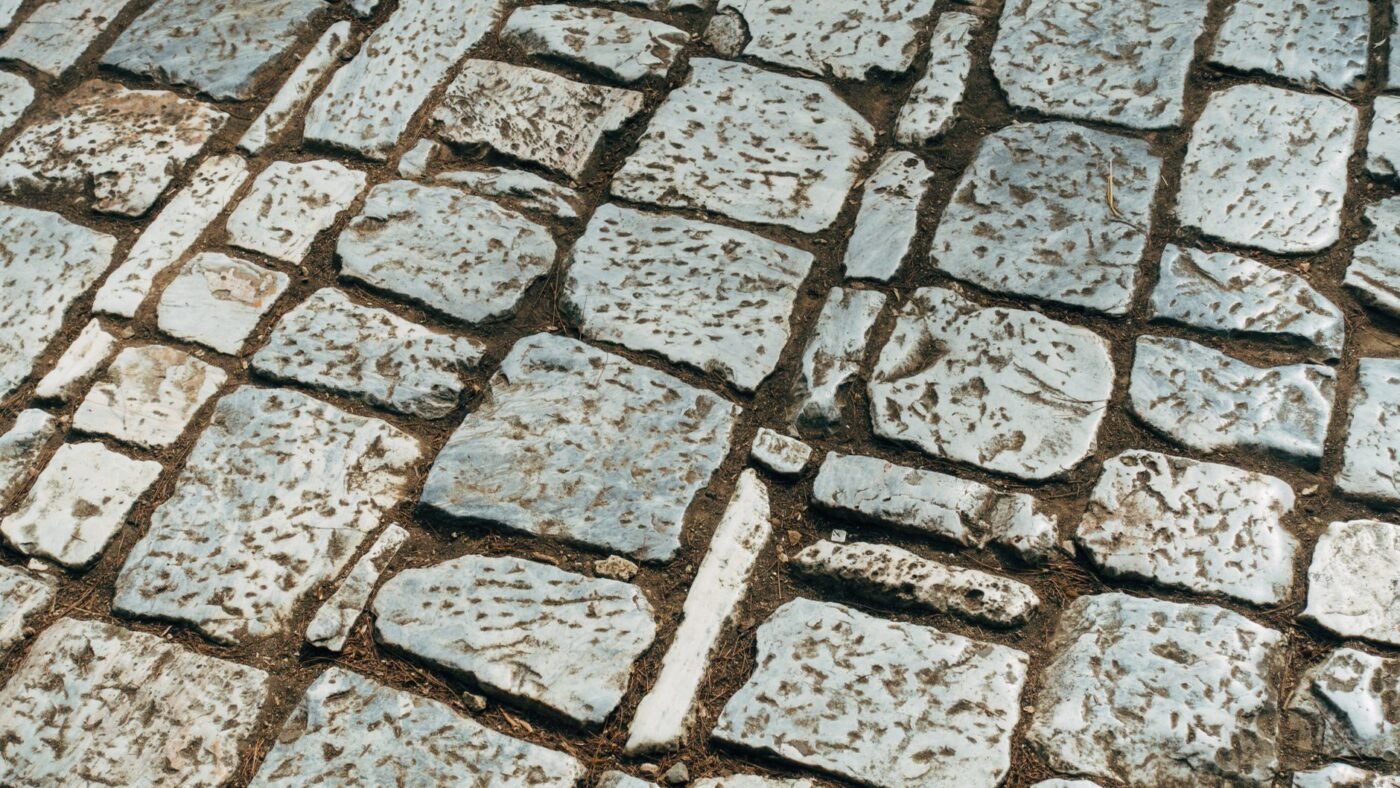
The ashlar paver pattern is a layout of rectangular pavers in staggered courses (rows), where the pavers in each course vary in length and, in the random version, in height. No joint in one course lines up with a joint in the next. It looks like cut stone masonry laid flat. It suits patios, courtyards and walks, and it is usually bought as a pre-mixed set of three or more sizes.
If running bond is a brick wall, ashlar is the stone wall that took more time to build. Here is how the two versions work and where the trap is.
Coursed vs random: the two ashlar paver patterns

World of Stones separates the laying patterns into two families. Coursed layouts have continuous horizontal joints, so every course is a straight band. Random layouts break the courses up, with joints falling at irregular intervals in both directions.
- Coursed ashlar. Courses are all the same height. Only the paver lengths vary, and the joints stagger from course to course. It reads as orderly stone.
- Random ashlar. Heights and lengths both vary, and courses may stop and start. It reads as a natural, informal surface. World of Stones notes this style is mostly used for patios and decks.
Belgard describes ashlar as "intentional" yet "random," and recommends it for both contemporary and classic styles. In plain terms, ashlar is a running bond that never repeats itself.
Why ashlar pavers come as a set
A random-looking pattern still follows a plan. Manufacturers pack pallets with a fixed ratio of sizes, such as one square and two rectangles, so the pattern plays out without you inventing the mix. The pallet tag or layout sheet shows the sequence. Follow it, and the sizes run out together. Ignore it, and you will finish with a heap of one size and a gap where another should be.
Belgard points to specific product lines for the ashlar look, so check each manufacturer's own pattern sheet rather than assuming any three sizes will work. For a general view of 2-piece and 3-piece sets, see paver patterns.
The large-format trap with an ashlar paver pattern
Ashlar sets often include big stones such as 12 x 24 inch pavers, and big stones are where homeowners get caught. The CMHA's Tech Spec 10 says a length-to-thickness ratio of 4:1 or more should stay off vehicle areas. Work it out:
| Paver | Thickness | Ratio | Vehicles? |
|---|---|---|---|
| 12 x 12 in | 2 3/8 in | about 5:1 | patio only |
| 12 x 24 in | 2 3/8 in | about 10:1 | patio only |
| 12 x 24 in | 3 1/8 in | about 7.7:1 | patio only |
| 6 x 12 in | 3 1/8 in | about 3.8:1 | light driveway use |
The look is great, and the ratio does not care. A thick, small-format ashlar can see a car; a large slab set cannot. Big sets also need a flatter base (CMHA specifies a surface tolerance of 3/8 inch over 10 feet), because a rocking slab shows. 24×24 pavers covers what goes wrong with big sizes.
Laying ashlar without repeating yourself
The base and bedding are the standard ones: at least 4 inches of compacted base on well-drained soil and 1 inch of loose, screeded sand (ICPI Tech Spec 2). The pattern is what changes.
- Dry-lay the first few courses and photograph them. It is much easier to see a repeat in a photo than from above.
- Start along the longest straight edge with a string line, then build course by course.
- Stagger every joint. Before you set a paver, check that its end joint does not sit above or below the joint in the next course.
- Pull from several bundles at once. Colors vary between pallets, and a random pattern makes a blotch more obvious.
- Break the sequence on purpose. Do not lay the same three-paver run twice in a row.
- Cut last. Lay every whole paver, install the edge restraint, then cut the border pieces. How to cut pavers has the technique.
Cuts, waste and edges
Ashlar wastes more than a single-size running bond because the sizes have to meet the edge at different places. Start from a straight, firm edge, such as a house wall or restraint, and let the cut pieces fall on the far side. Our paver patterns guide lists 5 to 10% as a starting allowance for rectangular layouts, and your supplier's layout calculator will be more precise for a given set. Order a few spares for repairs, since the same colors will not come twice.
Never finish with a sliver. If a cut piece is under a third of a paver, shorten the previous paver instead.
Ashlar against running bond and natural stone
If you like the stone look but not the price, ashlar-pattern concrete pavers copy it. If you want real stone, the closest relatives are natural stone pavers, which can be laid in coursed patterns of their own.
Mix the sizes, never the joints
An ashlar paver pattern works when the sizes vary and the joints never line up. Choose coursed ashlar for a tidy, formal look and random ashlar for a relaxed one. Keep it to patios and walks when the pavers are large, follow the pallet layout, and check every course for repeats before the sand fills in.
FAQ
What is an ashlar paver pattern?
A layout of rectangular pavers in staggered courses with mixed lengths, sometimes mixed heights. Joints in neighboring courses never line up, which gives a cut-stone look.
What is the difference between coursed and random ashlar?
Coursed ashlar keeps every course at one height with lengths varying. Random ashlar varies both heights and lengths, so courses can start and stop.
Is ashlar the same as running bond?
They are close relatives. Running bond uses one paver size with a half offset. Ashlar mixes sizes in the courses, so the joints never repeat.
Can you use an ashlar pattern on a driveway?
Only with pavers thick enough for the ratio. Large formats such as 12 x 24 inch fail the 4:1 length-to-thickness guide for vehicles, so use smaller, thicker pavers or a different pattern.
How many sizes are in an ashlar set?
Most sets use three or more sizes. Follow the manufacturer's layout sheet, since the pallet ratio matches a specific sequence.


