

Last Updated on October 20, 2026 by Umar Farooq
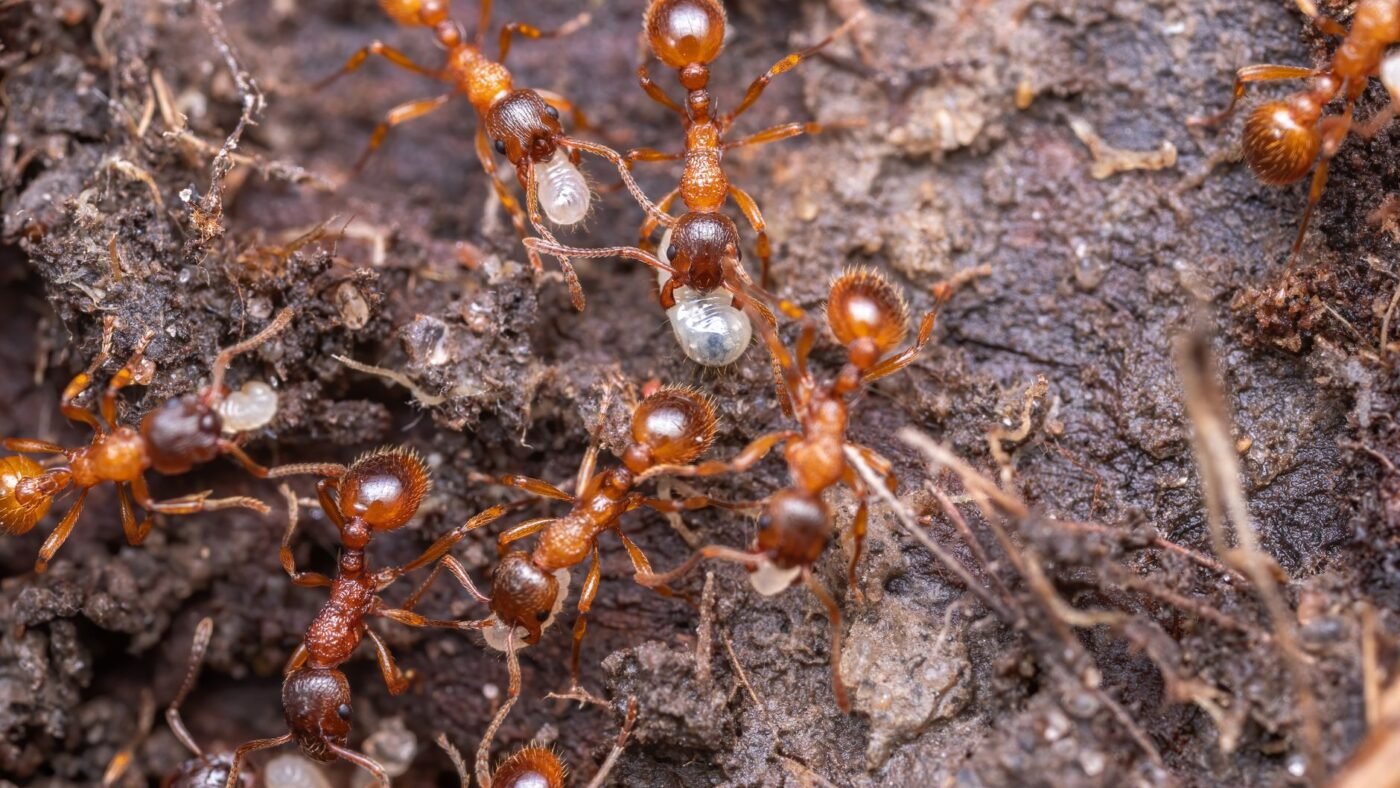
Fire ants in pavers are a colony working through the sand joints and the soil beneath, and the order that extension sources agree on is bait first, a spot treatment on any mound that gets in your way second, and joint repair last. Do not stand on the nest, do not pour boiling water or gasoline into it, and keep children and pets off the patio while you work. Fire ants sting in numbers, which is a different problem from the pavement ants that most patio guides are written about.
Our ants between pavers guide covers ordinary patio ants. This page is for the ones that sting.
Fire ants in pavers: how to tell them from ordinary ants
I found no paver-specific fire ant study, so what follows is extension guidance for fire ants in general, applied to a patio. The pages I opened come from Texas A&M and the University of Georgia. Ask your county extension office to confirm the species, because I found no reliable way to do that from a photograph.
What the sources do say is behavioural. Texas A&M's fire ant FAQ says fire ants are sensitive to movement and vibration, and that when one stings, others tend to follow. It says about 1 percent of people are hypersensitive to the venom and can have a dangerous reaction, and to watch for excessive swelling, itching, redness or shortness of breath and get medical help right away if they appear.
Why the usual patio-ant fixes miss
Extension has plain things to say about the usual shortcuts:
- Boiling water. Texas A&M says pouring 2 to 3 gallons of very hot or boiling water on a mound kills the ants about 60 percent of the time, and it kills the grass and plants around it.
- Gasoline. The Texas A&M FAQ strongly advises against it. It often fails to kill the whole colony, is dangerous to handle and can leach into ground or surface water.
- Grits and vinegar. A UGA expert in the field report says there is no proof either works. Texas A&M adds that worker ants cannot ingest particles larger than 2 microns, so grits do not work as a food-based killer.
Step one: bait
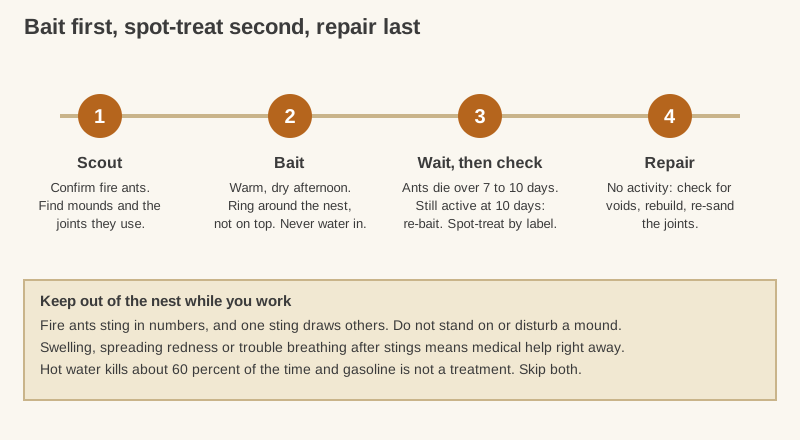
My one strong opinion: bait first, because it is the cheap, quiet and thorough option, and it is the one that reaches the part of the colony you cannot see. Texas A&M calls broadcast bait the first step of its two-step method, and UGA calls bait the most effective and ecologically sound way to control fire ants.
UGA's field report gives the practical rules:
- Choose a bait with hydramethylnon, methoprene or spinosad.
- Apply it on a warm, sunny afternoon, after the dew has dried.
- Never apply it to wet soil or water it in.
- Do not disturb the mounds beforehand, because that distracts the ants from foraging.
- Expect ants to die over about 7 to 10 days. If a mound is still active after 10 days, apply a second time.
Texas A&M adds that bait is slow, taking weeks to months to reach 80 to 90 percent control. I found no guidance on placing bait in paver joints, so follow the product label for hard surfaces.
Step two: one mound, one treatment
Texas A&M's two-step page says step two is treating individual problem mounds, and lists three kinds:
| Mound treatment | What the source says |
|---|---|
| Liquid drench | Generally eliminates mounds within a few hours and leaves little surface residue |
| Dust | Needs no water and acts fast, but leaves a surface residue |
| Granules | Fairly fast; put them on and around the mound, then water in with 1 to 2 gallons without disturbing it |
The page gives no waiting period between the two steps. Most of those products are written for lawns, so read each label for use near pavement and hard surfaces. I would not spot-treat a mound that is under pavers until the label says it can go there.
Step three: repair the joints
Once there is no activity, look for the damage. Ants carrying soil out leave voids, and the surface follows them down. The signs are in ants between pavers, and how to fix sunken pavers walks through lifting, rebuilding the base in thin lifts and relaying. Refill the joints with fresh sand last. CMHA's guide spec calls for pavers set 1/8 to 1/4 inch proud, so they settle flush after compaction.
When to hand it to a professional
Call a licensed pest professional if:
- Anyone who uses the patio has had a bad reaction to ant stings.
- The mounds keep returning after a second bait application.
- The nest is under a slab, steps or structure you cannot lift.
Why it keeps coming back
Bait kills the colonies that take it. I found no source on how soon new colonies move in, but a clean patio can plainly be reached again from neighbouring ground. Texas A&M's page puts the yard-wide bait between late August and mid-October, so that is the window to ask your county extension office about, together with fresh, tight joints. I found no test showing polymeric sand stops fire ants, so treat it as a tidy-up, not a guarantee.
Bait the colony, spot-treat the stubborn mound, then fix what it dug
Fire ants in pavers are a colony problem, so the answer is a colony treatment: bait on a warm dry afternoon, patience for 7 to 10 days, a second round if the mound is still alive, and a drench or granule only where the label allows it. Then rebuild the voids. The ants are the one thing on your patio that should leave without being asked twice.
FAQ
What kills fire ants in pavers?
Baits kill the colony slowly; UGA says ants die over about 7 to 10 days, and Texas A&M says bait can take weeks to months to reach 80 to 90 percent control. Mound drenches act within hours. Always follow the label for the product and for use near pavement.
Does boiling water kill fire ants in a patio?
Sometimes. Texas A&M says 2 to 3 gallons on a mound kills ants about 60 percent of the time, and it kills nearby plants. By my arithmetic that means it fails about four times in ten.
Can I use vinegar or grits on fire ants?
No. A UGA expert says there is no proof either works, and Texas A&M says grits are not effective because worker ants cannot ingest large particles.
How long until fire ants come back after treatment?
I found no number. Bait kills the colonies that take it, and nothing I read says it stops new ones arriving, so check the patio each season.


