

Last Updated on October 20, 2026 by Umar Farooq
On deck vs pavers cost, a paver patio on reasonably flat ground is usually the cheaper build and the cheaper one to own. LawnStarter's installed range for a paver patio is about $10 to $24 per square foot, while Ergeon prices an installed pressure-treated deck at $25 to $40 and a mid-grade composite deck at $35 to $55. The ranges overlap at the premium end of pavers, and the answer flips once the surface has to sit more than a couple of feet above the ground. A deck is really a patio that has decided to become carpentry, and carpentry charges by the post.
The rest of this page shows where those numbers come from, what they include, and how they change over twenty years.
Deck vs pavers cost per square foot, side by side
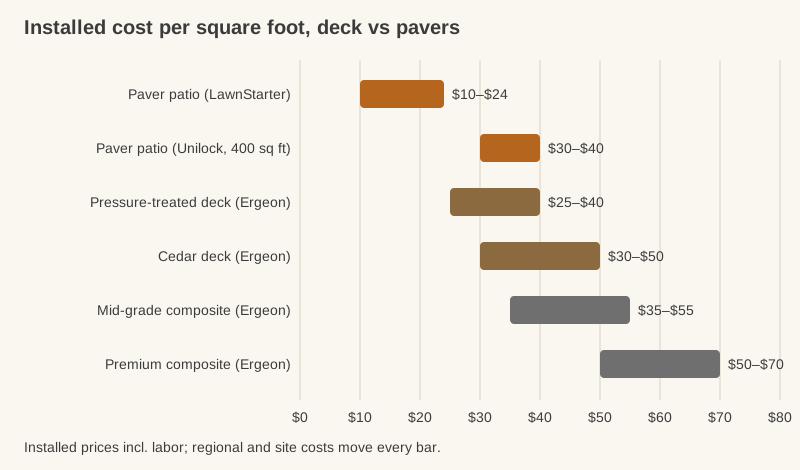
I lined up published installed prices from three sources and kept each one's own range, rather than averaging them into a number nobody quoted.
| Surface | Installed cost per sq ft | Source |
|---|---|---|
| Paver patio | $10–$24 | LawnStarter |
| Paver patio, 400 sq ft built to brand standards | $30–$40 | Unilock |
| Pressure-treated wood deck | $25–$40 | Ergeon |
| Cedar deck | $30–$50 | Ergeon |
| Mid-grade composite deck | $35–$55 | Ergeon |
| Premium composite deck | $50–$70 | Ergeon |
Ergeon's deck cost guide also puts a 200-square-foot pressure-treated deck at $5,000 to $16,000, and a mid-grade composite one at $10,000 to $18,000. Outback Landscape's deck vs patio cost comparison, written for one regional market, prices paver patios at $25 to $50 per square foot and pressure-treated decks at $25 to $35. Regional labor rates move every one of these numbers, so treat them as a comparison, not a quote.
A 12 x 16 patio vs a 12 x 16 deck
A 12 x 16 foot space is 192 square feet. Multiplying out the ranges above:
| Option | Upfront cost, 192 sq ft |
|---|---|
| Paver patio (LawnStarter range) | about $1,920–$4,610 |
| Paver patio (Unilock range) | about $5,760–$7,680 |
| Pressure-treated deck | about $4,800–$7,680 |
| Mid-grade composite deck | about $6,720–$10,560 |
A basic paver patio undercuts every deck. A premium paver patio lands in the same band as a wood deck. Composite sits above both. Small projects also cost more per square foot than these ranges suggest, because delivery, setup and equipment are spread over fewer feet. Our patio pavers price guide breaks the paver side down further, from material to labor.
What each price is really paying for
The two surfaces spend their money in different places, which is why their ranges look so different.
- A paver patio pays for digging and gravel. Unilock estimates the pavers are only about 20% of the total. The rest is excavation, base stone, compaction, edging and labor. That's why DIY saves so much on a patio: the expensive part is mostly hard work, not skill.
- A deck pays for structure. Footings, posts, beams, joists, hardware, the decking itself, and usually a permit and inspection. Deck Remodelers' article on patio vs deck cost makes the same point: the structural work, planning and permitting are what make decks the higher upfront number.
- Railings belong to both. A surface more than 30 inches above grade needs a guard under the IRC, whether it's a deck or a raised patio. That cost rarely appears in the per-square-foot ranges, and it adds up quickly on either.
Height is where the answer flips
This is the part the price tables leave out, and it's my firm view on this question: on ground-level sites, pavers win on cost; once the surface needs to be more than about two feet up, the deck usually wins.
The mechanism is volume. A deck gets taller by using longer posts, which costs very little extra. A patio gets taller by building a retaining wall around it and filling the middle with compacted stone, and both the wall and the fill grow with every foot of height. A 12 x 16 patio raised 2 feet holds about 14 cubic yards of fill, compacted in thin lifts, inside as much as 56 feet of wall. The same deck at 2 feet is a few inches of extra post.
So:
- Flat yard, door near grade: pavers.
- Door 2 or 3 steps up, gentle slope: a raised paver patio can still make sense. See our guide to building a raised paver patio.
- Walkout from a second floor, or a steep drop: a deck, often with a patio below it.
Lifespan and upkeep over twenty years
The upfront figure is half the story, because the two surfaces age very differently.
| Wood deck | Composite deck | Paver patio | |
|---|---|---|---|
| Typical life (Decks.com) | 10–20 years | 25–30+ years | 25–30+ years |
| Routine upkeep | Clean, stain or seal every few years | Wash | Sweep, top up joint sand |
| Occasional repair | Replace boards, refasten | Replace boards | Lift and relay a settled area |
Outback Landscape's figures run slightly shorter for wood, at 10 to 15 years for pressure-treated and 15 to 20 for cedar. Either way, a wood deck is likely to need replacing, or at least new decking, within a twenty-year window where a well-built patio just needs its joints topped up. Pavers can also be sealed, which Belgard suggests every 3 to 5 years as a rule of thumb, though many patios never need it. (Wood has strong opinions about water. So does every stain can, and they don't agree.)
A paver patio repair is also cheaper in kind. A sunken corner is a few hours of lifting pavers, fixing the base and relaying the same pavers. A rotted joist is a carpentry job with the decking off.
DIY moves the numbers the most
If you're doing the work yourself, the gap widens. A paver patio is one of the most DIY-friendly hardscapes: the skills are grading to a string line, running a rented plate compactor and cutting with a rented saw. LawnStarter estimates DIY paver patios at $12 to $17 per square foot, against $20 to $27 for a pro on the same job.
A deck can be built by a careful DIYer too, but it's a structure. It needs a permit in most places, footings sized to the load, correct ledger attachment to the house, and inspections. Mistakes there are safety problems, not just crooked joints. For most first-timers the patio is the safer DIY bet, and the savings are bigger. You can read more in the guide to paver patio inspection checklist.
When a deck is still the better buy
Pavers aren't always the answer, even on cost:
- The back door is well above grade. Stairs plus a patio can cost more than a deck at door height.
- The ground is steep or unstable. A deck on footings spans problems a patio would have to dig out.
- You want to keep the yard below. A deck leaves room underneath for storage or a shaded patio. See our guide to a paver patio under a deck for combining both.
Pavers on the ground, boards in the air
The deck vs pavers cost question mostly answers itself once you know the height. At or near grade, a paver patio costs less to build, far less to keep, and repairs one paver at a time. Up in the air, the deck earns its price by skipping the walls and fill. Measure from the door threshold to the ground before you collect a single quote. That one number decides more of the budget than any catalog will.
FAQ
Is a paver patio cheaper than a deck?
Usually, on level ground. Installed paver patios run about $10 to $24 per square foot in LawnStarter's figures, while Ergeon prices installed wood decks at $25 to $40 and mid-grade composite at $35 to $55. Premium paver patios can cost as much as a wood deck.
Which lasts longer, a deck or pavers?
A well-built paver patio and a composite deck both last 25 to 30 years or more, per Decks.com. A pressure-treated wood deck typically lasts 10 to 20 years, and needs regular staining or sealing along the way.
Is a composite deck worth it over a paver patio?
Only when height or site favors a deck. On flat ground, composite costs roughly two to three times as much as a basic paver patio per square foot, for a similar lifespan.
Is it cheaper to build a raised patio or a deck?
Up to about two feet above grade, a raised paver patio can compete. Beyond that, the retaining wall and compacted fill usually cost more than a deck's longer posts.


