

Last Updated on October 20, 2026 by Umar Farooq
The best driveway paver patterns are the two herringbones, set at 45 or 90 degrees. ICPI's construction guide recommends them for all street applications because, in its words, these interlocking patterns "provide the maximum load bearing support, and resist creep from starting, braking and turning tires" (ICPI Tech Spec 2). Running bond, basketweave and stack bond are patio and walkway patterns that can be made to work on a driveway, but they ask more of the base and the edge restraint.
That is the short answer on driveway paver patterns. The rest of this guide covers why, which angle to choose, what the pattern does to your cutting bill, and the places on a driveway where the pattern matters less than people think.
Why tires push on patterns, and which ones push back

A walking foot presses straight down. A tire does that too, but it also does something a patio never sees: it brakes, accelerates and turns on the surface. Each of those shoves the top layer of pavers sideways. Over thousands of trips, a layout with weak lateral lock lets the pavers creep, and that is where ruts, open joints and the "why is my driveway wavy" emails come from.
A pattern resists that push in proportion to how many directions its joints run. Look at the plan view below.
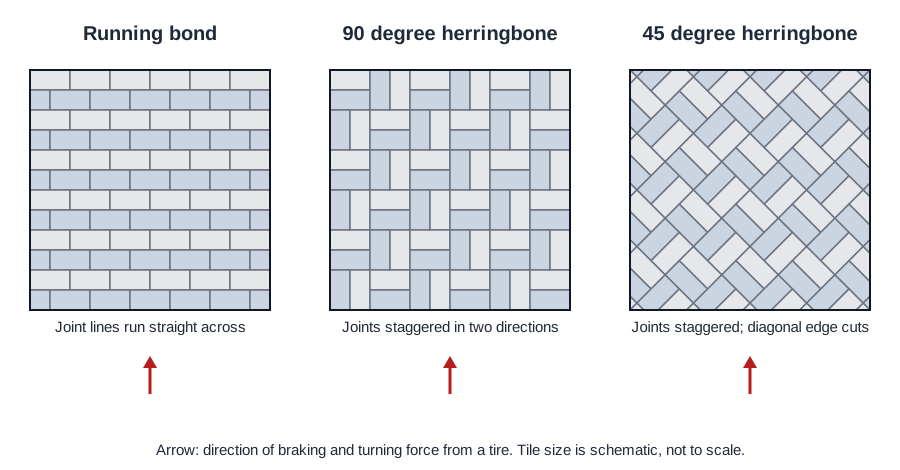
In running bond, the joint lines between courses run straight across the whole driveway. A braking force in the direction of travel meets those joints edge-on, and the only thing stopping a row from sliding is the sand in the joints and the edge restraint at the end of it. In herringbone, the joints change direction every paver, so no joint line runs more than a paver or two before a neighbor's end blocks it. Every paver is held by several others. Hence the ICPI wording about "maximum load bearing support".
I also checked ICPI Tech Spec 10, which has a figure of typical laying patterns. It groups parquet and running bond under "pedestrian traffic" and puts both herringbones under "pedestrian or vehicular traffic" (ICPI Tech Spec 10). That is the industry-body source for the pattern rule. Everything after it in this guide is about making the rule workable on a real driveway.
My one opinion for this article: choose the pattern last and the base first. A herringbone on a thin base will still rut. A running bond on a properly built base with good edge restraint will often outlast it. ICPI's minimum for a residential driveway on well-drained soil is at least 6 inches of compacted base, and 2 to 4 inches more where the soil is wet or weak or the ground freezes (ICPI Tech Spec 2). Our paver driveway installation guide walks through the layers.
45 or 90 degrees: the real trade is at the edges
Both herringbone angles are on ICPI's list, so structurally you are choosing between two good options. The difference shows up where the pattern meets a straight edge.
- 90 degree herringbone runs its pavers parallel and perpendicular to the driveway edges. Along a straight curb or wall, the edge pavers need few cuts, and the ones you do cut are simple square-ended pieces.
- 45 degree herringbone turns the whole pattern on the diagonal. Every straight edge now meets the pattern at an angle, so each edge paver is a diagonal cut. That is more cutting, more waste, and more slivers to manage (see the one-third rule below).
The 45 degree version has a reputation for looking more dynamic and for "pulling the eye" down the driveway, which is design opinion and not something I can source. If you like the look, it is a fine choice. Just price the cutting honestly.
Pick 90 degrees when the driveway is rectangular, when you are laying it yourself, or when you want the fewest cuts. Pick 45 degrees when you want the diagonal look and a crew with a good saw. Our deeper article on the herringbone pattern paver patio covers the layout details.
Running bond on a driveway: where it works and where it creeps
Running bond is the brick-wall pattern, every course offset by half a paver. It is fast to lay, it produces fewer cuts than any other pattern, and it follows a gentle curve without much fuss. Those are real advantages. Our running bond paver pattern article covers it in full.
Its weakness, as above, is the straight joint line. If you choose it for a driveway, here is how I would tilt the odds:
- Lay it so the continuous joint lines run across the direction of travel, not along it. (This is mechanical reasoning from the joint geometry. I could not find a spec that states the orientation for residential driveways, so treat it as a sensible precaution, not a rule.)
- Use the thicker paver. CMHA's Tech Spec 10 says 2 3/8 inches (60 mm) is recommended for residential driveways and 3 1/8 inches (80 mm) for pavements with vehicle traffic.
- Keep the edge restraint tight and continuous. Running bond depends on its ends staying put.
A short, lightly used drive that goes straight from garage to street is a reasonable home for running bond. A long drive with a turning area is where I would pay the extra for herringbone.
Basketweave, stack bond and other patio favorites
These patterns are lovely on a patio. I would keep them off the part of the driveway that cars turn on.
- Basketweave pairs pavers side by side, so the joints form a repeating grid of short runs. It lacks the staggered, all-directions lock of herringbone. See our basketweave paver pattern piece.
- Stack bond lines every joint up in both directions, a grid with no stagger at all. It is the weakest layout against sliding. It looks clean and modern, but I would not put a car on it.
- Pinwheel and mixed-size kits can work if the units are thick enough, but check the aspect ratio of every unit in the kit before you buy. See pinwheel paver pattern.
If you love a patio pattern, a good compromise is to use it in a border or a decorative field next to the drive, and let herringbone carry the wheel paths.
Random and ashlar layouts: check the aspect ratio first
Ashlar and random layouts mix several sizes of rectangle and look the least repetitive of any option. They are popular, and some are used on driveways with success when the units are thick.
The catch is geometry, and CMHA spells it out. Aspect ratio is length divided by thickness. A ratio of 4:1 or greater should not be used where vehicles drive, between 4:1 and 3:1 is fine for limited car use such as a residential driveway, and 3:1 or less suits all vehicular use (CMHA Tech Spec 10). Do the arithmetic before you fall for a large format.
| Paver size | Thickness | Aspect ratio | Driveway verdict |
|---|---|---|---|
| 4 x 8 in | 2 3/8 in | about 3.4 : 1 | Fine for a residential driveway |
| 4 x 8 in | 3 1/8 in | about 2.6 : 1 | Suits all vehicle use |
| 12 x 12 in | 2 3/8 in | about 5 : 1 | Keep off the driveway |
| 12 x 12 in | 3 1/8 in | about 3.8 : 1 | Marginal; for light car use only |
The ratio is length over thickness, so I used the longest dimension of each unit. A large ashlar kit with 12 x 24 pieces needs to be thick to pass the test. Our ashlar paver pattern article covers how the sizes combine.
Borders, aprons and where the pattern changes
Most driveways are not one continuous field. There is a border, a turning area, an apron at the street and a threshold at the garage. Pattern decisions at these joins matter more than people expect, because this is where cuts and edge restraint cluster.
- Border. A soldier course (pavers set end to end around the perimeter) gives the herringbone a straight, finished edge so the field does not have to run out into ragged cuts. It also puts whole pavers where the edge restraint pushes against them. See driveway border pavers.
- Apron. The paver apron meets the street and the curb. Change of pattern here is common, and it is the place to read your local rules, since municipalities vary. Our paver driveway apron article covers it.
- Garage threshold. Keep the pattern simple where it meets a slab, and keep the slope in mind. Water should run away from the garage. See paver driveway slope.
Cuts at the edges: the one-third rule
Every pattern ends at an edge, and the edge is where the cut pavers live. The rules are worth knowing before you finalize a layout.
ICPI says cut pavers should fill gaps along the edge, that gaps wider than 3/8 inch should be filled with cut pavers, and that for street applications you should not cut pavers to less than one third of their original size; use two cut pavers instead (ICPI Tech Spec 2). CMHA's guide specification goes further for driveways: it says to adjust the bond pattern at the edges so cutting is minimized, and that cut pavers exposed to vehicular tires be no smaller than one third of a whole paver (CMHA PAV-GSP-011-21).
Practically, that means:
- Measure the driveway width in whole pavers before you start, and adjust the border or the starting line so the last row is not a thin strip.
- Cut with a diamond blade and water on the blade, as OSHA's silica rule for masonry saws requires. The how to cut pavers guide covers the process.
- A sliver under a tire works loose, then goes for a wander. (It is the only part of your driveway that will leave voluntarily.)
Match driveway paver patterns to the drive you actually have
Here is how I would decide, given what the sources say:
| Your driveway | Pattern I would choose | Why |
|---|---|---|
| Rectangular, DIY, tight budget | 90 degree herringbone | ICPI-listed for vehicles, fewest cuts of the herringbones |
| Long drive with a turning area | Herringbone at either angle | Turning tires push hardest here |
| Short, straight, lightly used | Running bond on a 2 3/8 in or thicker paver | Fewest cuts, but depends on the edge restraint |
| Curved drive | Running bond or herringbone with a border | Offset layouts follow gentle curves; check cutting cost |
| Large-format or ashlar kit | Only if the aspect ratio passes | CMHA's 4:1 limit |
Whatever you pick, compact the pavers with a plate compactor capable of at least 5,000 lbf of force at 75 to 90 hertz, and make at least two passes before the joint sand goes in (ICPI Tech Spec 2). The pattern is only as good as the interlock, and the interlock comes from the compaction and the joint sand.
Sealing afterward is a separate decision. See paver driveway sealing before you buy a bucket of anything.
Herringbone on a 6-inch base settles the argument
If you only remember one thing, remember this: a herringbone driveway on at least 6 inches of compacted base, with thick pavers and a firm edge, is the combination every source I opened points to. Choose 90 degrees to save cutting, 45 degrees if the look is worth the extra saw time, and save the pretty patio patterns for the patio. Get the edges right and the pattern does the rest, quietly, for years.
FAQ
What is the strongest paver pattern for a driveway?
Herringbone, at 45 or 90 degrees. ICPI recommends both for all street applications because the interlocking pattern gives maximum load-bearing support and resists creep from starting, braking and turning tires.
Is running bond OK for a driveway?
It can work for a short, straight, lightly used driveway with a thick paver and solid edge restraint. ICPI's pattern figure groups it with pedestrian traffic, so on a long or heavily used drive, herringbone is the safer choice.
Is 45 or 90 degree herringbone better for a driveway?
Both are on ICPI's list, so the choice is about cuts and looks. The 90 degree layout needs fewer and simpler edge cuts. The 45 degree layout cuts every straight edge on a diagonal, which costs more time and material.
Can I use large-format pavers on a driveway?
Only if the aspect ratio passes. CMHA says 4:1 or greater should not be used where vehicles drive. A 12 x 12 inch paver that is 2 3/8 inches thick is about 5:1, so it fails.
What paver thickness suits a residential driveway?
CMHA's Tech Spec 10 recommends 2 3/8 inches (60 mm) for residential driveways, and 3 1/8 inches (80 mm) for pavements with vehicular traffic. Thicker is the safer pick if the driveway will see delivery trucks.
Does the pattern matter more than the base?
No. The pattern helps resist sliding, but the base carries the load. ICPI's minimum for a residential driveway is at least 6 inches of compacted base on well-drained soil, with more where the ground is wet, weak or freezes.


