

Last Updated on October 20, 2026 by Umar Farooq
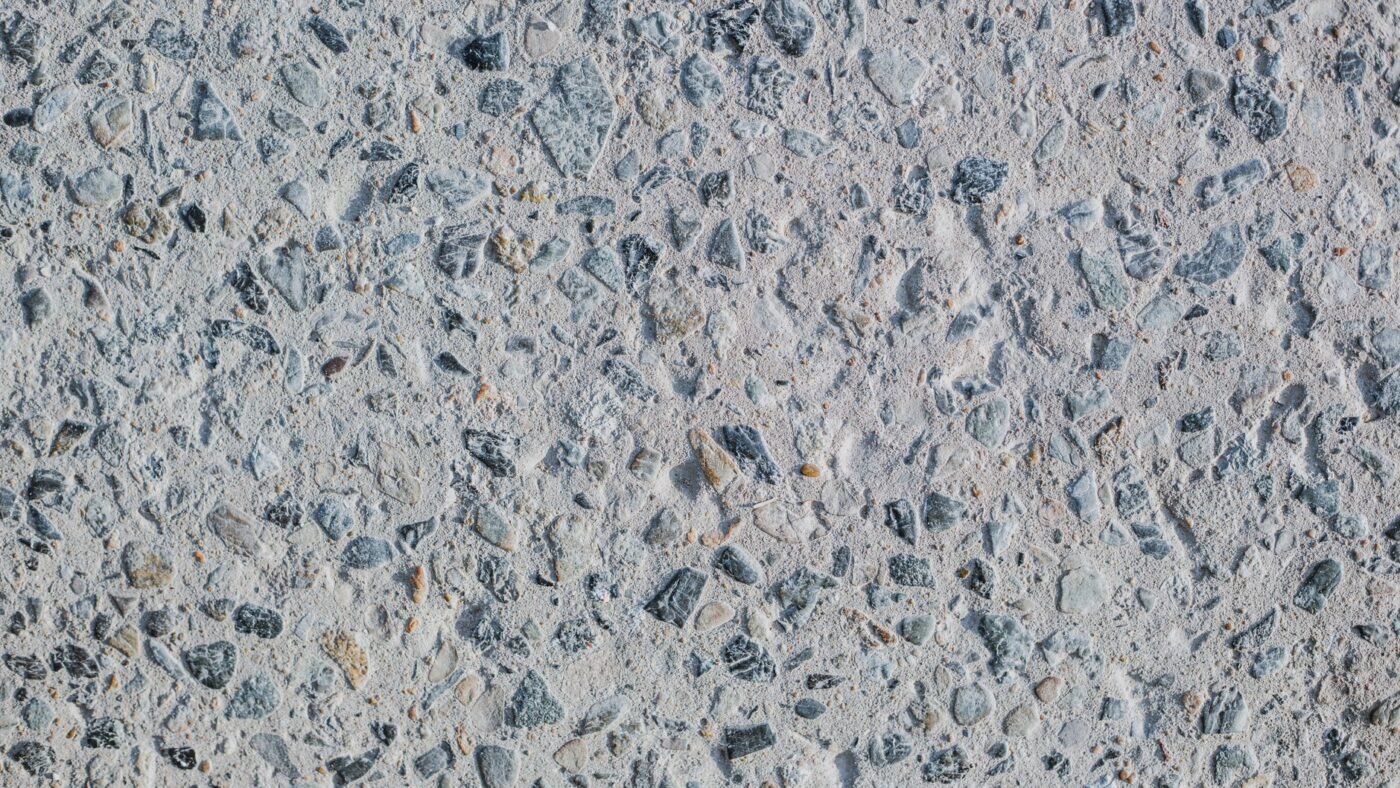
Exposed aggregate concrete vs pavers is a choice between one poured slab with stones showing and thousands of separate units. Exposed aggregate usually costs less and grips well when wet, but it is one piece, so it cracks as one piece and is hard to patch invisibly. Pavers cost more up front, drain through their joints and lift out one unit at a time. For a big flat driveway on stable ground the slab is a fair choice. Where the ground moves or you need to reach pipes underneath, pavers earn their price.
Most of the sources I found are sellers of one or the other, and several are Australian, so I have noted whose numbers are whose.
Exposed aggregate concrete vs pavers on price
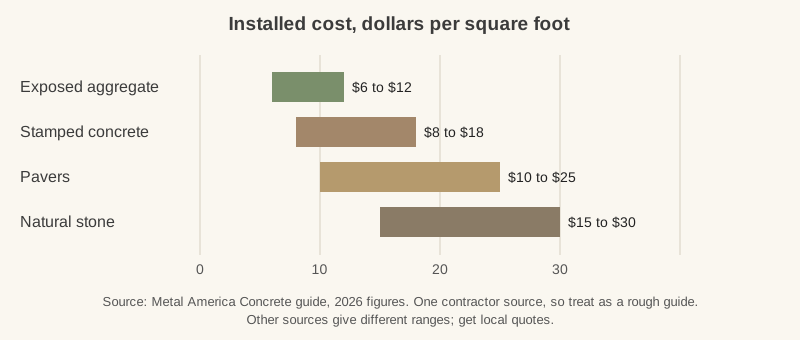
Metal America Concrete puts exposed aggregate at $6 to $12 per square foot installed in 2026, against $10 to $25 for pavers. It lists local aggregate at the cheap end and imported decorative stone at the top. That is one contractor's range and the overlap at $10 to $12 shows how thin the gap can get.
The Queensland builder Markon Group gives a very different picture, with exposed aggregate and standard concrete pavers both in the region of AUD 120 to 220 per square metre installed. Different country, different labor market. The takeaway is the same as in our pavers vs stamped concrete article: ranges overlap, so price two real quotes with the same base depth rather than trusting a headline figure.
One slab cracks as one slab
A slab has no joints to take up movement, apart from the control joints cut into it. When the soil under it moves, it cracks, and the crack runs through the stones. Australian Paving, a paver seller, makes this the first of its ten reasons and ties it to reactive soils in Adelaide. Treat that as a vendor argument, but the mechanism is real: a rigid sheet over soft ground breaks, and an interlocked field flexes.
Pavers are not magic here. They settle if the base is thin, and our concrete vs paver driveway guide covers the trade in more detail. The difference is what happens next. A settled paver is an afternoon with a screed board. A cracked aggregate slab is a patched scar through a decorative finish.
How long each one lasts: sources disagree badly
This is the widest disagreement I found.
| Source | Exposed aggregate lifespan | Pavers |
|---|---|---|
| Metal America (US) | 25 to 30 years, same as standard slab | not stated in the part I read |
| Markon Group (QLD) | 25+ years | 25+ years |
| Odd Jobs (Michigan paver installer) | 5 to 10 years | lifetime warranty offered |
The Michigan figure comes from a paver installer in a freeze-thaw climate, and it is the outlier. I could not find its basis, so I would not repeat it as fact. The 25-to-30-year figure fits the usual life of a well-built concrete slab. What all three agree on is that the base and the sealing schedule decide the result more than the surface does.
The one-shot problem: getting the stones to show
Exposing aggregate is a timing job. CoastCrete, a Perth contractor, describes removing the top 2 to 4 mm of cement paste before the concrete fully cures, using a surface retarder and a pressure wash, with the wash-back done roughly 8 to 14 hours after the pour. Miss that window and the finish is harder to get right. That is one contractor's process and the window varies with weather, but it explains why this is a job for a crew, not a Saturday experiment.
Pavers are the opposite. A factory has already done the hard bit, and you can stop for the night with a half-laid field. For the factory-made version of the stone-in-cement look, see our aggregate pavers guide.
Grip, bare feet and sealing
Metal America describes exposed aggregate as having excellent slip resistance when wet, because the protruding stones give mechanical grip, and says a non-slip sealer is usually not needed. CoastCrete quotes a typical wet rating of R11 to R12, which is an Australian scale, so do not compare it to a US number.
Grip comes with a catch: bare feet and sharp stone. Choose rounded, small aggregate for patios and pool surrounds, as covered in our aggregate pavers article.
Both surfaces need sealing on a schedule. Metal America says to seal exposed aggregate every 3 to 5 years and to reseal when water stops beading. Markon says to reseal all three of its surfaces every 2 to 4 years in Queensland. Our general rule applies: reseal when water stops beading, not by the calendar.
Repairs and getting to what is underneath
This is where pavers pull ahead on every source I read. Australian Paving points out that a pipe or cable under a driveway means digging up the concrete, while pavers can be lifted and relaid. Its seller bias is obvious, but the logic is plain. A slab you cut for a repair stays visibly cut, and a patch rarely matches washed stone.
If a utility is likely to need access, or you are building over roots or reactive soil, that alone can settle it. Our paver patio repair article shows how little a paver fix actually involves.
What a driveway asks of each one
Driveways are where the two surfaces are most often compared, so it is worth being specific. Markon Group gives a nominal 100 mm (about 4 in) for an exposed aggregate slab, thicker in turning and parking zones, on 75 to 100 mm of compacted road base. For pavers it gives 60 to 80 mm units on 100 to 150 mm of base, with roughly 20 to 30 mm of bedding sand. Those are Queensland specs, not US ones.
The US numbers point the same way. ICPI Tech Spec 2 asks for at least 6 inches of compacted base under a residential paver driveway, and CMHA Tech Spec 10 says 2 3/8 inch pavers suit residential driveways while 3 1/8 inch is typical where heavier vehicles drive. By my own arithmetic, a paver driveway digs deeper than a slab one, which is part of why the labor bill runs higher.
The slab is the thinner build, and that is its appeal. It is also why a poor subgrade shows up as a crack instead of a dip.
Pick the slab for big stable flats, pavers for everything that moves
Exposed aggregate concrete suits a large, flat, well-drained area on stable ground where you want a seamless, grippy surface and a lower price. Pavers suit smaller areas, awkward shapes, reactive soil, and anywhere you might one day need to dig. Whichever you pick, put the money into the base first and the finish second.
If you are still undecided, the broader paving stones or concrete guide covers plain slabs too.
FAQ
Is exposed aggregate cheaper than pavers?
Usually. Metal America lists $6 to $12 per square foot for exposed aggregate and $10 to $25 for pavers, but the ranges overlap and local quotes vary. Premium decorative stone narrows the gap.
Does exposed aggregate crack?
Yes, like any concrete slab. Control joints guide where it cracks, but soil movement or a thin base can still crack it, and a patch will not blend in with the washed stone around it.
Is exposed aggregate slippery when wet?
Sources describe it as grippy. Metal America calls the slip resistance excellent, thanks to the protruding stones, but bare feet may find sharp stone uncomfortable, so choose small rounded aggregate.
How often should exposed aggregate be sealed?
Metal America says every 3 to 5 years, and Markon says every 2 to 4 years for Queensland conditions. Reseal when water stops beading, and follow the sealer's own instructions.
Can you lay pavers over exposed aggregate concrete?
Possibly, if the slab is sound and flat enough, but the stones add texture to deal with. See our pavers over concrete guide before you decide.


