Last Updated on September 23, 2026 by Umar Farooq
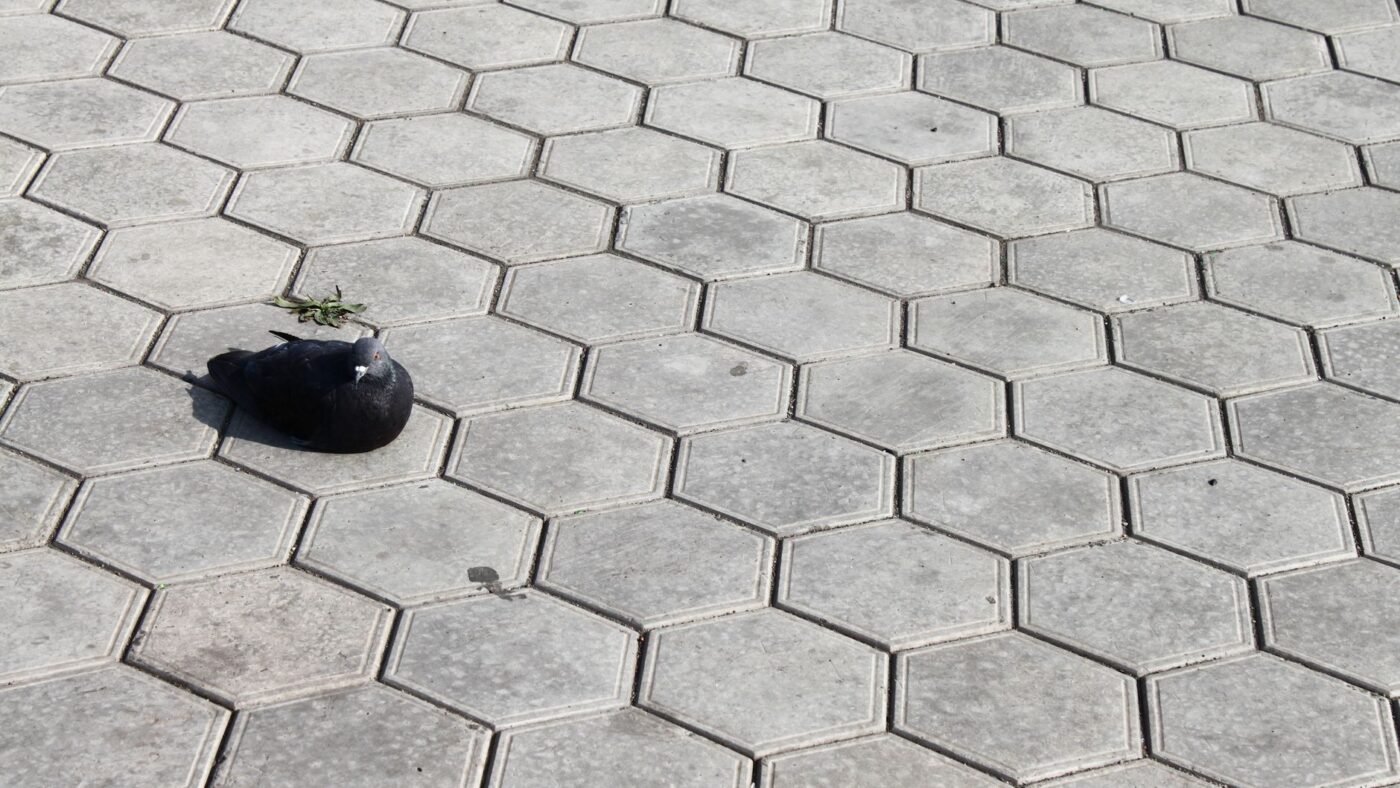
Hexagon pavers are six-sided pavers that fit together in a honeycomb, with every joint meeting at 120 degrees. Bees worked this out a long time ago, though bees never had to meet a straight fence line. Hexagons go down on the same compacted gravel base and sand bed as ordinary pavers. What's different is the layout: the rows run in three directions, and every straight edge crosses the pattern at an angle. Plan your edges first (half pieces, cuts or a gravel border), and hexagons are no harder to lay than rectangles.
Sizes, and how a hexagon is measured
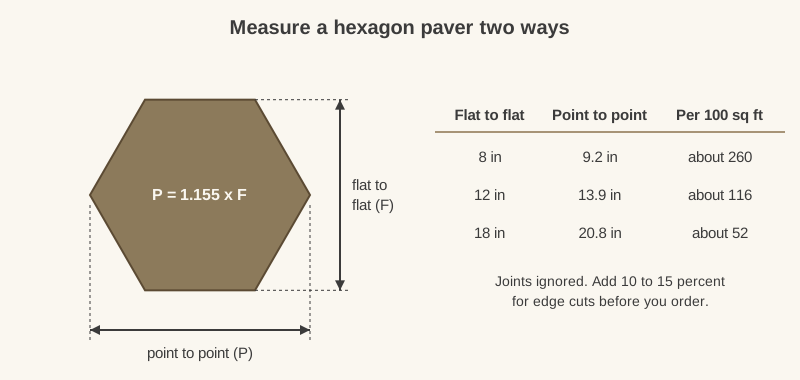
A hexagon can be measured two ways, and the flat-to-flat distance is about 15 percent shorter than corner to corner. I compared a few spec sheets and they don't all say which one they mean, so check before you work out quantities.
A few real examples:
- Belgard Hexagon comes in a 12-inch and an 18-inch size, both 2 3/8 inches thick with a smooth face. Belgard's hexagon paver page marks them as not rated for vehicular traffic.
- Unilock Hex is a smaller 8-inch (200 mm) unit, 2 3/4 inches (70 mm) thick, and Unilock lists it as drive-friendly.
- Porcelain hexagons exist too, thinner and larger.
The takeaway: small, thick hexagons can carry cars; large, thin ones are for patios. CMHA's aspect-ratio rule explains it. Unilock's 8-inch unit at 2 3/4 inches thick is under 3:1, which CMHA says suits all vehicular use. A 12-inch hexagon at 2 3/8 inches is about 5:1, and anything at 4:1 or above stays off the driveway.
For quantities, divide the area by the coverage of one paver. The diagram gives the numbers for flat-to-flat sizes. Order extra for the edges: 10 to 15 percent, because every straight edge needs half pieces or cuts.
Laying out hexagon pavers in straight rows
Hexagons line up in straight rows, but only in three directions, each 60 degrees apart. Pick one as your working line and keep it straight:
- Decide which edge matters most. Usually the house wall or a step. Lay the first row along it.
- Snap a string line along the first row. Laid by eye, hexagons drift into a gentle curve.
- Work outward in rows, not a spreading cluster. Each paver nests into two neighbors, so errors multiply.
- Check the rows every few courses with a second string along another direction.
Every joint is a Y where three pavers meet, with no four-way crossings, so the pattern hides small size differences. Stray joint widths still show as a wavy row. Units without spacer lugs take Y-shaped spacers.
Edge cuts: halves, cuts or a gravel border
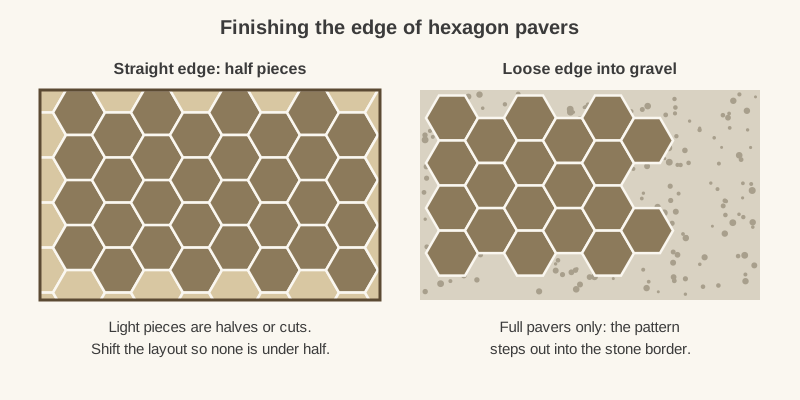
This is where hexagon patios succeed or look amateur. Archatrak's hexagonal paver guide warns that hexagons against a wall or edge restraint need cutting on one side, and that careless planning leaves small triangular gaps to fill.
You have three ways to finish:
- Factory half pieces. Some lines include matching half hexagons, cut corner to corner and flat to flat. They fill a straight edge with no saw work.
- Cut pieces. Mark each edge paver in place against a straightedge and cut it with a masonry saw, water on the blade. Shift the layout sideways by half a paver if needed so no edge piece is smaller than half. Slivers break loose and look patched. Our guide on how to cut pavers covers marking and saw technique.
- A loose edge. Let the hexagons stop in a stepped outline and fill around them with pea gravel or river stone. No cuts, and it suits informal gardens. You still need a restraint at the outer edge of the gravel, and this is the one point I won't hedge on. The gravel is not a restraint, and neither is the lawn. Hexagons lock together only if the outer row has nowhere to go; without something solid at the edge, the outer hexagons roll, the joints open and the whole honeycomb starts migrating toward the grass.
A soldier course of rectangular pavers around the field is a fourth option. You still cut every edge hexagon, but the border makes it look deliberate.
Base, bedding and joints for hexagon patio pavers
Nothing here is special to the shape. Unilock's installation notes for its Hex paver call for:
- 6 to 8 inches of compacted crusher-run gravel for a standard base, or clear open-graded stone for a permeable one
- 1 inch of bedding sand (ASTM C33 concrete sand, screeded and left loose, per CMHA; not stone dust)
- an edge restraint around the whole perimeter
- a protective pad on the plate compactor for the final compaction
- joint sand kept 1/8 inch below the chamfer
Lay the pavers, compact, and sweep in joint sand. Hexagons have more joint length per square foot than rectangles, so buy more joint sand. (Every one of those Y joints wants feeding.) Install the paver edging before you start cutting, so the edge pieces are cut to a fixed line.
Hexagon paver patterns
With one shape, pattern comes from color:
- Solid honeycomb. One color, pure geometry.
- Rosettes. One accent hexagon surrounded by six in a second color, repeated or scattered across the field.
- Stripes. Rows of a second color, running along one of the three row directions.
- Scatter or gradient. Dark pieces that thin out toward one side.
- Inlays. A panel of hexagons set into a field of rectangular pavers. Belgard's hexagons are sized to pair with its modular pavers for exactly this.
Plan the accent pieces on graph paper first. A rosette that lands half-cut against a wall looks like an error, because it is one.
Plan the edges before the first hexagon goes down
Hexagon pavers are easy to set and hard to finish carelessly. Decide on half pieces, cuts or a gravel border before you order, keep the first row on a string line, and every other row follows. Get the edges right and the honeycomb looks built on purpose. The bees would approve, if bees approved of anything.
FAQ
Are hexagon pavers harder to install than regular pavers?
Setting them is no harder. Each paver nests into its neighbors. The extra work is at the edges, where every straight side needs half pieces or angled cuts, and in keeping the rows straight with string lines.
How many hexagon pavers do I need?
Divide the area by the coverage of one paver. A 12-inch hexagon measured flat to flat covers about 0.87 square feet, so you need about 116 per 100 square feet. Add 10 to 15 percent for edge cuts.
Can you use hexagon pavers for a driveway?
Only if the product is rated for vehicles. Small, thick units such as 8-inch, 70 mm hexagons can be. Larger 2 3/8-inch hexagons are often rated for foot traffic only.
Do hexagon pavers need edge restraint?
Yes, like any sand-set paver. If you finish with a gravel border, put the restraint at the outer edge of the gravel, so both the pavers and the stone are contained.
What joint sand should I use for hexagon pavers?
Use polymeric sand or regular joint sand, as you would for other concrete pavers, filled to about 1/8 inch below the chamfer. Hexagons have more joint length per square foot, so buy a little more than you would for large rectangles.