

Last Updated on September 27, 2026 by Umar Farooq
How much paver base do I need? Multiply the base footprint (the paver area plus a shoulder on every side) by the compacted depth in feet, divide by 27 to get cubic yards, then add about 20% because loose stone shrinks when you compact it. For a 10 x 14 ft patio on a 4-inch base, that comes to about 2.3 cubic yards, or roughly 3 to 4 tons of crushed stone. Bags only make sense for tiny jobs: the same patio would take about 126 half-cubic-foot bags.
Gravel is the one material where a small maths slip means either a second delivery fee or a small hill in the driveway that the kids will claim.
Pick the compacted depth before you touch a calculator
Settle the depth first. ICPI's Tech Spec 2 puts the floor at 4 inches of compacted base for patios and walks on well-drained soil and 6 inches under a driveway, with 2 to 4 inches more where the ground is wet, weak or freezes. Unilock's base depth guidance goes deeper: 6 to 8 inches under patios in established neighbourhoods and 8 to 10 in new developments where backfill is still settling.
Which number fits your yard is covered in our guide to paver base. For ordering, remember that it's a compacted depth. The truck delivers loose stone.
The paver base formula, with the two corrections people skip
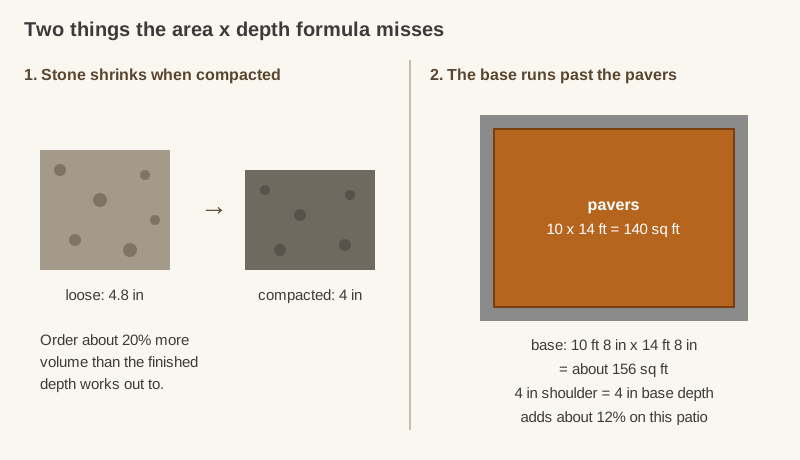
- Base footprint. CMHA's guide spec sets the distance from the base edge to the edge-restraint spikes equal to the base thickness (up to 10 inches). So a 10 x 14 ft patio on a 4-inch base needs a 10 ft 8 in x 14 ft 8 in base: about 156 sq ft, not 140.
- Compacted volume. Footprint (sq ft) x depth (inches ÷ 12) = cubic feet. Divide by 27 for cubic yards.
- Compaction allowance. Multiply by 1.2. Inch Calculator's paver base calculator uses the same 20% so the stone still reaches the target depth once compacted.
- Convert to cubic yards, tons or bags.
Skip step 1 and a small patio comes up about 12% short. Skip step 3 and you lose another 20%, and find out on Saturday afternoon, when the yard is shut.
Worked examples for a patio, a walkway and a driveway
All three use the shoulder and the 20% allowance. Tons use 1.35 to 1.7 tons per cubic yard, the spread the Stone Center calculator gives for crushed stone.
| Project | Base depth | Base footprint | Order (cu yd) | Tons | 0.5 cu ft bags |
|---|---|---|---|---|---|
| 10 x 14 ft patio, drained soil | 4 in | 156 sq ft | 2.3 | 3.1–3.9 | 126 |
| 3 x 30 ft walkway on clay | 6 in | 124 sq ft | 2.8 | 3.7–4.7 | 149 |
| 12 x 40 ft driveway, cold climate | 8 in | 551 sq ft | 16.3 | 22–28 | 882 |
| 4 x 4 ft landing at a door | 4 in | 22 sq ft | 0.3 | 0.4–0.5 | 18 |
The walkway is the one that surprises people. It's a skinny path, but a 6-inch shoulder on both sides of a 3-foot path adds a third to its width.
For quick planning without a shoulder, per 100 sq ft of base footprint with 20% added:
| Compacted depth | Cubic yards | Tons | 0.5 cu ft bags |
|---|---|---|---|
| 4 in | 1.5 | 2.0–2.5 | 80 |
| 6 in | 2.2 | 3.0–3.8 | 120 |
| 8 in | 3.0 | 4.0–5.0 | 160 |
Converting cubic yards to tons at the yard
Most yards sell by the ton, and the conversion changes with the rock. I opened the Stone Center calculator hoping for one tidy number and got a range, 2,700 to 3,400 lb per cubic yard, which is the honest answer. Ask the yard for its figure for the exact product (crusher run, road base, "paver base") and multiply.
If they won't give one, order at the top of the range. Leftover stone patches a low spot or beds a shed pad. Being short by half a ton is useful for nothing. (A spare pile of gravel has never annoyed anyone as much as a second delivery charge.)
How much paver base do I need in bags?
Bags are sold by volume, most often 0.5 cubic feet:
Bags = footprint (sq ft) x depth (in) ÷ 12 x 1.2 ÷ 0.5, rounded up.
A 4 x 4 ft landing at a back door, 4 inches deep, needs about 18 bags. That is a reasonable afternoon.
My view: bags are for landings, not patios. One cubic yard is 54 half-cubic-foot bags, so the 10 x 14 patio above means loading, carrying and slitting open 126 of them. Above about one cubic yard, get a bulk delivery quote before you get a cart. You skip the lifting, and the pile lands where you point.
Where a bag lists coverage, still add the 20% yourself. A coverage figure can't know how hard you'll compact.
Add the bedding sand to the same delivery
The 1-inch bed of concrete sand isn't compacted before the pavers go down, so skip the 20%: paver area (not the base footprint) x 1/12 ft ÷ 27. The 10 x 14 patio needs about 0.43 cubic yards. Which sand, and why not stone dust, is in our sand for pavers guide.
If all this hauling looks like more than a small, light-use area deserves, no-dig pavers covers where skipping the excavation works and where it doesn't.
Measure the dig, add a fifth, and order by the ton
Figure the footprint with its shoulder, multiply by the compacted depth, add 20%, and convert with your yard's tons-per-yard figure. For anything bigger than a doorstep, order bulk. The gravel pile will be the least photographed part of the project, and the reason the photos still look good in five years.
FAQ
How many tons of paver base do I need for a 10 x 10 patio?
With a 4-inch base and a 4-inch shoulder on every side, the base footprint is about 113 sq ft. That's about 1.7 cubic yards after the 20% compaction allowance, or roughly 2.3 to 2.9 tons at 1.35 to 1.7 tons per cubic yard. A 6-inch base (with a 6-inch shoulder) raises it to about 3.6 to 4.6 tons.
How much does paver base compact?
A common planning figure is about 20%: roughly 4.8 inches of loose stone compacts to a 4-inch base. The actual shrinkage depends on the stone's gradation and moisture and how well it's compacted, so rounding up is the safer choice.
Is it cheaper to buy paver base in bags or bulk?
For more than about a cubic yard, bulk is usually cheaper and far less work, even with a delivery fee. Bags suit a landing, a few stepping stones or a repair patch.
Should I include the edge shoulder when calculating paver base?
Yes. The base should run past the pavers by about its own depth so the edge restraint sits on compacted stone. On a small patio that adds 10% or more.


