

Last Updated on October 20, 2026 by Umar Farooq
The major pavers brands in North America are Belgard, Techo-Bloc, Unilock and Pavestone, with strong regional makers such as Nicolock, EP Henry, Cambridge, Hanover, Nitterhouse, Mutual Materials and Tremron. Belgard (owned by Oldcastle APG) and Pavestone (owned by Quikrete) are the widest-reaching. Techo-Bloc and Unilock are family-run premium brands that grew out of Canada's paver industry. The regional makers often match the big names on quality and beat them on delivery cost and local availability. For most homeowners the best brand is simply the best-rated product your nearest dealer stocks, because every concrete paver sold for patios and driveways is made to the same ASTM standard.
Page one of this search is mostly roundups by contractors and manufacturers, each of which, by remarkable coincidence, finds the brand it installs or makes near the top. This overview doesn't install or sell anything, so it sorts brands by who owns them, where they sell and how they position themselves, and leaves the ranking to your local yard.
The big pavers brands at a glance

| Brand | Based | Owned by | Since | Positioning |
|---|---|---|---|---|
| Belgard | Atlanta, GA | Oldcastle APG, a CRH company | 1995 | Broad range, national dealer network |
| Techo-Bloc | Saint-Hubert, Quebec | Family-owned | 1989 | Premium design, slabs and textures |
| Unilock | North America | Family-owned | 1972 | Premium, contractor-network led |
| Pavestone | Grapevine, TX | The Quikrete Companies | 1980 | Value, wide retail reach |
| Nicolock | Lindenhurst, NY | Family-owned, US-owned | 50+ years | Northeast and Mid-Atlantic |
| EP Henry | Woodbury, NJ | Oldcastle APG since 2021 | 1903 | Mid-Atlantic |
Sources for the table: Belgard's company fact sheet, Oldcastle APG's EP Henry acquisition notice, Unilock's own history page, Nicolock's about page, and company press material for Techo-Bloc and Pavestone.
Belgard and the Oldcastle family
Belgard is the brand most American homeowners have heard of, largely because it's everywhere. Its fact sheet describes it as "part of Oldcastle APG," founded in 1995 and headquartered in Atlanta, with a Belgard Authorized Contractors and Dealer Program behind it. Oldcastle APG in turn sits in CRH's Building Products division, alongside brands like Sakrete.
Two things follow from that ownership:
- Reach. A Belgard dealer is within driving distance of most US homes, which matters when you need three more pallets, or ten replacement pavers five years later.
- Regional lines. Belgard's catalog varies by region, so a line you saw online may not be made near you. Check what your nearest plant produces before you fall in love with a color. Our Belgard paver dimensions guide lists sizes and thicknesses by line.
EP Henry, a New Jersey maker established in 1903 by Edward P. Henry, joined the same family when Oldcastle APG acquired it. According to Oldcastle's notice, EP Henry runs seven manufacturing and distribution facilities across New Jersey, Pennsylvania, Virginia and Maryland, and it still sells under its own name.
Techo-Bloc and Unilock: the premium family firms
These two are the brands contractors tend to mention when a client asks for "the good stuff," and both came out of Canada's early paver industry.
Techo-Bloc was founded in 1989 by Charles Ciccarello and is still family-owned, headquartered in Saint-Hubert, Quebec, with plants in Canada and the United States. It is known for large slabs, textured and smooth premium finishes, and wall and outdoor-living products. Its residential warranty is lifetime and transferable, but it pays for replacement product only, not labour, and excludes things like efflorescence and settlement of the base. The details are in our Techo-Bloc pavers guide.
Unilock says it was "the first to bring paving stones to North America in 1972," and that it was the first concrete paver maker in North America to offer a lifetime guarantee. Its best brand of pavers page lists its own surface technologies, EasyClean for stain protection and EnduraColor for color retention, and names Belgard, Permacon, Cambridge and Techo-Bloc as the competition. Unilock leans heavily on its authorized contractor network, which it describes as screened and trained, with manufacturer-backed guarantees.
I read both brands' marketing pages back to back, and between them I counted more trademarked surface names than I expected concrete could need.
Pavestone: the home-center brand
Pavestone, founded in 1980 and based in Grapevine, Texas, is now a subsidiary of The Quikrete Companies (the Pavestone website footer carries Quikrete's copyright). Its range centers on concrete pavers, patio stones, retaining and freestanding wall systems, edging and landscape accessories, and when Quikrete bought it the deal covered 22 US manufacturing plants. Worth a read next: ants between pavers.
That footprint makes Pavestone a value and availability brand rather than a design-led one. If you buy it off a store shelf, check the thickness on the label: thin patio stones and real pavers are often stacked side by side. For patio and walkway pavers, CMHA's Tech Spec 10 recommends 2 3/8 inches (60 mm); a 1 1/2-inch patio stone is a different product.
Regional makers worth knowing
Outside the four big names, most of the country is served by strong regional manufacturers. Pavers are heavy (a full pallet weighs well over a ton), so plants tend to serve a radius, and a local maker can beat a national brand on delivery and on replacement stock years later.
- Nicolock (Long Island, New York): family-run, "100 percent U.S.-owned and operated," with plants on Long Island and in New Jersey, Maryland and Connecticut, serving the Northeast and Mid-Atlantic.
- EP Henry (New Jersey): Mid-Atlantic, part of Oldcastle APG since 2021, as above.
- Cambridge Pavingstones: known for its ArmorTec surface technology.
- Hanover Architectural Products (Pennsylvania): architectural and commercial pavers, including permeable systems.
- Nitterhouse Masonry (Pennsylvania): masonry and pavers for the Mid-Atlantic; its standard interlocking pavers come in 4 x 8, 6 x 6, 6 x 9 and 8 x 8 inch units at 2 3/8 inches.
- Mutual Materials: Pacific Northwest; its plank paver is sold through its own branches.
- Tremron: Florida and the Southeast.
- Basalite: California, including permeable plank pavers.
- Permacon: Canada.
If you live between plants, ask a yard which brands it gets delivered in bulk, not which it can order. The one on the lot is usually the better deal.
What the brand name doesn't change
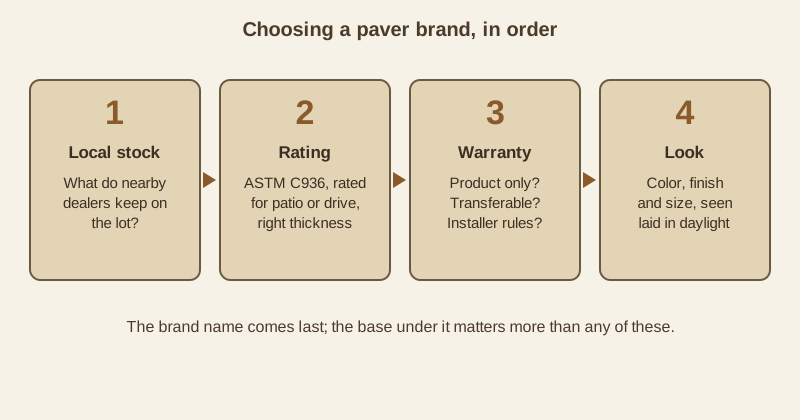
Here is my one opinion, and it's the reason this article doesn't rank anybody: the brand matters less than the dealer, the product rating and the base underneath. Every concrete paver sold for patios and driveways in the US is made to ASTM C936. The CMHA guide spec lists what that standard demands: an average compressive strength of 8,000 psi with no unit below 7,200, average water absorption of 5 percent or less with no unit above 7, and freeze-thaw testing. A Belgard paver and a regional maker's paver both have to clear that bar.
What actually differs between brands:
- The face. Surface technologies such as ArmorTec (Cambridge), EasyClean and EnduraColor (Unilock), Duraface (Belgard), HD² (Techo-Bloc) and paver-shield (Nicolock) are each maker's approach to a denser, more stain- and fade-resistant top layer. They are worth having, but they are trademarked names for a manufacturing process, not a different standard.
- Design range. Premium brands offer larger slabs, more textures and more coordinated wall, step and cap units.
- Warranty terms. Lifetime and transferable is common among the premium brands. Read what it covers: product-only replacement, exclusions for efflorescence and base settlement, and sometimes a requirement to use an authorized contractor.
- Availability and replacements. A paver discontinued in your region in ten years is a paver you can't match when a section needs relaying.
If you want proof rather than a brochure, ask the dealer or the manufacturer's rep for a recent ASTM C936 test report on the product you're buying. Serious makers test their production regularly and can show strength and absorption results. A brand that can tell you its surface technology's trademark but not its absorption figure is telling you which department wrote the page. For a patio in a freezing climate, the freeze-thaw result is the number worth reading twice, because it's the test that most directly predicts whether the face scales after a few winters of de-icing salt.
None of these beat a well-built base. A mid-range paver on a properly compacted base will outperform a premium one on a rushed base; the brand only decides what the top 2 3/8 inches look like.
Natural stone, porcelain and clay: a different kind of brand
Everything above is about concrete pavers, where the manufacturer's name is on the pallet. Other materials are branded differently.
- Natural stone is usually sold by the quarry region or stone type (Pennsylvania bluestone, travertine, granite) and by the importer or distributor, such as Polycor, rather than by a paver brand. Quality varies by quarry and by batch, so the yard's reputation matters more than any name.
- Porcelain pavers come from tile makers and, increasingly, from the concrete paver brands themselves; Belgard, for example, now sells its own porcelain paver line. The important specs are thickness (usually 2 cm for outdoor use) and slip rating, not the logo.
- Clay brick pavers are made by brick manufacturers. Where pavers freeze while wet, the Brick Industry Association's Technical Note 14 calls for ASTM C902 Class SX, which is a better filter than any brand name.
Mixing brands, and buying for the repair you'll need later
Pavers from different brands rarely mix well, even when the catalog sizes match. A "6 x 9" from one maker and a "6 x 9" from another can differ by a fraction of an inch in length or thickness (one may be a true 2 3/8 inches, another a metric 60 mm, which is a hair thinner), and colors named "charcoal" or "sand" by two brands are two different colors. Mixed in one field, the joints wander and the color patches show.
So:
- Buy the whole job from one brand, one product and, ideally, one production run. Pull from several pallets as you lay to blend the natural variation.
- Keep a few spares. Ten or twenty pavers stacked behind the shed are the cheapest insurance you'll ever buy. Colors drift between runs and lines get discontinued, and a patched patio with near-miss pavers looks patched forever.
- Note the product name, color and date somewhere you'll find it again, such as on the inside of the garage door. Your future self, standing at a dealer counter trying to describe "the grey-ish one," will be grateful.
How to compare pavers brands at the dealer
Bring these questions, and ask the same ones at every yard:
- Is it ASTM C936, and what is it rated for? Patio, walkway, driveway. Ask for the product sheet, not the sales sheet.
- What thickness? 2 3/8 inches (60 mm) for patios and home driveways, 3 1/8 inches (80 mm) for heavier vehicular use (CMHA Tech Spec 10).
- What does the warranty cover, and who has to install it?
- Is this color and size made locally? Local stock means quicker delivery and easier replacements.
- What's the delivery charge per pallet and per trip? On a small patio, delivery can decide which brand is cheapest. Where to buy, and how bulk and delivery work, is covered in where can I buy pavers.
Then look at a laid display in daylight, not a single paver under showroom lights. Most brands look alike in the catalog and quite different on the ground.
The brand your yard stocks is usually the right one
Belgard, Techo-Bloc, Unilock and Pavestone are the names you'll see most, and the regional makers are every bit as serious. Choose between them on the product's rating and thickness, the warranty's small print, the finish you like and, above all, what your local dealer keeps in stock. Then put the money you didn't spend on a brand name into the base. Nobody has ever complimented a patio by reading the pallet tag.
FAQ
What is the best brand of pavers?
There's no single best brand. Techo-Bloc and Unilock are generally positioned as premium, Belgard as a broad national range, and Pavestone as the value, home-center option. Every concrete paver brand has to meet ASTM C936, so the best choice is usually the well-rated product your local dealer stocks.
Who owns Belgard?
Belgard is part of Oldcastle APG, which is a CRH company. Oldcastle APG also acquired the New Jersey paver maker EP Henry in 2021.
Are Pavestone pavers good quality?
Pavestone makes standard concrete pavers and is owned by The Quikrete Companies. Its home-center stock covers basic sizes and colors. Check the label: use 2 3/8-inch pavers for patios and walkways, not thinner patio stones.
Is Techo-Bloc better than Belgard?
Techo-Bloc is positioned as the more premium design brand, with more slabs and textures. Belgard has a wider dealer network and range. Both make pavers to the same ASTM standard, so compare the specific product, its rating and warranty, and local availability.
Are regional paver brands as good as national ones?
Often, yes. Regional makers produce to the same ASTM C936 standard and can be cheaper to deliver. They also make it easier to find matching replacements later, because the plant is nearby.


