

Last Updated on October 20, 2026 by Umar Farooq
Paver styles come down to three choices: the overall look (brick, cobble, stone-look, slab, plank or flagstone), the surface finish (smooth, textured, tumbled, natural cleft or exposed aggregate), and the edge profile (square, chamfered, rounded or worn). Smooth faces with crisp edges read modern. Tumbled and worn faces read old-world and rustic. Brick and cobble looks suit traditional houses. The practical rule is to choose the finish for what the surface has to survive (rain, shade, snow shovels, bare feet) and then pick the look that echoes one material already on the house. For the full picture, see exposed aggregate concrete vs pavers.
Color is its own decision and has its own guide in paver colors. This article is about everything else a catalog means when it says "style."
The looks: what each paver style is imitating
Nearly every concrete paver is imitating something older: a clay brick, a hand-cut cobble, a quarried slab, a split flagstone. Knowing what it imitates tells you where it belongs.
| Look | Typical format | Reads as | Suits |
|---|---|---|---|
| Brick | 4 x 8 in rectangles | Traditional, formal | Colonial, Georgian, brick houses, formal walks |
| Cobble | small squares and rectangles, worn edges | Old-world, European | Farmhouse, Tudor, courtyard, driveway aprons |
| Stone-look | mixed-size rectangles, textured face | Natural, relaxed | Craftsman, ranch, most suburban houses |
| Slab | 16 to 24 in and larger squares | Clean, contemporary | Modern, mid-century, pool decks |
| Plank | long, narrow units | Linear, modern | Modern, Scandinavian, narrow spaces |
| Flagstone-look | irregular angular units | Organic, rustic | Cottage, woodland, Mediterranean |
These aren't laws. A slab patio beside a colonial house can look great if the color picks up the trim. But when a style looks "off" beside a house, it's usually because the paver is imitating a material that has nothing to do with the building.
Surface finishes, from smooth to split

Meyer Landscape's guide to paver styles sorts surfaces into flat ("a smooth finish that looks polished and elegant"), dimpled and mottled ("an even more weathered, Old-World look"). Manufacturers use more names than that, but they all fall somewhere on the same scale:
- Smooth (flat). The face straight from the mold. Crisp, modern, easiest to sweep and shovel. Shows dirt, tire marks and efflorescence more than any other finish.
- Textured (shot-blast, brushed, embossed or micro-textured). The face is roughened after molding or pressed with a pattern. Better grip, hides dirt, and the aggregate in the face shows a little, which gives the color depth.
- Tumbled. Units are rolled in a drum so faces and edges chip and round. Instant age. More on this in tumbled pavers.
- Natural cleft. Stone split along its natural layers (bluestone, sandstone, slate). Gently uneven, with a real stone surface. Concrete "cleft" finishes copy it with a molded texture.
- Exposed aggregate. The cement paste is removed from the face of aggregate pavers to show the stones in the mix. Very grippy, very forgiving of dirt.
- Flamed or thermal. A natural-stone finish made with a torch; flatter than cleft, with a fine grit. Common on bluestone and granite.
- Split-face. Rough, broken-rock texture. It belongs on the vertical faces of wall block, steps and caps, not on something you walk across barefoot. (If a walking surface looks split-faced, it's either a very rustic cobble or a sprained ankle waiting for a date.)
The same concrete mix can look very different with a different face. Nicolock's types of pavers guide pairs smooth finishes with contemporary designs and tumbled edges with an old-world courtyard look, which matches what every catalog I read shows in its photos.
Edge profiles change the style more than you'd think
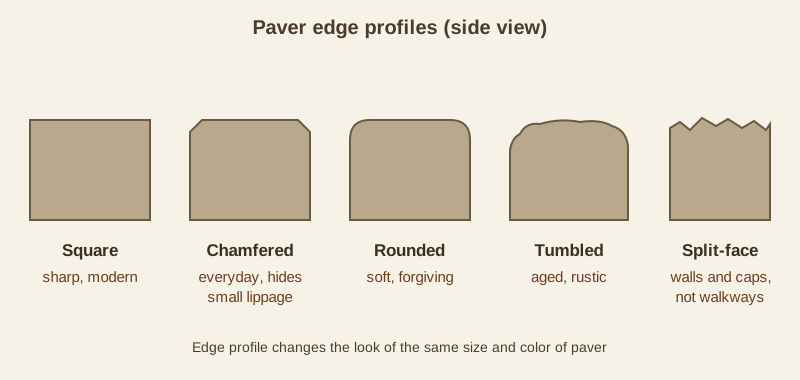
Look at a paver from the side and the style becomes obvious. Meyer's guide names three edge styles: beveled ("the cleanest of edges"), rounded (like weathered stone) and worn ("an aged and rustic look, like time-worn cobblestone").
What each one does in practice:
- Square edge. No bevel at all. Sharpest modern look, tightest-looking joints. The edges chip more easily, and any height difference between neighbours shows as a line of shadow.
- Chamfered (beveled) edge. A small 45-degree cut along the top edge. It hides small height differences and resists chipping, which is why most everyday concrete pavers have one. It also sets the joint-sand line: Alliance Gator's SuperSand G2 data sheet wants finished polymeric sand at least 1/8 inch below the top of the paver or the bottom of the chamfer.
- Rounded edge. Softer, more forgiving underfoot and to snow shovels.
- Tumbled or worn edge. Irregular, chipped profile. Joints look wider and less even, which is the point, and they take more joint sand.
A plain square paver with a big chamfer looks like a driveway. The same paver with a square edge looks like a modern plaza. That's why two products with the same size and color can photograph as completely different styles.
Textured vs smooth pavers for an outdoor patio
This is the choice people agonize over most, and it's where I'll give you my one opinion: a smooth face is the wrong choice for a shaded, sloped or pool-side surface, however good it looks in the showroom.
The mechanism is simple. Water sits on a smooth face as a thin, continuous film. In shade, that film grows algae; on a slope, it's what your heel slides on; beside a pool, it's permanent. A textured face breaks the film up and gives shoe soles and bare feet something to grip. Sealer changes this too: a glossy wet-look coat on a smooth paver makes the film slicker still.
A quick way to decide:
| Where it goes | Choose | Why |
|---|---|---|
| Sunny, flat patio | Smooth or light texture | Easy to clean, crisp look, dries fast |
| Shaded patio or north side of the house | Textured | Algae and damp film on smooth faces |
| Walkway on a slope or steps | Textured or exposed aggregate | Grip when wet |
| Pool deck | Textured, light color | Bare feet, constant water, heat |
| Driveway in snow country | Textured, chamfered | Grip, and edges survive the shovel |
| Outdoor dining area | Smooth or fine texture | Chairs slide, spills wipe off |
Smooth isn't bad; it's just a flat-and-sunny finish. Textured isn't perfect either: it holds dirt and grease in its pores, so a textured grill area needs a scrub brush where a smooth one needs a mop.
Rustic, old-world and cobble styles

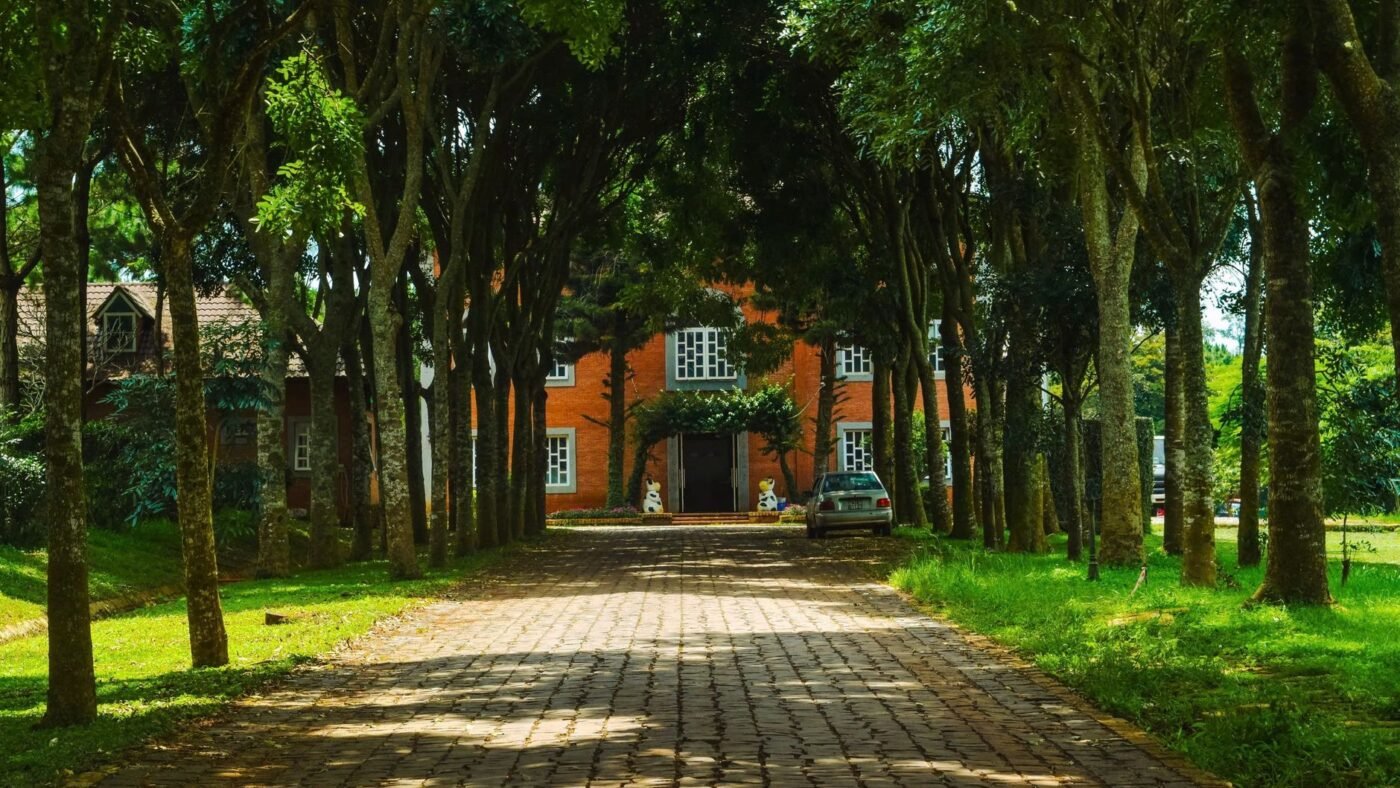
Rustic styles copy streets like the one above: small units, uneven faces, worn edges and a blend of two or three colors. Concrete makes the same look with tumbled cobble-size units, usually in multi-piece patterns so no two neighbours are quite the same size. For the full picture, see mixing paver colors.
Three things to know before you choose one:
- Joints do most of the work in the look. Wide, irregular joints filled with a darker sand make a cobble patio. The same units with tight, pale joints look like a parking lot trying too hard.
- Rough faces are harder to clean and grip leaves, pollen and grill drips. Plan on a stiff brush.
- They hide wear beautifully. A chip in a tumbled cobble is just more character. A chip in a smooth slab is a chip.
Cobble looks suit farmhouses, Tudors, older brick homes and enclosed courtyards. They also make good driveway aprons and borders around a smoother field, which gives you the old-world texture without cobble under the patio chairs.
Modern and minimal styles
Modern paver styles go the other way: bigger units, smooth or finely textured faces, square or small-chamfer edges, narrow joints and one color family. Picture large smooth grey slabs against a dark facade, laid in a straight line parallel to the wall: that's the whole idea.
The catch is that minimal styles hide nothing. Large units need a flatter base, narrow joints show any wandering line, and a smooth face shows every tire mark. If you like the look, see plank pavers for the linear version and budget more care for the base than you would for a cobble.
Matching a paver style to the house
The simplest method I found, and the one the Nicolock home-style table and Unilock's design tips both point toward: echo one thing, contrast one thing.
- Echo a material, color or line from the house. A brick house gets brick-look pavers or a brick border. A stone chimney gets a stone-look blend with the same undertone. A modern facade gets straight lines parallel to its walls.
- Contrast in one controlled way. Smooth field with a tumbled border. Light patio with a charcoal soldier course. Large slabs with a strip of small cobbles.
By house style:
- Colonial, Georgian, traditional brick: red or brown brick-look, running bond or herringbone, chamfered edges.
- Craftsman, ranch, most suburban houses: textured stone-look blends in random multi-size patterns.
- Mediterranean, Spanish, stucco: warm tumbled units, travertine-look, fan or circle features.
- Farmhouse, Tudor, cottage: tumbled cobbles, flagstone-look, wide joints.
- Modern, mid-century, contemporary: smooth or finely textured slabs and planks, stack bond or plank bond, narrow joints.
Mix no more than two finishes in one space. Three textures, three colors and three shapes in one patio read as a sample board, and a sample board is a hard thing to relax on.
One style, three materials: concrete, clay and stone
Most paver styles come in more than one material, and the material changes how the style ages.
- Concrete imitates almost everything, at the lowest price and with the most consistent sizes. Its color comes from pigment in the mix, and the surface paste wears slowly over the years to expose more of the aggregate, so a smooth concrete paver gradually becomes a lightly textured one. That's normal, and it's worth knowing before you pay extra for the smoothest face in the catalog.
- Clay brick is the real thing the brick look copies. The color comes from the firing, so it doesn't fade the way a surface pigment can. Where pavers freeze while wet, the Brick Industry Association's Technical Note 14 calls for ASTM C902 Class SX; a brick sold for garden edging or walls isn't automatically a paver.
- Natural stone is the real thing the cleft, flagstone and slab looks copy. Every piece varies, the color runs all the way through, and it usually costs more to buy and lay.
If you love a style but the budget says concrete, pick the concrete version with the best face texture and the most color variation in the blend. Those two features do more to make a copy convincing than any brand name on the pallet.
Judge a paver style on a sample, wet and dry

Catalog photos are shot in soft light on clean pavers. Before committing:
- Get a sample or visit a laid display. A single paver tells you color; ten laid together tell you style, because the joints and edges are half the look.
- Wet it. Most concrete pavers darken noticeably when wet, and textured faces darken more. You'll see the wet version every time it rains.
- Look in your own light. North-facing and shaded areas make warm colors look muddy and cool colors look cold.
- Run a hand over the face. If a smooth sample feels slick when wet in the store, it will be slicker with algae on it in the shade.
- Check a cut face or a chipped corner. It shows whether the color runs through the unit or only sits on the top layer, which matters on tumbled units, where chips are part of the design.
(I went through several manufacturer catalogs for this, and not one of them photographs its pavers in the rain. Take that as a hint.)
Pick the finish for the weather, the look for the house
The paver style that works is the one that suits both the conditions it lives in and the building it sits beside. Choose the surface first: textured for shade, slopes, pools and snow, smooth for sunny, flat, easy-to-clean areas. Then choose the look and edge that echo something already on the house, and let one contrast do the decorating. Get that order right and the style will look deliberate on the first day and still look right on the rainy one.
FAQ
What are the most popular paver styles?
Textured stone-look concrete pavers in multi-size blends are the most common on suburban patios, followed by brick-look rectangles for traditional houses and large smooth slabs for modern ones. Tumbled cobble styles are popular for old-world and farmhouse looks.
Are textured or smooth pavers better for a patio?
Textured pavers are better where the surface gets wet, shaded or sloped, because they grip and hide dirt. Smooth pavers are better for sunny, flat dining areas where chairs slide and spills need wiping. Neither is better everywhere.
What paver style goes with a brick house?
Brick-look pavers or a brick-colored border that picks up the house brick, in running bond or herringbone. A neutral stone-look field with a brick soldier course also works if full brick feels too heavy.
Do tumbled pavers cost more than standard pavers?
Usually, because tumbling is an extra manufacturing step and the rounded edges lose some material. Check the per-square-foot price of the same line in standard and tumbled versions at your dealer.
What is a chamfered edge on a paver?
A small beveled cut along the top edge of the paver. It hides slight height differences between units, reduces chipping and gives the joint a defined line. Polymeric sand should stop at least 1/8 inch below the paver top or the bottom of the chamfer.


