


Last Updated on October 20, 2026 by Umar Farooq
Quartzite pavers are natural stone paving cut from quartzite, a very hard rock that began as quartz sandstone and was recrystallized by heat and pressure. They suit patios, pool decks and walks, and the good ones absorb very little water and shrug off frost. The catch is the label. "Quartzite" is sold loosely, so the only way to know what you are buying is the test sheet: absorption of 1 percent or less and compressive strength of at least 20,000 psi is what the ASTM standard means by the word.
I read a stone comparison guide, a seller's product page and the reference article on the rock, then checked their claims against the ASTM stone classes we already cover. Nobody opened with the test sheet, which is why it comes first here. For how quartzite sits against the other stones, see our natural stone pavers guide.
What quartzite is, and why the label slips
Quartzite is a hard, non-foliated metamorphic rock that was originally quartz sandstone, per Wikipedia. Heat and pressure recrystallize the quartz grains and erase the sandstone texture. The British Geological Survey, as Wikipedia reports it, requires at least 80 percent quartz by volume for a metamorphic rock to count as quartzite.
That origin explains the confusion. Dense sandstone and true quartzite sit close together on a spectrum, and sellers use the more prestigious word when they can. The standard draws a line. ASTM C616 sorts quartz-based stone into sandstone, quartzitic sandstone and quartzite, each with its own limits. Our sandstone pavers guide covers the first two in detail.
The test sheet that separates quartzite from quartzitic sandstone
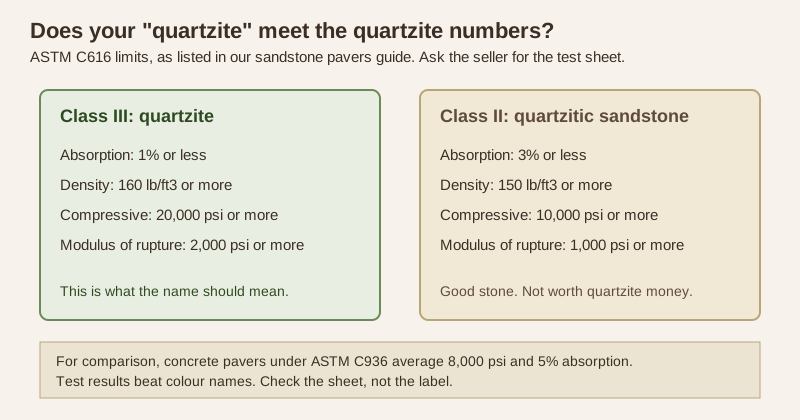
Here is my one strong opinion. Do not pay quartzite money without a number on paper. Class III quartzite under ASTM C616 allows absorption up to 1 percent and requires at least 160 pounds per cubic foot, 20,000 psi compressive strength and 2,000 psi modulus of rupture. Class II quartzitic sandstone allows 3 percent and needs 150, 10,000 and 1,000.
Concrete pavers, by ASTM C936, average 8,000 psi and 5 percent absorption (as stated in the CMHA guide specification). So a stone that meets Class III is much stronger and tighter than a standard concrete paver. A Class II stone is still a strong paver. It is just a different price.
One seller's page for a white quartzite paver lists water absorption under 0.5 percent, which would beat the Class III limit, but that is a single product on a sales page. Ask for the lab report.
Colours, formats and the finish to ask for
The two product pages I read are typical. One lists a beige, grey, off-white and brown quartzite in sizes from 12 x 12 up to 24 x 36 inches, at 1 1/4 inches thick. The other lists a white to pale grey quartzite in 12 x 24, 16 x 24 and 24 x 24 inch sizes, 3 cm (about 1 3/16 inches) thick, with a flamed or brushed finish and straight-cut edges. Flagstone is the cheaper format: irregular quartzite slabs, which our flagstones guide lists in silver, gold, gray and green from Idaho, Utah and Oklahoma.
Choose flamed or brushed for outdoors. A smooth face is slick when wet, as with any stone, and the seller's claim that its pavers are slip-resistant describes a finish, not the rock.
Heat, grip and winter: what the claims actually rest on
NT Pavers rates quartzite 7 on the Mohs scale, against 3 to 4 for marble, and says it has high UV resistance and suits outdoor use. The seller's page adds that its pavers are frost resistant and handle large temperature swings. Both are sellers. The mechanism behind the frost claim is real: low absorption leaves little water to freeze. But I did not find independent freeze-thaw test data for a specific quartzite paver, so ask for it in cold climates and give the base the drainage it needs (add 2 to 4 inches on wet or weak ground, per ICPI Tech Spec 2).
Sealing quartzite: once a year, or only when it needs it
NT Pavers describes quartzite as low to medium porosity and says it needs sealing about once a year, against two or three times a year for marble. I did not find a manufacturer's interval for a quartzite paver.
My view, as with any paver: do not seal on a calendar. Seal when you have a reason, such as oil, wine or leaf stains, and reseal when water stops beading. Use a penetrating, breathable sealer and test a spare paver first.
Laying quartzite: flagstone on gravel, slabs on mortar
None of the pages I opened gave quartzite-specific installation steps, so here is the general rule. Small and thick units can be sand-set like concrete pavers: at least 4 inches of compacted base under a patio or walkway on well-drained soil, a nominal 1 inch of loose bedding sand and a base flat to within 3/8 inch over 10 feet (ICPI Tech Spec 2; CMHA). Our paver base guide has the build. Large thin slabs of 24 x 36 inches bend more easily, so a bonded mortar bed is the safer choice, and the supplier's setting instructions beat anything general.
Cut it wet, with a diamond blade. Quartzite is largely quartz, and the OSHA rule for masonry saws is water on the blade every time (29 CFR 1926.1153).
What quartzite costs, and the cheaper way in
Prices disagree by format. The white quartzite page I read starts at $24.17 per square foot for the paver alone. Our cost of flagstone pavers guide puts quartzite flagstone at $7 to $25 per square foot from HomeGuide. Those are stone prices, not installed costs, and freight changes them.
The cheaper option first: if you want a quartzite look at a lower price, buy local irregular flagstone and lay it on a good base. Save the cut, flamed pavers for the area people actually see.
Buy quartzite by the test sheet, then spend the saving on the base
Quartzite pavers are worth the money where you want very low absorption and hard wear: entries, steps, walks and cold-climate patios. Ask for the ASTM C616 class and the absorption and strength numbers, choose a flamed or brushed face, seal when water stops beading and cut it wet. If the seller cannot give you a number, buy a different stone. The rock was made under serious pressure. The least a seller can do is hand over a lab report.
FAQ
Are quartzite pavers good for patios?
Yes, when they are true quartzite. They are very hard, low in absorption and suit foot traffic, pool decks and cold climates. Check the test sheet, because "quartzite" is applied loosely.
Do quartzite pavers need to be sealed?
Sources vary. NT Pavers says about once a year. I found no manufacturer interval, so seal for a reason, such as stains, and reseal when water stops beading.
What is the difference between quartzite and sandstone pavers?
Quartzite is sandstone changed by heat and pressure into a denser, harder rock. ASTM C616 limits absorption to 1 percent for quartzite and 8 percent for sandstone, and requires 20,000 psi against 4,000 psi.
Are quartzite pavers slippery?
Smooth faces are slick when wet. Flamed and brushed finishes give grip. Slope and drainage matter as much as the finish.
Can quartzite pavers be used in cold climates?
Usually, because the low absorption leaves little water to freeze, but ask for freeze-thaw data and build a draining base. Sellers' claims are not a substitute for a test.
How thick should quartzite pavers be?
Listings I read were 1 1/4 inches and 3 cm (1 3/16 inches). Thicker units cope better with a less perfect base and heavier loads.


