


Last Updated on October 20, 2026 by Umar Farooq
A wobbly seat wall is usually one of three things, and a two-minute push test tells you which. If only the cap rocks while the blocks below stay still, the adhesive let go: scrape, dry and re-glue it. If the top courses slide on the ones beneath, the courses were never bonded. If the whole wall rocks or the top has gone out of level, the footing is moving, and no amount of glue will fix that.
Do the test before you buy anything. Adhesive is the cheap fix, but only gravel fixes a wall that is sinking.
Find out what is actually moving
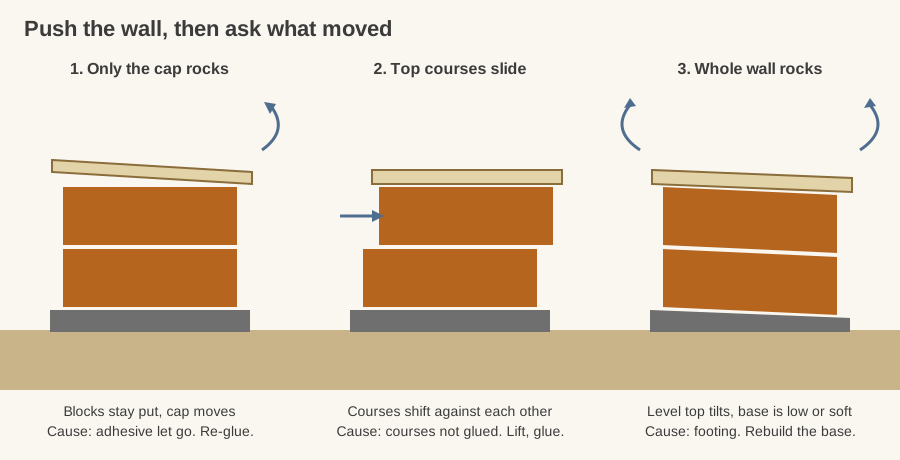
You need a helper and a level. One person pushes or sits; the other watches the joints.
- Press down and sideways on the cap, near an end. Watch the line between the cap and the top course. If the cap moves and the course under it does not, that is the first picture.
- Push the top two courses sideways with your whole body weight. If the cap and the blocks move together, but the courses below stay put, the courses are sliding on each other.
- Push the wall at the middle. If the whole thing rocks, or if there is a gap opening and closing at the bottom against the soil, the movement starts at the footing.
- Lay a level on top. A cap that was level and now tilts, or a wall that has stepped down at one end, means the ground moved, whatever else is true.
This sorting is my own reading of how the parts connect, not a published test. I found no source that separates the three, only advice for each on its own.
A loose cap: scrape it back and glue it properly
The cap is the only part that is not mechanically attached to anything. Unilock's wall construction guide says to glue the coping to the row with a high-quality concrete adhesive, and that the units must be dry and dust free. That last part is where most re-glues fail: new adhesive on top of old adhesive and dust.
A short how-to on loose capstones says rigid concrete block walls can pry the capstone loose when the ground shifts, and the fix is to wire-brush off the old glue, clear the debris, then re-bond.
- Lift the cap off. If it will not lift, it is not loose, and your wobble is lower down.
- Scrape or wire-brush the old adhesive off both the cap and the top course. Brush away the dust.
- Let both surfaces dry, then apply the adhesive the way its label says.
- Set the cap, check it with a level, and keep weight off it for the cure time printed on that tube. I will not give you a number, because it differs by product.
If the cap comes off easily and the same cap loosens again within a season, stop treating it as a glue problem. The cap is telling you the wall underneath is moving, as the capstone how-to says, and you are looking at the third picture.
When the courses slide against each other
Some freestanding systems rely on adhesive alone. Unilock describes walls under about 2 feet as non-structural (garden walls, planters, grill islands), and says systems such as Brussels Dimensional Stone, Lineo and Quarrystone rely only on concrete adhesive and cannot be built higher than 2 feet. A seat wall is well inside that height, which means the courses are held by glue and weight, and nothing else.
If the top courses move, they were not glued, or the glue let go. Lift them off in order, scrape, and re-glue course by course as you rebuild. This is the one place I will state a firm opinion: glue every course, not only the cap, because a seat wall gets sat on, leaned on and stood on, and a dry-stacked block slides one bump at a time. That is the same stance as our seat wall guide. Follow your block maker's instructions if the system uses pins, lips or setback instead.
When the whole wall rocks, it is the footing
The base sets how still a wall stays. Unilock's install guide calls for a trench 12 to 16 inches deep, depending on block height, twice the width of the wall unit, with 4 to 8 inches of free-draining gravel (3/8 to 3/4 inch, ASTM No. 57), compacted, and at least one complete row of blocks below grade. Allan Block's embedment guidance adds that the buried block should be at least 6 inches, the base trench should get at least two passes of a walk-behind plate compactor, and unsuitable soil such as heavy clay or wet fill should be replaced with granular material compacted in lifts of 8 inches or less. It also says the leveling pad can absorb movement from freeze-thaw cycles.
Both are retaining-wall instructions. A seat wall holds no soil, so treat them as a ceiling and use the block maker's freestanding instructions where they exist.
To fix it, you rebuild from the bottom:
- Number the blocks with chalk and lift them off, cap first.
- Dig out the soft layer, fix whatever made it soft (a downspout, a low spot where water sits), and recompact the gravel in thin lifts. Our how to compact gravel guide covers lift thickness and plate size.
- Re-level the first course end to end and front to back, then rebuild and glue upward.
Rent the plate compactor for an afternoon. Do not buy one for a wall this size.
Stop and call someone if
- The wall is holding back soil. Then it is a retaining wall, and the rules change: see our bulging retaining wall and leaning retaining wall guides.
- Blocks have cracked, or the wall is leaning, not just rocking.
- The wall edges a raised patio. Check your local code for guard rules.
Fixes that only look like fixes
- Gluing over dirt or old adhesive. Unilock's text asks for dry, dust-free units.
- Wedging stones or shims under a rocking cap. It hides the symptom and leaves the cause.
- Gluing a moving wall. If the ground is still settling, the glue line is the weakest part and it fails first.
Re-glue the cap, but dig for the footing
A loose cap is a small job. A rocking wall is a base job, and glue will only slow it. Bury the first course, compact in lifts, glue every course, keep downspouts away, and you can sit on the thing without testing it first.
FAQ
Why is my seat wall wobbly?
Because the cap is loose, the courses are not bonded to each other, or the footing is moving. A push test shows which: if only the cap moves, it is adhesive; if the top courses slide, they are unglued; if the whole wall rocks, it is the base.
How do I fix a loose wall cap?
Lift it off, scrape and brush the old adhesive from both surfaces, let them dry, and re-bond with a concrete adhesive made for modular units, as Unilock recommends. Keep weight off it for the cure time on the tube.
Can I just glue a wobbly seat wall back together?
Only if the footing is sound. If the wall rocks as a whole, glue holds the blocks together on top of a base that is still moving.
How deep should a seat wall footing be?
Unilock's retaining-wall guide gives a trench 12 to 16 inches deep with 4 to 8 inches of compacted gravel and a full row of blocks below grade. For a freestanding seat wall, use your block maker's own instructions.
Is a wobbly seat wall dangerous?
It can be, because people sit on it and lean on it. Stop using it until you know what is moving.


