Last Updated on September 23, 2026 by Umar Farooq
12×12 pavers are square pavers that measure a nominal 12 by 12 inches, so each one covers about 1 square foot. You need roughly 100 of them for every 100 square feet, plus 5 to 10 percent for cuts and breakage. It is the only paver whose math you can do in your head, which is suspicious, and sure enough the "12" is usually 11.7. Most 12×12 concrete pavers at home centers are thin patio stones 1 1/2 to 2 inches thick, made for patios, walkways, stepping stones and pads under grills or trash cans. The bigger 16×16 and 18×18 squares work the same way, with fewer joints.
Plan the patio size around the paver, choose a pattern that suits the square, and build a proper base under it.
What 12×12 pavers are, and what they are not
"12×12" covers two quite different products:
- Patio stones and step stones. Wet-cast or pressed concrete squares, often 1 1/2 inches thick, with square edges and no spacer nubs. Home Depot's Pavestone 12 x 12 x 1.5 in step stones are typical: cheap, light, and fine for foot traffic.
- Interlocking square pavers. These are thicker, usually 2 3/8 inches (60 mm), and made to ASTM C936 like regular interlocking pavers. Some come in a multi-size system with 6×6, 6×12 and 12×24 pieces. They cost more and are much stronger, and the 3 1/8 inch (80 mm) versions can take a car.
Nominal sizes are rounded. (I have yet to find one rounded in the buyer's favor.) Lowe's lists its gray "12 in x 12 in" concrete patio stone at an actual 11.7 x 11.7 inches. That missing 0.3 inch matters when you plan a patio edge to edge, as shown below.
Rough weights for plain concrete squares, at about 145 lb per cubic foot:
| Size | Thickness | Approximate weight |
|---|---|---|
| 12 x 12 in | 1 1/2 in | 18 lb |
| 12 x 12 in | 2 in | 24 lb |
| 16 x 16 in | 2 in | 43 lb |
| 18 x 18 in | 2 in | 54 lb |
Squares larger than this, 20×20 and up, behave differently on the base. We cover them in 24×24 pavers.
12×12 pavers per square foot, and the bigger squares
The math for square pavers is one division: patio area ÷ area of one paver.
| Paver | Area of one paver | Pavers per sq ft | Pavers per 100 sq ft |
|---|---|---|---|
| 12 x 12 in | 1.00 sq ft | 1.00 | 100 |
| 16 x 16 in | 1.78 sq ft | 0.56 | 57 |
| 18 x 18 in | 2.25 sq ft | 0.44 | 45 |
Two adjustments turn that into an order:
- Waste. Add 5 to 10 percent for straight layouts. Left Coast Pavers suggests 10 percent for straight patterns and 20 percent for diagonal or complex ones in its paver quantity guide. Diagonal layouts cut a triangle off every edge piece.
- Actual size and joints. An 11.7-inch "12×12" covers about 0.95 sq ft on its own. If you lay them butted tight, you need about 5 percent more pieces than the nominal math says. If you leave a 1/4-inch joint, the joint takes up most of the gap and the nominal count is close.
Worked example. A 12 x 14 ft patio is 168 sq ft.
- With 12×12 pavers: 168 + 10 percent = 185 pavers.
- With 16×16 pavers: 168 ÷ 1.78 = 95, + 10 percent = 105 pavers.
- With 18×18 pavers: 168 ÷ 2.25 = 75, + 10 percent = 83 pavers.
Omni Calculator's paver calculator runs the same formula if you want to check the numbers. For odd shapes, L-shaped patios and borders, our guide to how many pavers you need walks through it step by step.
Where square pavers make sense
Square pavers are at their best on small, flat, simple jobs:
- Small patios and landings. A 10 x 10 ft sitting area in 12x12s is a weekend job.
- Pads. Under a grill, AC condenser, trash cans or a shed ramp. Four 18x18s make a 3 x 3 ft pad.
- Walkways. A 36-inch path is exactly three 12x12s or two 18x18s wide, with no ripping cuts along the length.
- Stepping stones. A 16×16 or 18×18 is a comfortable landing for one foot. A 12×12 works but feels small at a normal stride. Spacing and setting depth are covered in how to lay stepping stones.
- Borders and inlays. A single row of dark 12x12s frames a lighter field neatly.
They are weaker on curves, where every edge square needs a cut, and on driveways. I ran CMHA's aspect-ratio rule (length divided by thickness) to see where the line sits. A 12-inch square at 2 3/8 inches is about 5:1, and CMHA says 4:1 or above stays off the driveway. At 3 1/8 inches it drops to about 3.8:1, inside the 3:1 to 4:1 band CMHA allows for residential driveways. Thin 1 1/2-inch patio stones, at 8:1, will crack under a car.
Square paver patterns worth laying
Squares don't interlock the way rectangles do in herringbone, so pattern choice is mostly about looks and cutting.
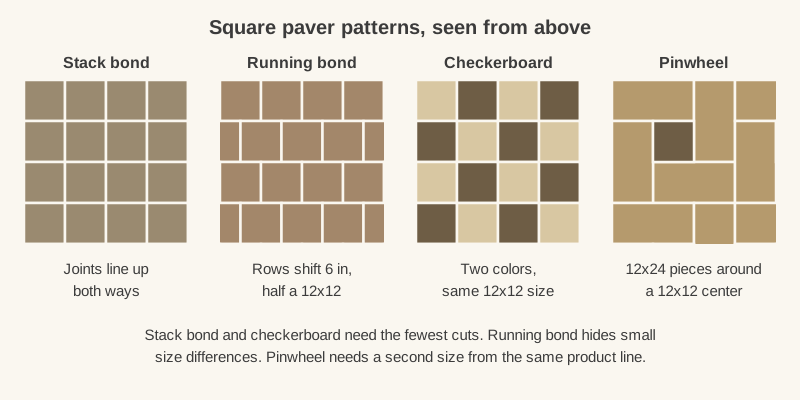
- Stack bond (grid). Every joint lines up both ways. It is the fastest to lay with the fewest cuts, but any drift shows as a crooked line across the whole patio, so pull string lines both ways every few rows.
- Running bond. Shift each row by half a paver, 6 inches on a 12×12. It hides small size differences between pieces, because the joints between rows never line up. Every other row ends in a half piece.
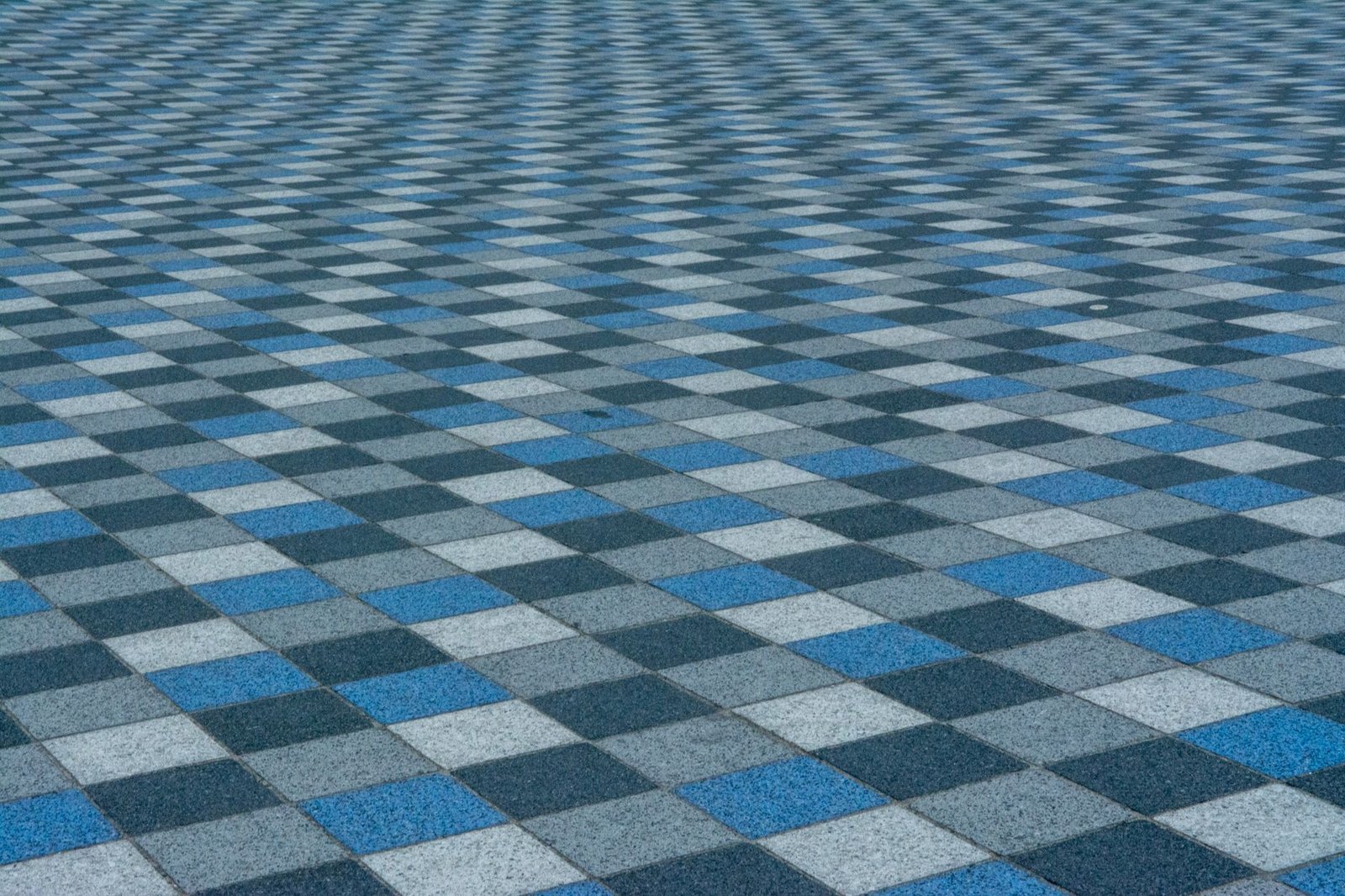
- Checkerboard. A stack bond in two colors. Buy both from one product line so the thicknesses match.
- Diagonal or diamond. A grid turned 45 degrees. It hides out-of-square walls, but every edge piece is a triangle cut. Order the higher waste factor.
- Pinwheel. Four 12×24 pavers wrap around a 12×12 center, forming a repeating 36-inch block. It needs a second size, so it only works with a system that includes both.
Mixing 12x12s with 6×6 or 12×24 pieces in a random pattern also works, if they come from the same line and have the same thickness.
12×12 paver patio designs that avoid cuts
The best trick with square pavers is to size the patio to the paver, not the other way around. If a patio is a whole number of pavers wide, you get full pieces all the way across and no thin slivers at the edge.
- Measure a real paver, then add the joint. For 11.7-inch stones with a 1/4-inch joint, one "module" is about 11.95 inches. Ten across is just under 10 feet.
- Build 16-inch squares in multiples of 16. A 16×16 patio should be 12 ft (9 pavers), 13 ft 4 in (10), 16 ft (12) and so on. Pick a width like 14 ft and you'll be ripping a strip off every edge paver.
- Start at the most visible edge. Usually the house or the step. Full pavers go there; cuts go to the lawn side or behind a planter.
- Use a border to absorb the error. A soldier course of rectangles, or a contrasting row of squares, around a field of 16x16s or 18x18s hides a cut row neatly.
- Line joints up with doors and steps. In stack bond, a joint running out from the center of the patio door looks deliberate. A joint 2 inches off center looks like a mistake, and every guest who owns a tape measure will find it.
For a round or curved patio, squares are the wrong tool: every edge piece needs a fragile triangle cut.
Base and bedding for square pavers
Thin square pavers need the same foundation as any other paver. The only difference is that they tolerate a soft base even less, because a 1 1/2-inch stone can crack if it bridges a hollow.
- Remove sod and topsoil, and dig for a compacted crushed-stone base of 4 inches or more under a patio (ICPI Tech Spec 2), deeper by 2 to 4 inches where the soil stays wet or freezes, plus 1 inch of sand and the paver thickness.
- Compact the base in lifts sized to the plate: ICPI's 4 to 6 inches assumes a 7,000 lbf machine, and smaller plates need thinner lifts. Slope it away from the house: 2% near the foundation, which is a quarter inch for every foot (IRC R401.3).
- Screed an inch of concrete sand (ASTM C33), leave it loose, set the pavers, and bed each one with a rubber mallet.
- Fill the joints with sand or polymeric sand, and add an edge restraint on every open side.
Plate-compacting thin patio stones can crack them, so follow the maker's instructions. Thick interlocking squares can usually take a padded plate.
My opinion on that plate: rent it, don't buy it. A 10 x 10 patio of 12x12s needs a compactor for one weekend. Plan the base and the pavers inside the rental. The one you'd buy spends the next decade in the garage being walked around.
Many people search for how to lay 12×12 pavers on dirt. For a single step stone in a garden bed, a scooped-out hole with a thin sand bed can be fine. For a patio, it isn't: bare soil moves with rain and frost, and every paver moves on its own schedule.
Choosing between 12, 16 and 18 inch squares
| 12 x 12 | 16 x 16 | 18 x 18 | |
|---|---|---|---|
| Pieces per 100 sq ft | 100 | 57 | 45 |
| Weight (2 in thick) | about 24 lb | about 43 lb | about 54 lb |
| Look | busier, traditional | balanced | open, more modern |
| Best for | walkways, small pads, borders | patios, stepping stones | patios, larger stepping stones |
| Handling | easy one-hand lift | two hands | two hands, heavy by the end of the day |
| Tolerance of a lumpy base | fair | lower | lower still |
A useful rule: the bigger the space, the bigger the square. A 12×12 grid across 400 square feet looks busy; 18x18s on a 3-foot path leave awkward half pieces.
Pick the square size that divides your patio
12×12 pavers are the simplest paver there is to plan: one per square foot, a straight grid, few cuts. Choose 16×16 or 18×18 when you want fewer joints on a larger patio, and size the patio to whole pavers so the edges stay clean. Put a real compacted base underneath and keep the joints straight with string lines. It is the one paver you can count as you lay it, so at least you'll always know exactly how many are left.
FAQ
Is a 12×12 paver exactly one square foot?
Only nominally. Many 12×12 pavers actually measure about 11.7 inches, which covers about 0.95 square feet. With a 1/4-inch joint, each paver plus its joint comes close to a full square foot. Laid tight, you need about 5 percent more pavers than the area suggests.
What patio sizes work with 16×16 pavers without cuts?
Any side that is a multiple of 16 inches: 8 ft (6 pavers), 12 ft (9), 13 ft 4 in (10) or 16 ft (12). A 12 x 12 ft patio takes exactly 81 pavers, nine by nine, if the pavers measure a true 16 inches. Measure a sample, since actual sizes often run a little small.
Can 12×12 pavers be used for a driveway?
Not thin patio stones. Squares 1 1/2 to 2 inches thick crack under vehicles. A 12×12 at 2 3/8 inches has an aspect ratio of about 5, which CMHA keeps off driveways. Interlocking squares 3 1/8 inches (80 mm) thick fall inside its limit for residential driveways. Check the manufacturer's rating before you buy.
What is the best pattern for square pavers?
Stack bond (a straight grid) is the most popular and needs the fewest cuts. Running bond, with rows shifted half a paver, hides small size differences better. Checkerboard and diagonal layouts add interest but need more planning or cutting.
What goes under 12×12 patio pavers?
A compacted crushed-stone base, at least 4 inches for a patio and more on wet or freezing ground, topped with 1 inch of screeded ASTM C33 concrete sand. The pavers sit on the sand, and polymeric sand or regular sand fills the joints.
How thick are 12×12 pavers?
Home-center patio stones are usually 1 1/2 to 2 inches thick. Interlocking square pavers are usually 2 3/8 inches (60 mm), and driveway-rated versions are 3 1/8 inches (80 mm).