

Last Updated on September 27, 2026 by Umar Farooq
Cinder block pavers work in a narrow set of jobs: laid cores up as rough grass cells for an occasional parking spot, or as stepping pads in a garden path. They make a poor patio or daily driveway: a hollow block only has to reach about 2,000 psi, a concrete paver 8,000. I read the block and paver standards side by side, and "it's all just concrete" doesn't survive the comparison.
What a cinder block actually is
Almost nothing sold as a cinder block today contains cinders. It's a hollow concrete masonry unit made to ASTM C90, the wall-block spec. Angelus Block's page on CMU strengths puts C90's minimum average net compressive strength at 2,000 psi (1,900 in editions before 2014). CMHA's paver spec requires 8,000 psi for concrete pavers, with no single unit under 7,200.
Water is the other gap. NCMA's TEK 1-1F summary of ASTM C90 allows normal-weight block to absorb up to 13 lb of water per cubic foot. For block of at least 125 lb per cubic foot that's roughly 10% by weight, against a 5% average for pavers, and more water means more for frost to work on.
It also lets 5% of a shipment carry chips up to an inch across. Fine in a wall that gets stuccoed; less fine under bare feet.
Cores up or on its side?
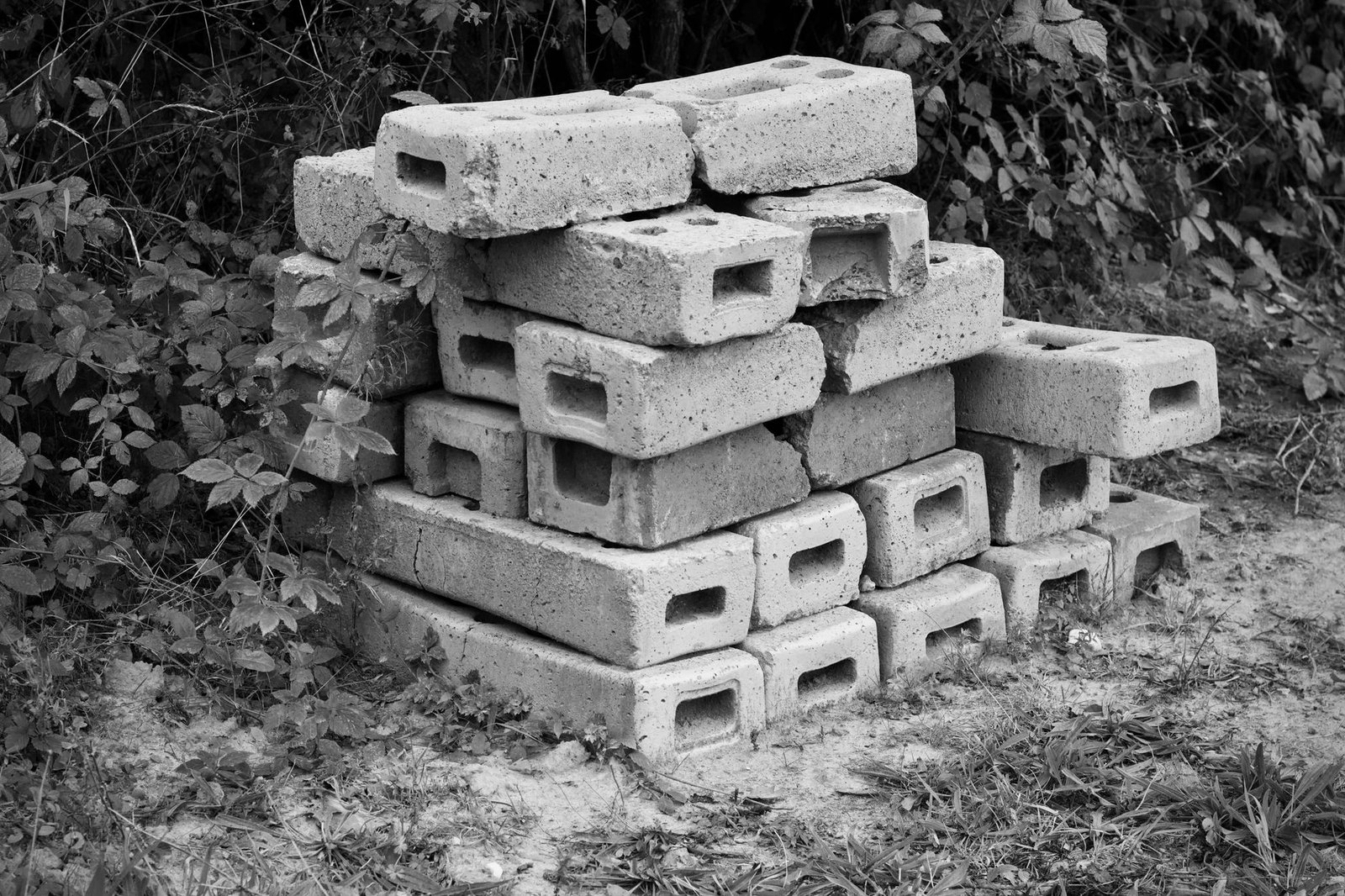
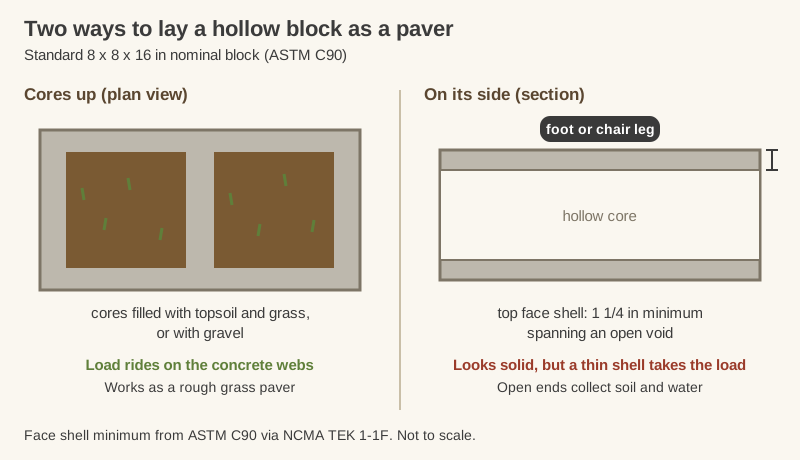
Cores up is the only orientation that makes sense. The cells take soil and grass, or gravel, and feet and tires ride on the concrete webs, the way purpose-made grass pavers work.
On its side looks tidier, but you're walking on one face shell, which C90 only requires to be 1 1/4 inch thick on an 8-inch block, spanning an empty core. The open ends fill with soil and water.
Where cinder block pavers earn their keep
- An overflow parking pad or trailer spot used a few times a month. This is the "cinder block driveway" most guides describe. It holds a car; it won't stay pretty under two cars a day.
- Garden and compost-bin paths, where a rough surface doesn't matter and the blocks are left over from a wall or a raised garden bed.
- Temporary pads: under a rain barrel, a shed ramp or a grill you plan to move.
For anything you want flat and tidy, buy real pavers; the plain gray ones are the budget pick in our cheapest pavers for a patio guide. For grass you can park on, concrete grid units are built for it; see our Turfstone pavers guide.
Laying hollow block as grass cells
Treat the blocks like any paver: dig out, compact a crushed-stone base (at least 4 inches for feet and 6 where a car parks, per ICPI), screed an inch of sand and lay them tight. Blocks dropped on bare lawn start rocking, because each one carries a tire on a narrow edge.
Borrow the grass-paver rule and stop the soil about half an inch below the concrete, so tires ride on the webs, not the grass. Use gravel in shade or where a car sits daily.
Signs it's failing: blocks rocking underfoot (a base problem) or corners spalling after the first winter (water and frost). Sealing block paving slows the water, but it can't turn a 2,000 psi unit into an 8,000 psi one.
Keep cinder block pavers for grass and garden jobs
My view: cinder block belongs in walls, not underfoot. Its standard asks for a quarter of a paver's strength and allows roughly twice the water. As grass cells for a spare parking spot, or a garden path you'll never photograph, it's fine. For a patio, it's a wall that fell over in a neat row.
FAQ
Can you use cinder blocks as pavers?
Yes, for rough jobs: grass cells for occasional parking or a garden path, laid cores up on compacted gravel. Not for a patio or daily driveway, since block only has to reach about 2,000 psi.
Can you drive on cinder block pavers?
Occasionally. Cores up, tight together, on at least 6 inches of compacted base, they'll carry a parked car. Daily traffic wears them fast, especially where it freezes.
Should cinder block pavers go cores up or on their side?
Cores up. On its side you walk on a face shell as thin as 1 1/4 inches over a hollow core.
What do you fill cinder block cores with?
Topsoil and grass seed, kept about half an inch below the top, or clean gravel where grass won't survive.


