

Last Updated on October 20, 2026 by Umar Farooq
Pavers vs flagstone patio is a choice between uniform manufactured units and natural stone that varies from slab to slab. Pavers are easier to lay flat, easier to match when one breaks and quicker for a first-timer. Flagstone is thicker in places, needs wider joints and takes more patience on the base, but no two patios look the same. Hunker puts installed flagstone at $15 to $45 per square foot and pavers at $22 to $35, so cost is a coin toss and the real question is what you want to build.
This is a decision guide. For flagstone itself (rock types, cut versus irregular) see our guide to flagstones, and for the price in detail see cost of flagstone pavers.
Cost: the ranges collide
Flagstone looks expensive and often is. Hunker says installed flagstone runs $15 to $45 per square foot against $22 to $35 for pavers, and that precast pavers cost roughly the same per square foot. EngineerFix separates the material price: standard concrete pavers at $3 to $6 per square foot and flagstone at $15 to $20 for the stone alone.
Both can be right. Plain concrete pavers are a cheap material and expensive labor. Flagstone is a pricey material and often more labor. Premium pavers and ordinary flagstone land in the same place.
A 200 square foot patio on Hunker's installed ranges is $3,000 to $9,000 in flagstone and $4,400 to $7,000 in pavers (my arithmetic on their ranges, not a bid). The flagstone range is wide because "flagstone" means a dozen different rocks.
Laying them flat: the base work
Both patios sit on compacted gravel and a thin bed of sand. EngineerFix describes a 4 to 6 inch layer of crushed stone aggregate plus a final 1 inch layer of bedding sand for pavers. ICPI Tech Spec 2 says at least 4 inches of compacted base under a patio on well-drained soil, with 2 to 4 inches more in cold climates or on wet or weak soil.
Where they differ is the top. Pavers come in one thickness, so you screed the sand to an even 1 inch, set them, and compact. ICPI Tech Spec 2 limits lippage on pedestrian routes to 1/8 inch between pavers.
Flagstone varies in thickness stone to stone. Each slab needs its own sand bed height, and you adjust by lifting, adding, and resetting. That is why a flagstone patio is slower and why I would call it a skill project, not a weekend one. Our flagstone guide says dry-laid stone works at about 1 1/2 to 2 inches thick, and thinner stone belongs mortared on concrete.
Joints decide the look and the upkeep

EngineerFix notes that pavers are laid tightly together while flagstone usually needs wider joints to accommodate its irregular edges. That one difference changes the maintenance.
Narrow, even joints take polymeric sand well. Alliance Gator's SuperSand G2 data sheet lists a joint width of 1/8 to 2 inches and a minimum joint depth of 1 1/2 inches, with the finished sand at least 1/8 inch below the paver top. A thin flagstone with a deep wide joint is outside that window, and wide gaps may need a different fill, such as pea gravel, stone dust or groundcover.
Hunker says to reapply joint sand every year or two. Wide flagstone joints mean more sand to lose and more space for weeds. Our guide to mortar in paver joints explains why mortar belongs only on a rigid concrete base, never on a sand bed.
Repairs and matching a replacement
When a paver cracks, you lift it, check the base, and set a new one of the same size. If the line is still sold, a match is easy. If you kept leftovers from the original order, it is exact.
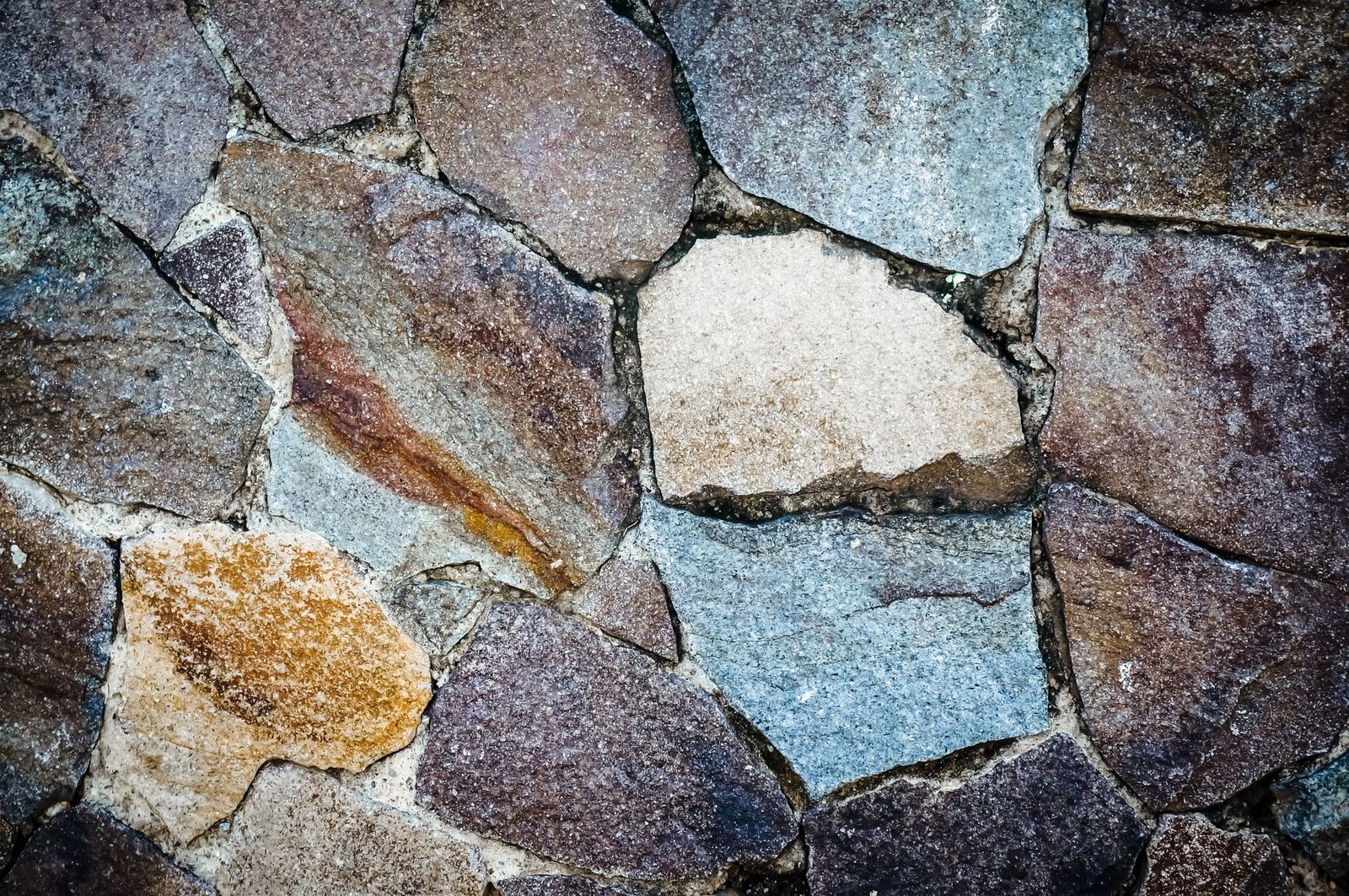
Flagstone is natural stone, so each slab is one of a kind. A cracked flagstone is lifted and replaced with another stone that approximately fits the hole, or the stone gets trimmed to suit. The patio hides this well, because variation is the point, but a stone from a different quarry shows.
What each looks like after a few winters
EngineerFix says both can last 50 years or more when properly installed. Which actually does depends on the stone and the paver:
- Pavers. The CMHA guide specification for concrete pavers requires average compressive strength of 8,000 psi, average absorption of 5%, and a freeze-thaw limit of 225 g/m² loss after 28 cycles.
- Flagstone. Sandstone, limestone and bluestone behave differently. Choose a rock proven in your climate and ask the supplier about absorption and freeze-thaw performance.
A middle path is worth knowing about. Irregular concrete pavers imitate flagstone with a uniform thickness, so you get the broken-stone look with the paver's install behavior. If the budget argument for flagstone is "it looks natural," this is the option to price first.
Choose pavers to build it, flagstone to look at it
Choose pavers if you are building it yourself, want a flat surface for furniture and a spare unit for repairs. Choose flagstone if you want a one-of-a-kind natural look, have the patience to fit each stone, and accept wider joints and a slower job. For a first patio, I would pick pavers. If the look of stone is the point, lay a pavers-first patio and edge it with a flagstone border, which gets you most of the character with far less fitting.
FAQ
Is flagstone cheaper than pavers?
Not reliably. Hunker puts installed flagstone at $15 to $45 per square foot and pavers at $22 to $35, so the ranges overlap. Flagstone stone alone is often $15 to $20 per square foot, while basic concrete pavers are $3 to $6 per square foot in materials.
Which is easier for a DIYer, pavers or flagstone?
Pavers, because they are uniform and sit on an even sand bed. Flagstone varies in thickness, so each slab needs its own adjustment and joints are wider and less even.
Do flagstone patios need sealing or joint sand?
Joints need attention on both. Hunker says to reapply joint sand every year or two. Wide flagstone joints may need a fill chosen for their width, and the sand product you use has maximum joint widths on its data sheet.
How thick should flagstone be for a patio?
For a dry-laid patio on sand and gravel, about 1 1/2 to 2 inches. Thinner flagstone belongs mortared onto a concrete slab so it does not crack.
Can you mix pavers and flagstone in one patio?
Yes. A common approach is a paver field with a flagstone border or walkway, or flagstone steps leading to a paver patio. Keep the base depth and edge restraint consistent so they settle together.


