


Last Updated on October 20, 2026 by Umar Farooq
Paver expansion joints are not something a normal sand-set patio needs inside the field. The joints between the pavers, filled with sand, already give the surface room to move. You need a deliberate gap in three places: where pavers meet something fixed (a wall, a step, pool coping), where pavers are bonded to a slab that has its own joints, and where new concrete meets old. Everywhere else, leave it alone.
Paver expansion joints depend on how the pavers are set
I looked for any guidance asking for expansion joints inside a sand-set paver field and did not find any. What I found were joints at fixed things. The answer depends on the setting method.
| How the pavers are set | Joint inside the field | Gap at fixed edges |
|---|---|---|
| Sand-set on a compacted base | Not called for. Sand joints do the work | Yes: a flexible sealant joint where pavers meet a wall, coping or concrete |
| Mortar or adhesive on a concrete slab | Yes: copy the slab's joints through the paving | Yes: against walls and other surfaces |
| New concrete apron or border beside existing concrete | Felt or mastic joint at the meeting line | Yes |
If you are not sure which one you have, scratch a joint with a screwdriver. Loose sand means sand-set. Hard gray material means mortar. The mortared case is covered in mortar paver joints.
Why a sand-set patio already has its movement allowance

CMHA's Tech Spec 10 says interlocking concrete pavements "are typically designed and constructed as flexible pavements on a compacted soil subgrade and compacted aggregate base." The pavers sit on 1 inch of bedding sand, sand is swept into the joints, and the units are compacted so that they interlock and pass loads down through the base.
A flexible pavement moves in tiny steps at every joint rather than building up force and cracking at one. Sand joints are, in effect, hundreds of small expansion joints. That is my reading of how the system works, not a quote from a standard. The edge restraint keeps the whole field from spreading, so the movement stays inside the joints. That is why paver edging matters more than any added gap. The pavers' mechanics are in interlocking pavers.
(Hundreds of tiny joints, no saw required. Sand is the least dramatic expansion joint ever invented.)
Where sand-set pavers still need a gap
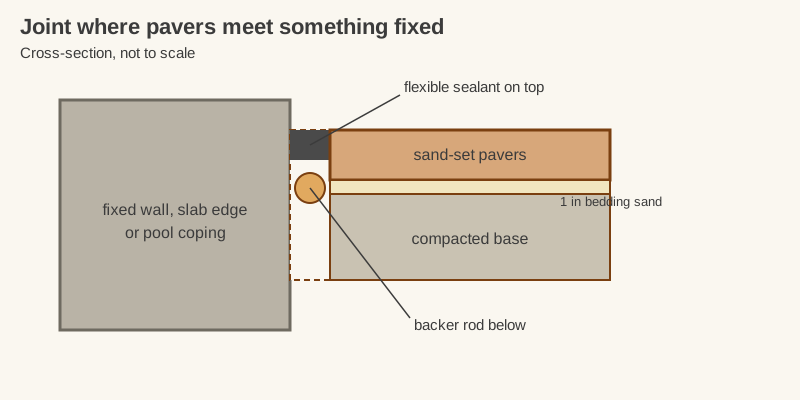
The movement problem begins where the flexible pavers touch something rigid. CMHA's Tech Spec 10 spells it out for swimming pools: "a urethane or neoprene sealant and backer rod typical to pool construction should be placed between the course of pavers and the pool coping." Its stated reason is that the joint keeps water out while "allowing for differential movement between the pool wall and the adjacent pavement." My pool deck pavers article covers the rest of the deck.
The same logic applies to any rigid neighbour. Tech Spec 10 only talks about pool coping, so the rest is my own extension, but the mechanism is identical: wherever the pavers meet something that does not shift the way they do, leave a gap and fill it with something that flexes.
- House walls and foundations. Keep a gap and fill it with sealant.
- Concrete steps and landings. The same.
- Posts and piers inside the patio. A small gap around each.
- Existing concrete slabs. A gap where the slab ends and the pavers begin.
Classic Arch, an Australian paver supplier, says the same in its installation guide for fixed paving: "there should be expansion joints between the pavers and any other products or surface."
Bonded pavers on a slab copy the slab's joints
Mortared or adhered pavers on a concrete slab are different. The paving is stuck to a rigid base, so it moves when the slab moves. Tech Spec 10 says mortared pavers should only be used in pedestrian areas in non-freeze-thaw areas, because mortared joints have a high risk of deterioration with traffic, freezing and de-icing salts. It adds that polymer adhesives made for concrete pavers can be used in freezing climates, but not for vehicular areas.
Classic Arch's guide for paving fixed to a slab recommends expansion joints "every 4 meters or roughly every 20 m2" (about 13 feet, or about 215 square feet). It also says to put control joints in the concrete sub-base and carry them "through the mortar bed and grout joint," and not to lay masonry units over any control or expansion joint. This is an Australian supplier's guide for its own products, so treat the spacing as an example and ask your own supplier for theirs. The simple rule is to cut the paving at every joint in the slab underneath.
New concrete beside old is the same idea. Concrete Network recommends a felt or mastic joint where new concrete meets existing concrete, for example at a concrete apron or border.
What goes in the gap
Use backer rod and a flexible sealant, as the pool coping guidance says. Backer rod is a round foam cord that sets the depth, so the sealant bonds on two sides and stays stretchy instead of three and tearing.
Do not use these:
- Polymeric sand. It hardens, and it is designed for joints with compactable sand and drainage, not for a moving gap. My article on polymeric sand for concrete cracks explains why control and expansion joints are better filled with backer rod and sealant.
- Mortar. It is rigid, which is the opposite of what the gap is for.
- Nothing at all. An open gap collects dirt and water, and incompressible grit stops the joint moving.
Fill the gap after the pavers are laid and compacted, so the final settling is done before the sealant cures.
Give the fixed things a gap and leave the sand alone
Do not cut expansion joints into a sand-set field. Spend the effort where the pavers meet something fixed, and carry the slab's joints through any bonded paving. Backer rod and flexible sealant are cheap, and the failure they prevent is a cracked coping or a lifted corner. Everything else is sand, restraint and compaction, doing what they were always going to do.
FAQ
Do pavers need expansion joints?
Not inside a sand-set field, as far as I could find: the sand joints give the surface room to move. They do need a flexible joint where they meet fixed structures such as walls, steps and pool coping, and bonded pavers on a slab need the slab's joints carried through.
How far apart should paver expansion joints be?
For pavers fixed to a slab, one Australian supplier, Classic Arch, recommends joints every 4 meters or about every 20 square meters (roughly 13 feet or 215 square feet). I found no spacing for sand-set pavers because none is called for.
What do you put in a paver expansion joint?
Backer rod with a flexible sealant on top. CMHA's Tech Spec 10 names a urethane or neoprene sealant and backer rod for the joint between pavers and pool coping.
Can you use polymeric sand in an expansion joint?
Polymeric sand is meant for joints between pavers that drain and compact. It is the wrong choice for a gap that has to keep moving, which is better filled with backer rod and sealant.
Do pavers over a concrete slab need expansion joints?
Yes. Pavers bonded to a slab move with it, so cut the paving at the slab's control and expansion joints rather than laying over them, and fill the cut with flexible sealant.


