

Last Updated on October 20, 2026 by Umar Farooq
Marble pavers are cut slabs of natural marble, a carbonate stone, used outdoors for pool decks, patios and walkways, and they are one of the few stones that looks expensive in a photo and still looks expensive in person. They are also soft, porous and chemically sensitive, so a good result depends on three choices: a textured finish rather than polished, a rigid bonded base rather than loose sand, and a climate or maintenance plan that respects what marble does when it freezes or meets acid. Get those right and marble works. Get one wrong and it is an expensive lesson in geology.
I read two buyer's guides from one supplier, a second supplier's installation notes and the ASTM marble standard, and I went looking for the part the sales pages skip. They mostly skip the same part. For where marble sits among the other stones, see our natural stone pavers guide.
What marble is, and the chemistry that decides its outdoor life
ASTM C503 covers marble dimension stone for building use and sorts marbles into two classes, calcite and dolomite (ASTM C503). The abstract lists the properties a marble must meet, including absorption, density, compressive strength and abrasion resistance. It does not print the limits, so the numbers live in the full standard, and your supplier should be able to quote them.
The part that matters for a patio is carbonate chemistry. A research paper on protecting outdoor stone says marble and limestone are especially vulnerable because carbonate minerals react with acidic substances, including acidic air pollutants and carbon dioxide dissolved in water (PMC11857110). NT Pavers' care advice agrees in practical terms: pH-neutral cleaner only, and no bleach or acidic cleaners, which can dull the surface (NT Pavers).
That is etching in plain English. A splash of something acidic does not leave a stain you can scrub out. It leaves a dull patch where the polish used to be. (Lemon in a pool-side cocktail is a stone-care event.)
Granite ignores all this. Marble does not.
Finishes: which marble face is safe when it rains
Finish is the first thing to decide, because it decides grip.
| Finish | What it looks like | Outdoor use |
|---|---|---|
| Polished | Glossy | Not recommended. NT Pavers says it is slippery when wet |
| Honed | Matte, velvety | Better grip than polished |
| Tumbled | Rough, aged edges | Suits pools and patios |
| Brushed | Wire-brushed, aged look | Better slip resistance |
| Sandblasted | Textured | The standard pool-deck finish at Stonelux |
| Bush hammered | Rugged with 1 to 3 mm pitting | Non-slip, used around pools |
Stonelux adds a line I appreciated: "No natural stone surface should be treated as slip-proof." Actual performance depends on finish, slope, drainage, cleaning, sealing and site conditions. So choose a textured face, then slope the deck so water leaves it. Slope first, finish second.
Heat and colour: marble runs cooler than concrete, with a catch
NT Pavers says marble reflects sunlight and stays cooler than concrete or asphalt, and that light stones such as Afyon Ice and Snowshadow suit pool decks while greys hide dust better. That is a supplier claim and I did not find a measured temperature comparison, so treat it as direction, not data. Our pavers that don't get hot guide compares materials more fully.
The catch is dirt. White marble shows it, and the same guide says gray tones hide dust and minor stains better. Pick the colour for the life you actually lead, not the one in the showroom.
Freezing weather: where the sales pages go quiet
NT Pavers says marble can handle freeze-thaw cycles and links that to low porosity. In another article on the same site, the same supplier describes marble as porous and calls freezing winters harsh on exterior marble. Both statements sit on its pages, and neither gives test data. I would not treat them as settled.
Stonelux is more careful. For Mid-Atlantic and Northeast freeze-thaw conditions it says base preparation, drainage, slope, setting method, movement joints, sealing and maintenance are especially important. That reads like an installer who has seen what happens when they are not. If winters freeze where you live, ask for the supplier's absorption figure and frost data before you pay, and avoid deicing salt. NT Pavers recommends a non-corrosive ice melt, and salt is a problem for stone.
Bonded to a slab, not dropped on sand
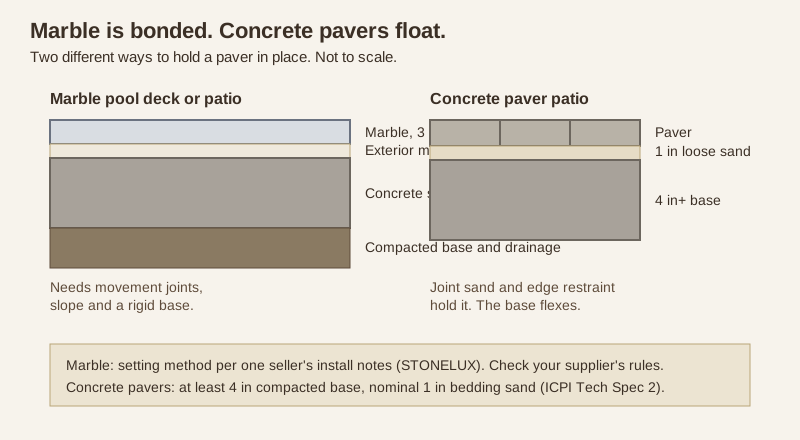
Here is the one strong opinion in this article. If you want a patio you can build in a weekend on gravel and sand, marble is the wrong stone. Concrete pavers are made for that build and marble is not.
Stonelux's requirement is blunt. Its marble pavers must be permanently bonded over a properly designed concrete or approved cementitious base, using an exterior-rated wet-set or approved white polymer-modified mortar. Installation over sand, gravel, stone dust, soil or turf is not approved. That is one seller's rule, and other installers may do things differently, but it tells you what the supplier will stand behind.
The mechanism is easy to guess at but I could not find a source that states it, so I will not claim one. What I can say is that the concrete-paver build in our paver base guide, with at least 4 inches of compacted stone and a nominal 1 inch of loose bedding sand (ICPI Tech Spec 2), is a different system from a bonded slab, and the two should not be mixed on one deck without an installer who knows both.
Thickness follows the system. Stonelux lists 3 cm (1 3/16 inch) and 5 cm (2 inch) pavers. NT Pavers puts outdoor marble at about 1 1/4 to 2 inches.
Sealing marble, and what a sealer will not do
Both suppliers recommend sealing exterior marble. Stonelux says to seal after installation and after the setting system's cure time, with a penetrating, breathable sealer, tested on a small area first. The intervals disagree. NT Pavers' care page says a penetrating sealer once or twice a year, and its quartzite comparison says two or three times a year. Stonelux gives no interval.
I would not follow any calendar. Seal when water stops beading on the surface, as we explain in how often should pavers be sealed. And do not assume a sealer makes marble acid-proof. None of the suppliers I opened say it does, and the research paper treats protective coatings as a way of shielding stone, not making it immune.
What marble costs, and what the quotes tend to leave out
Cost guides differ. Our travertine pavers guide reports Pool Research putting marble at $15 to $40 per square foot for the stone alone, and NT Pavers says even its lower-priced marbles cost more than many alternatives. Grade matters: NT Pavers describes four grades by blemish, from commercial with the most veining and discoloration to first grade with the fewest, and the higher grades cost more.
The stone is not the whole bill. A bonded install needs a slab, mortar, movement joints and labour that is not the same as setting concrete pavers. That is my own reasoning from the setting method above, not a priced quote, so get one.
Cheaper first, as always: porcelain or travertine will give you a similar look with fewer rules. Use marble for a pool deck or a feature area, and put concrete pavers on the rest.
Marble for a bonded pool deck, concrete pavers for everything else
Marble pavers are worth it where looks and cool feet matter most and where someone will bond them properly: pool decks, courtyards and entries in mild climates. Choose a sandblasted, tumbled or honed face, buy the supplier's frost and absorption data, seal it when water stops beading and keep acid off it. For a dig-it-yourself patio on a gravel base, use concrete pavers and enjoy your weekend. Marble will still be there for the day you want to impress someone. It just needs a slab.
FAQ
Are marble pavers good for patios?
Yes, in the right conditions. They look excellent and run cooler than concrete, but they are soft, porous and sensitive to acids, so they suit mild climates and a bonded installation better than a loose sand-set patio.
Are marble pavers slippery when wet?
Polished marble is. Tumbled, sandblasted, brushed and bush-hammered finishes give better grip, but no natural stone should be treated as slip-proof. Slope and drainage matter as much as the finish.
Do marble pavers need sealing?
Both suppliers I read recommend a penetrating, breathable sealer. They disagree on how often, so seal when water stops beading and test a small area first. A sealer helps with stains but should not be relied on to stop acid etching.
Can marble pavers be used in freezing climates?
Sometimes. Suppliers disagree and I found no test data. Ask for absorption and frost-resistance figures, build the base for drainage, add movement joints and avoid deicing salt.
How thick should marble pavers be?
Stonelux sells 3 cm (1 3/16 inch) and 5 cm (2 inch). NT Pavers puts outdoor marble at about 1 1/4 to 2 inches. Thicker units cope with heavier loads and a less perfect base.
Do marble pavers get hot in the sun?
Suppliers say marble stays cooler than concrete or asphalt, and lighter colours cooler still. I found no measured comparison, so check a sample in your own sun before you commit.


