Last Updated on October 20, 2026 by Umar Farooq
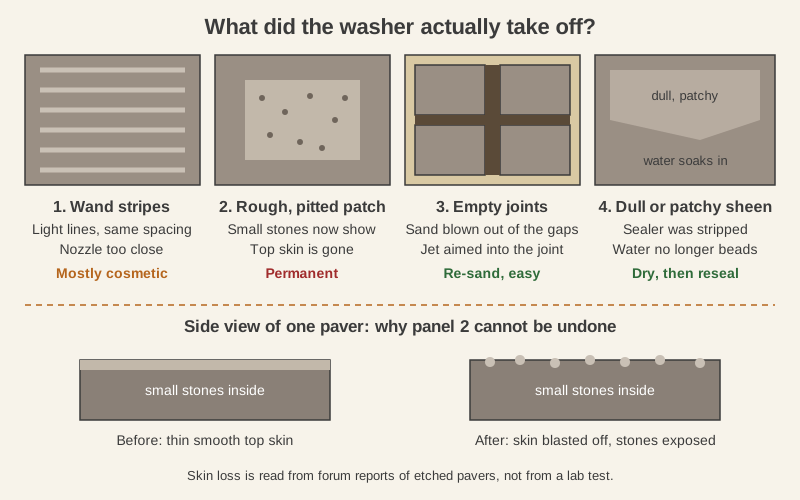
Pressure washer damage to pavers comes in four kinds, and only some of it can be undone. Stripes and a dull sheen are cosmetic or fixable, and empty joints are fixed by re-sanding once everything is dry. A rough, pitted patch where tiny stones now show is permanent, because the thin top layer is gone. Put the washer away first: the common instinct, more pressure to even it out, is the one move the sources warn against.
I read five pages on this. None explains how to repair the damage; they all explain how to avoid it. This page is the other half.
Read the marks before you touch anything
Look at the patio when it is dry, from a low angle. In a forum thread about a patio etched with a turbo nozzle, the damage showed most when the pavers were dry, so a wet patio flatters the problem.
| What you see | Most likely meaning | Fixable? |
|---|---|---|
| Parallel lighter lines, evenly spaced | Nozzle too close or moved too slowly | Mostly cosmetic |
| Rough, lighter patch with tiny stones showing | Top skin blasted off, aggregate exposed | No: mask or replace |
| Hollow joints, pavers wobble | Sand blown out by a jet aimed into the gap | Yes: re-sand |
| Dull, patchy sheen, water soaks in | Old sealer stripped in places | Yes: clean, dry, reseal |
The sources agree on this list. AOL names etching, cracks, removed joint filler, stripped seals and discoloration. The Paving Superstore director quoted by Gardeningetc adds pitting and lines. PureSeal says a nozzle held too close leaves stripes or etching, and too much pressure can chip stone or expose aggregate.
Gardeningetc, citing Install Direct, also says paving under a year old is more likely to be damaged. No source gives the reason, so I'll only say: go gentler on a new patio.
Which pit marks stay forever?
The pitted patch is the hard one. A member of that forum thread explains that once the top layer is off, the aggregate underneath is exposed. The thread's options were: replace the pavers, carefully level the neighbours up to the polymeric sand lines so the patch blends in, run a surface cleaner over the whole patio, or leave it, since another member said it becomes less obvious as the stones weather. That is one anecdotal thread, not a technical bulletin.
I looked for a source on grinding, honing or re-coloring an etched concrete paver and found none I could open and trust. So there is no polished fix here. The honest choices:
- Leave it. A small patch on an otherwise weathered patio narrows with time and foot traffic.
- Replace the worst pavers. Pavers are the one surface you can lift, swap and relay. Use spares from the original pallet if you kept any, and follow replacing a broken paver.
- Even out the whole patio. A surface cleaner at a safe distance makes the field uniform rather than fixing the patch.
Joints first, because they are the easy win
Blown-out joint sand is the most repairable result. Kärcher's guide says that aiming the jet into joints also removes joint material, so sand may need refilling. Let the patio dry completely, clear loose debris from any partly empty joint, and refill. Re-sanding pavers has the steps.
When the sealer went with the dirt
PureSeal and AOL both list stripped sealer. Test it by pouring a little water on the area. If it soaks in and darkens where it used to bead, the film is worn there. Clean that patch, let it dry completely, and reseal only what the water drop calls bare. Sealing old pavers walks through the test.
Popular fixes that make it worse
- Another pass to blend it in. Members of the forum thread warned that blending marks with the same nozzle can cause more damage.
- Washing again in freezing weather. PureSeal says water driven into porous stone can cause frost damage, and advises against jet washing in frost.
- Acid on the marks. My inference, not a sourced finding: acid works by taking material off, and material is what you are already missing. No source I found recommends it for etching.
Prevent pressure washer damage to pavers: start wide, far and low
The numbers differ by source. Western Interlock says about 1,500 PSI is best for hardscape, and if your washer cannot be adjusted, hold the wand at least 24 inches away with the widest tip, after testing a few stones. Our sibling guide, power washing pavers, uses 1,200 to 1,800 PSI at about 12 inches, citing a masonry contractor. Kärcher gives about 6 inches, but that is for its own rotating nozzle. Unilock says to keep the spray angle at 30 degrees or less. Nobody agrees on one distance, so start far, wide and low, and test a hidden paver.
My opinion: the cheapest tool is the right first tool. Unilock suggests a soft-bristled brush for stubborn spots and a hose, or a washer on a low setting, for rinsing. A turbo nozzle is where the forum thread started. If you do rent a washer, rent a rotary surface cleaner with it, because it holds the nozzle at a fixed height and ends the stripe problem.
Stripes fade, pits stay: stop at the first mark
Pressure washer damage to pavers is usually one afternoon's mistake, not a ruined patio. Joints and sealer are a weekend's repair, a small pitted patch weathers or gets swapped, and nobody reads the stripes from the garden chair. The one thing that makes it worse is another pass. (The patio has had its edit. It does not need a second draft.)
FAQ
Can you repair etched pavers?
Not really. Once the top layer is off and the aggregate shows, you can replace the pavers, let them weather, or even out the surrounding area. I found no source for grinding or polishing concrete pavers.
Will pressure washer marks go away on their own?
One forum reply says the marks become less obvious as the stones weather, but nothing I opened gives a timeline. Stripes are the most likely to blend.
What PSI is safe for pavers?
Western Interlock suggests about 1,500 PSI with a wide tip, and at least 24 inches of distance if the pressure cannot be adjusted. Other guides give different figures, so test a hidden paver first.
Did the pressure washer ruin my polymeric sand?
It may have removed it. Kärcher notes that spraying into joints removes joint material. Let the pavers dry, clear the gaps and re-sand.
Is it okay to pressure wash new pavers?
Gardeningetc, citing Install Direct, says newer paving is more likely to be damaged than older paving, so use a wider tip, more distance and a test patch.