
Last Updated on October 20, 2026 by Umar Farooq
Pavers around window well openings come down to three rules: set the finished height from the well lip, not from the door, keep the ground and the pavers falling away from the house, and keep the drain at the bottom of the well reachable. Pave right up to the well, and do not pave over it. For the strip right beside the well, a loose paver border with no adhesive lets you lift it out when the drain or the gravel needs attention.
A window well is the one hole in your patio that has a basement on the other end.
Set the height from the well lip
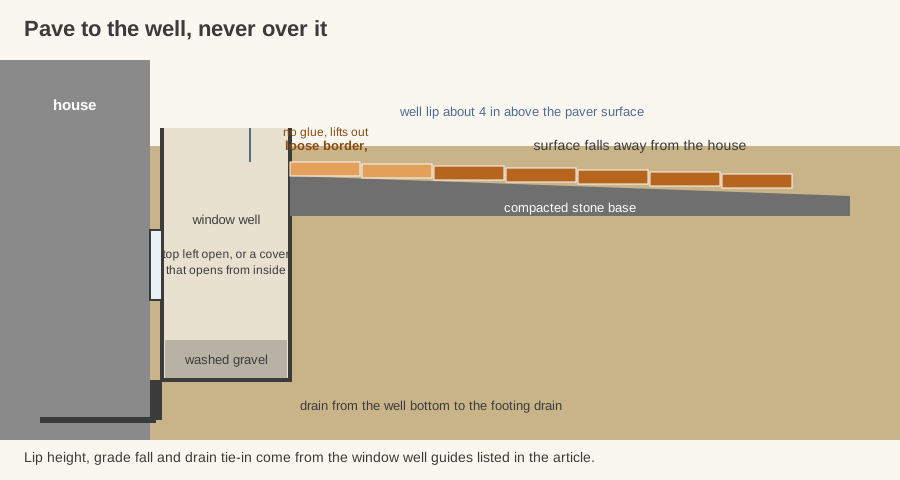
One guide for window wells says the well's lip should rise 4 inches above grade, and that the ground around the wells and house should drop at least 5 percent away from the building, ideally 1 inch per foot. A patio changes that grade, which is where trouble starts.
My arithmetic, using ICPI's figures: 4 inches of compacted base, 1 inch of bedding sand and a 2 3/8 inch paver add up to about 7 3/8 inches of finished build (ICPI Tech Spec 2; CMHA Tech Spec 10). If you lay that on top of the old ground without digging, the patio rises about 7 inches and swallows a 4-inch lip. So excavate the full build depth, and set your string lines so the pavers finish at the old grade, with the lip still standing up from the surface.
The building code adds the fall. The IRC wants grade to fall at least 6 inches within the first 10 feet from the foundation, and impervious surfaces within 10 feet to slope at least 2% away from the building (R401.3; model code, so check with your local building department). Our pavers around house foundation guide covers the rest of the strip beside the wall.
Find what is down there before you dig
Window wells sit close to the footing drain, utility lines and often a downspout. Call 811 a few days before you dig and hand-dig near the marks (see call 811 before digging).
Then check what the well already does. A window well gravel guide from DG Floors says wells without a drain are prone to pooling and that the best option is a connection to the footing drain, and that decorative pavers over a gravel base look tidy but still rely on the stone beneath for drainage. It also says clay performs poorly if you hope the gravel will soak water away.
An installer's note from Lexington, Massachusetts, describes two new window wells that kept flooding in clay: the ground around them had been dug up and refilled with loose material, so surface water drained into it. The fix was to remove the loose clay, dig below the well, and fill with crushed stone to make a dry well, which also served as the patio base, with the pavers pitched away from the house. That is one case from an installer, not a rule, but it shows what to look for: loose backfill beside a well is a funnel.
Pave to the well, never over it
If the window is a bedroom or basement egress window, the cover rules matter. A city tip sheet quoting the 2018 IRC says bars, grilles, covers and screens over a window well must be releasable or removable from the inside without a key, tool, special knowledge or force beyond normal operation, and it gives the well's minimum size as 9 square feet with at least 36 inches of projection and width (R310.4 and R310.3.2 in that edition). Another guide says wells need at least 30 inches of clearance; the code figure and that figure differ, so go by your local code.
So my firm opinion: pave to the well, never over it. A paver lying on top of the opening is not a cover that opens from the inside. Leave the well open, or use a cover made for it that releases from inside, and check what your building department requires. If the well is not an egress well the rule may differ, so ask.
Lay the pavers and the border
- Excavate the full depth to the grade you set from the lip, and keep the surface falling away from the wall.
- Compact the base in thin lifts and keep it solid right up to the well wall. Soft stone beside a rigid well is the first place a patio dips.
- Cut the pavers to the well's shape, cutting wet (OSHA's rule for masonry saws is water on the blade).
- Make the strip next to the well a loose border. Lay it on the same base and sand, but do not glue it and do not spike restraint through it. Then you can lift it with a flat bar when the gravel needs refreshing or the drain needs a look.
- Keep downspouts away. The window well guide says downspouts should never discharge near or uphill of a well. Our downspout drain under patio guide covers where to send roof water instead.
The loose border is my design suggestion, not a published method. Its logic is simple: a glued ring is a repair you will have to break.
Habits that only move the water around
- A patio that pitches toward the well. Water has to go somewhere, and the well is a hole.
- Pavers that cover the drain access. The drain cap needs to be reachable.
- Gravel with no drain. It holds water, it does not remove it, especially in clay.
When the job stops being a paver job
- Water is already coming in through the window or the wall. Fix the source before you pave.
- The well needs a new drain tie-in to the footing drain. That means digging at the foundation.
- The wall or well has cracked or is leaning.
Pave to it, grade away from it, keep it reachable
Pavers around a window well work when the height is set from the lip, the ground falls away from the house, the drain stays reachable, and the top stays open. Get those right and the well is just another edge. A patio with a clean border around a well is a patio that will not need to be torn up.
FAQ
Can you put pavers around a window well?
Yes. Pave right up to the well, set the surface lower than the lip so water does not run in, and keep the ground falling away from the house.
Can you cover a window well with pavers?
Not if it is an egress window. Covers over egress wells must open from the inside without a key, tool or special knowledge, which a paver lying on top does not. Check your local code.
How high should a window well be above the pavers?
One guide says the lip should rise 4 inches above grade. Excavate the full paver build depth so the lip is not buried.
Should a window well have a drain?
The best option, according to a window well gravel guide, is a connection to the footing drain. Wells without a drain tend to pool, especially in clay.
How much space do you need around a window well?
It depends on whether it is an egress well. The IRC edition one city quotes calls for at least 9 square feet and 36 inches of projection and width, while another guide says 30 inches. Follow your local code.