Last Updated on September 23, 2026 by Umar Farooq
Paver patterns are the arrangements pavers are laid in, and after reading more manufacturer pattern catalogs than any reasonable person should, I can report that five cover nearly every patio, walkway and driveway: running bond, stack bond, basketweave, herringbone (at 90 or 45 degrees) and multi-piece modular patterns. Herringbone is the strongest because every paver interlocks with its neighbors in two directions, so it is the default for driveways. Running bond is the easiest all-rounder for patios and walks. Stack bond and basketweave look tidy but are weaker, so keep them to foot traffic.
The pattern affects three things: how well the surface resists shifting, how many cuts you make, and how the space looks. Below I compare them on all three. For shapes, zones and features, see the paver patio designs guide.
Seven paver patterns at a glance
| Pattern | Paver shape | Strength under load | Cuts at edges | Best for |
|---|---|---|---|---|
| Running bond | rectangle | good | few | patios, walkways, pool decks |
| Stack bond | rectangle or square | weakest | fewest | modern patios, foot traffic |
| Basketweave | rectangle (2:1) | fair | few | traditional patios, walks |
| 90° herringbone | rectangle (2:1) | high | moderate | patios and driveways |
| 45° herringbone | rectangle (2:1) | highest | many | driveways, formal patios |
| 2-piece pattern | two rectangles or squares | good | few to moderate | patios |
| 3-piece modular | three sizes | good | moderate | patios, natural-stone looks |
"Strength" here means resistance to pavers creeping and rotating when loads push on them. Every pattern is strong enough for a patio if the base is right. The differences start to matter under car tires, which push, turn and brake, usually while someone is looking at their phone.
Running bond: the easy all-rounder
Running bond is the brickwork pattern: rectangular pavers in straight rows, each row shifted half a paver so the joints never line up across rows. It is the simplest pattern to lay after stack bond, wastes little on a rectangle, and looks at home everywhere. It is the beige chinos of paver patterns, and I mean that as a compliment.
Western Interlock's pattern guide rates it as more structural than stack bond or basketweave, because the offset rows let each paver bear on two below it.
Direction is the one design decision. Rows across a walkway make it look wider; rows along it make it look longer and draw the eye to the door. On a patio, run rows parallel to the house for a calm look, or at 45 degrees for movement, at the cost of cutting every edge paver.
The trade-off: the long, continuous joints give it less interlock in the direction they run. For driveways, most installers pick herringbone instead.
Stack bond: clean lines, least interlock
Stack bond sets every paver in line with its neighbors, so joints run straight both ways like a grid. With large-format pavers it looks sharp and modern, and it needs the fewest cuts of any pattern on a rectangle.
It is also the weakest pattern. With continuous joints both ways, nothing locks one row to the next, so pavers can slide along the joint lines. Keep stack bond to foot traffic, on a flat, well-compacted base, with solid edge restraint all around.
Stack bond also shows every mistake. A joint line that wanders even slightly is obvious from across the yard (and from the upstairs window, which is where your in-laws will spot it), so snap string lines often.
Basketweave and its variations
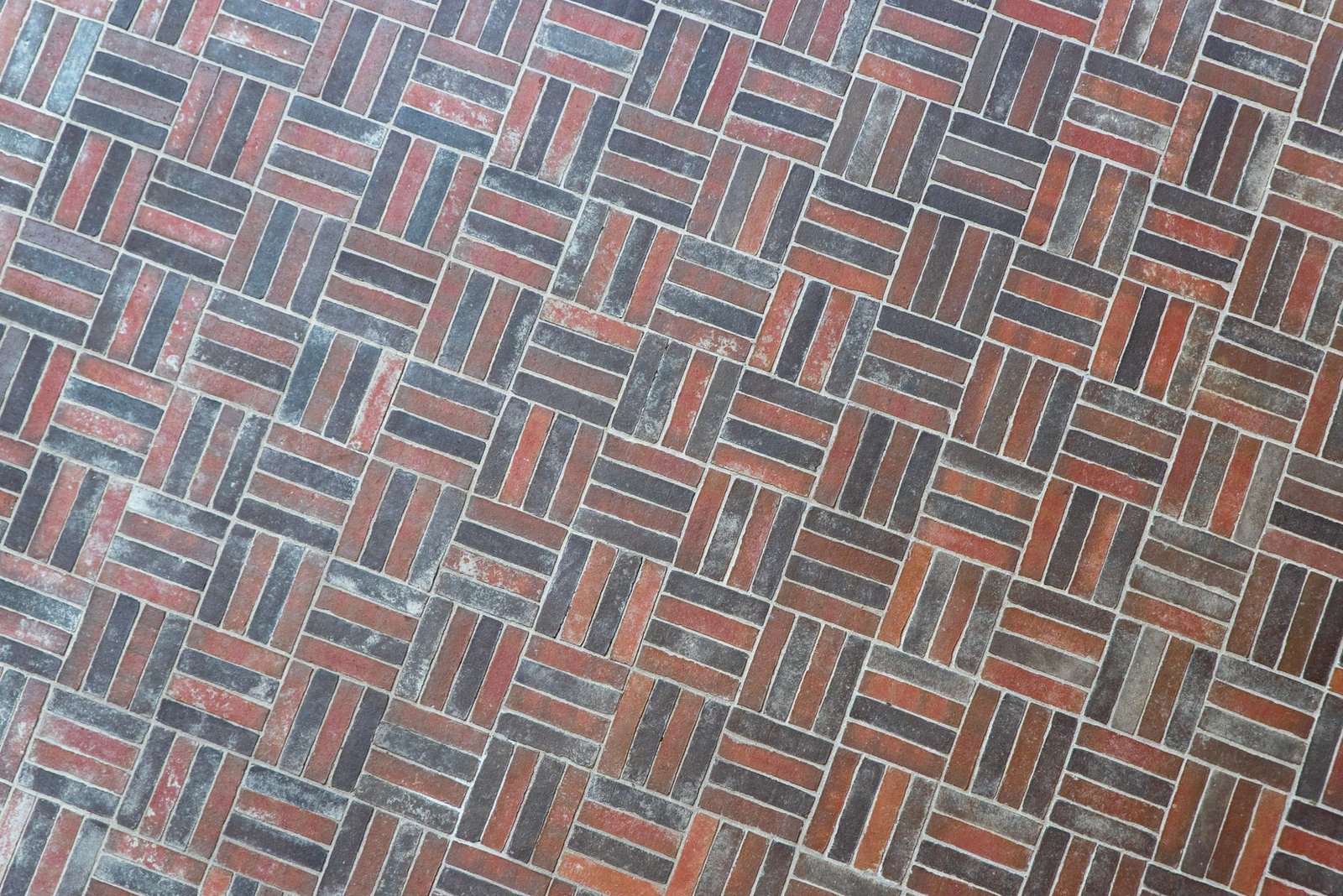
Basketweave pairs two rectangular pavers side by side to make a square, then turns the next pair 90 degrees. It looks like woven cane and suits colonial, Tudor and cottage-style houses.
It only works with pavers exactly twice as long as they are wide, including the joint, such as 4 x 8 inch pavers. Variations include:
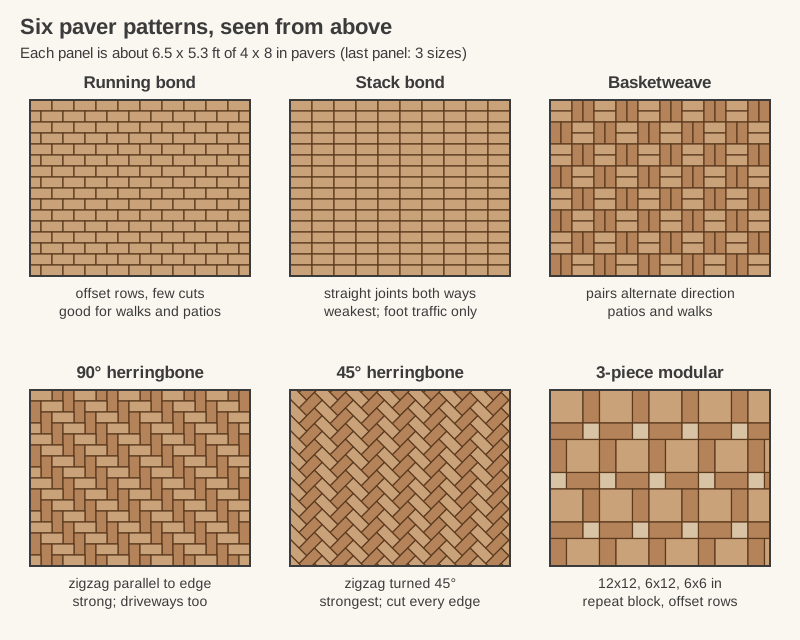
- Single basketweave: pairs alternating direction, as in the diagram above.
- Triple basketweave: three pavers per block instead of two, for larger squares.
- Basketweave with a border: each block framed by a single soldier row, often in a second color.
Basketweave interlocks better than stack bond but not as well as running bond or herringbone, so it belongs on patios and walks rather than driveways.
Herringbone at 90 and 45 degrees
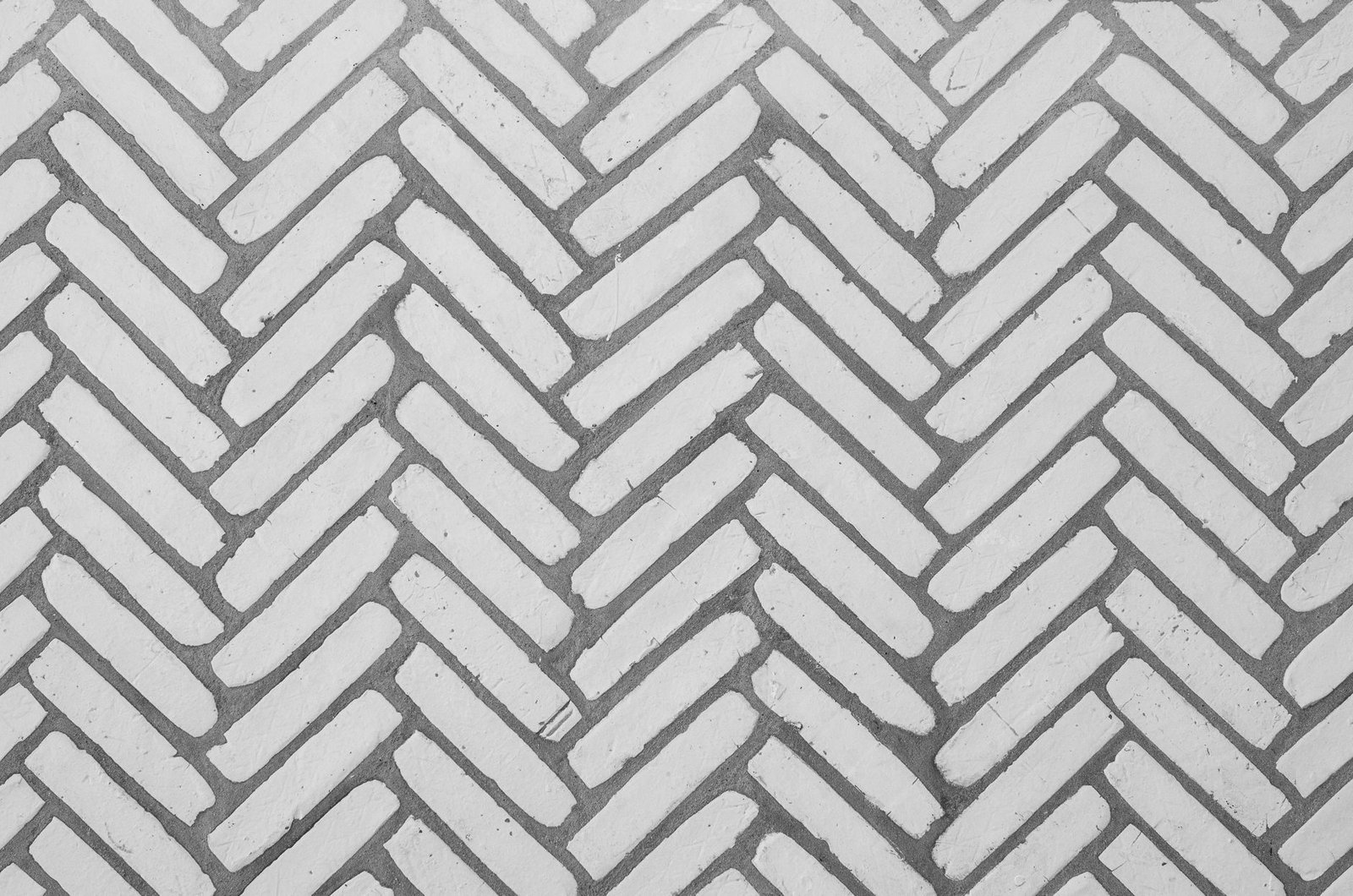
Herringbone sets rectangular pavers in a zigzag of L-shapes, so every paver's end butts against the side of its neighbor. No joint runs more than about one and a half paver lengths in a straight line, and that is what makes it the strongest paver pattern for vehicle traffic. Western Interlock calls it "by far the most structural pattern," and Belgard's pattern guide recommends it for heavy traffic. I checked a handful of other manufacturers hoping for a dissenting view. There isn't one.
There are two versions:
- 90° herringbone. The zigzag runs parallel to the edges. Edge cuts are moderate, and each alternating edge paver gets a straight cut.
- 45° herringbone. The zigzag is turned 45 degrees to the edges. It is marginally stronger for driveways because no joint lines up with the direction cars travel, and it looks more formal. The price is a diagonal cut on almost every edge paver.
For a driveway, many installers use a 45° herringbone field with a soldier-course border, so the triangular cuts disappear against the border. Our paver driveway installation guide covers the base and edge details that driveways need on top of the pattern.
Getting herringbone started is the hard part. Snap a string line, lay a short "starter" run of L-shapes along it, and check it with a square before you build out. A herringbone that drifts a few degrees becomes a slanting zigzag across the whole patio, and it will not drift back.
2- and 3-piece paver patterns
Multi-piece patterns use two or three paver sizes from one product line, laid in a repeating block. They give the random look of cut stone without the cutting, which is why pallets come pre-mixed in the right ratio.
- 2-piece patterns usually pair a square with a rectangle (such as 6 x 6 and 6 x 9 inches) in alternating rows or a pinwheel.
- 3-piece patterns add a third size, often a large square, a rectangle and a small square in a repeating block (the modular panel in the diagram). Offsetting each row of blocks breaks up the grid.
- I-pattern and K-pattern pavers are single-shape interlocking pavers with shaped sides (an "I" or dog-bone outline, or the German "Muster K" layout). They lock mechanically on all sides and are common in commercial and driveway work.
Two rules make these patterns work:
- Follow the manufacturer's layout sheet. The ratio of sizes on the pallet matches a specific pattern. Invent your own and you run out of one size.
- Pull from several bundles at once. Pallets vary slightly in color, so mixing from three or four bundles avoids blotches.
Western Interlock notes that its 3-stone I pattern works for foot and vehicle traffic, and the same logic applies to most modular sets: the mix of sizes breaks up continuous joints.
Cuts and waste by pattern
Every pattern needs cuts where it meets an edge, a wall, a drain or a curve. How many depends on the pattern and how it meets the edge:
| Pattern | Typical extra to order |
|---|---|
| Running bond, stack bond, basketweave on a rectangle | 5 to 10% |
| 90° herringbone | about 10% |
| 45° herringbone or any pattern laid on a diagonal | 10 to 15% |
| Curved edges with any pattern | 15% or more |
These are ordering allowances, not rules. I looked for a standards body that publishes waste by pattern and found only supplier calculators. Curves, obstacles and a first project all push the number up.
Two ways to cut less:
- Size the patio to the pattern. Lay a dry row of pavers and adjust the patio's width by an inch or two so the field ends on a full paver.
- Use a border. A soldier or sailor course around the edge gives the field a straight line to meet, and the small cuts sit against it. Our how to cut pavers guide covers the saw and the marking.
Never finish the edge with a sliver less than one-third of a paver. Small pieces work loose and wander off. Shift the pattern or cut two pavers to medium sizes instead.
Choosing paver patterns for patios, walkways and driveways
Match the pattern to the traffic first, then to the look:
- Driveway or parking pad: 45° or 90° herringbone, or an interlocking I-pattern. Avoid stack bond and basketweave.
- Walkway: running bond is the easy choice, with herringbone for a formal front walk. Running bond also handles gentle curves well.
- Patio, traditional house: basketweave, running bond or a 3-piece pattern in a tumbled paver.
- Patio, modern house: stack bond or running bond with large, smooth pavers and narrow joints.
- First project: running bond. It forgives small errors that stack bond and herringbone would show.
You can also combine paver patterns in one space. A herringbone field with a soldier border, or a 3-piece field with a basketweave "rug" under the table, adds interest without looking busy, as long as the colors stay related.
One check before you order: herringbone and basketweave need 2:1 pavers, and multi-piece patterns need the exact sizes from one product line.
Pick the pattern for the traffic, then the look
For most homeowners, the decision is short. Use running bond for an easy, good-looking patio or walkway. Use herringbone, ideally at 45 degrees, whenever cars will drive on it. Save stack bond for modern patios with foot traffic, and basketweave for traditional ones. Choose multi-piece paver patterns for a natural-stone look, and lay them exactly as the manufacturer's sheet shows.
The one thing I won't hedge on: whichever pattern you pick, it needs a solid edge restraint, spiked into the base, a concrete toe, a curb or a house wall. Not the lawn. Without a restraint the field is free to spread, so the outer row rolls, the joints open, the sand washes out, and even the finest herringbone starts heading for the grass.
Snap the string line, and remember that the first ten pavers decide how the last thousand line up. No pressure.
FAQ
What is the strongest paver pattern?
Herringbone, especially at 45 degrees. Each paver locks against the sides of its neighbors, so no long joint lines line up with traffic. That makes it the standard choice for driveways.
What is the easiest paver pattern to lay?
Stack bond, closely followed by running bond. Running bond is the better choice for a first project, because its offset rows hide small alignment errors that a stack bond grid would show.
Which paver pattern uses the fewest cuts?
Stack bond and running bond laid parallel to the edges of a rectangle. Anything laid at 45 degrees, including 45° herringbone, needs a cut on almost every edge paver.
Is running bond good for a driveway?
It works for light residential use if the base is right, but herringbone is the better choice because it resists the turning and braking forces of tires. If you do use running bond, run the rows across the direction of travel.
What is a 3-piece paver pattern?
A pattern made from three sizes of paver in one product line, usually a large square, a rectangle and a small square, laid in a repeating block. It gives a random, cut-stone look without cutting, as long as you follow the manufacturer's layout.
Can you mix paver patterns in one patio?
Yes. A different pattern for the border, or a contrasting "rug" of a second pattern in one zone, works well. Keep the paver colors related and change patterns only at a clear line, such as a border row.