Last Updated on September 23, 2026 by Umar Farooq
Standard paver thickness is 2 3/8 inches (60 mm), a number I've now read in so many spec sheets that I see it when I close my eyes. That's the thickness for patios, walkways, pool decks and most residential driveways. Pavers that carry regular or heavier vehicle traffic step up to 3 1/8 inches (80 mm). Thin pavers of about 1 1/4 inches (30 mm) are made for overlaying an existing concrete slab and only for foot traffic. Porcelain pavers are thinner still, at roughly 3/4 inch (2 cm).
Thickness is only one part of the strength of a paver surface. The shape of the paver and the base underneath matter just as much.
Paver thicknesses at a glance
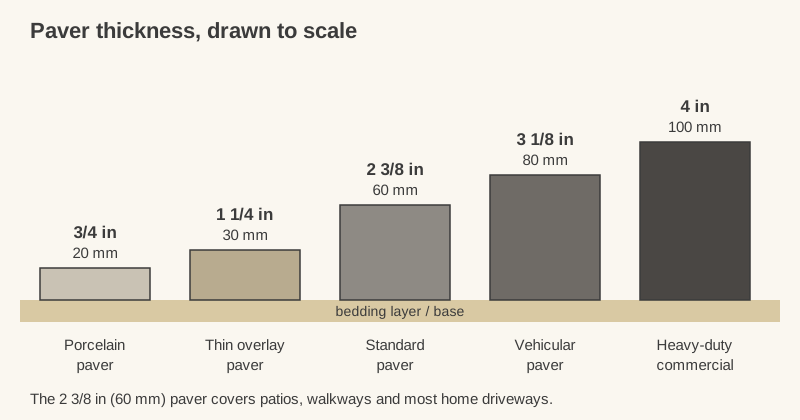
| Thickness | Metric | Typical product | Use |
|---|---|---|---|
| About 3/4 in | 20 mm | Porcelain pavers | Patios on pedestals, gravel, sand or mortar; foot traffic |
| 1 1/4–1 3/4 in | 30–45 mm | Thin concrete or clay overlay pavers | Over existing concrete; foot traffic only |
| 2 3/8 in | 60 mm | Standard interlocking concrete paver | Patios, walkways, residential driveways |
| 3 1/8 in | 80 mm | Vehicular paver | Driveways with heavier use, streets, parking areas |
| 4 in and up | 100–120 mm | Heavy-duty units | Commercial and industrial pavements |
The first three rows cover nearly every home project. The Concrete Masonry & Hardscapes Association (CMHA) application guide is the source for the 60 mm, 80 mm, 100–120 mm and thin-overlay figures. It also notes that ASTM C936 pavers have a minimum thickness of 2 3/8 inches, which is why that number turns up everywhere.
Some brands also make in-between sizes. Unilock's tumbled Brussels Block, for instance, is 70 mm (2 3/4 in).
How thick should patio pavers be?
For patios, walkways and pool decks, 2 3/8-inch (60 mm) pavers are the standard, and there is no structural reason to go thicker. People aren't heavy enough to break a properly bedded 60 mm paver (not even your uncle doing the limbo), and a thicker unit won't make up for a weak base.
Nicolock's paver thickness guide recommends at least 2-inch pavers for patios and walkways, with 2 3/8 inches for heavier foot traffic, over 4 to 6 inches of compacted base.
Large slabs, such as 24×24 units, are often thin for their size. Fine for foot traffic, but it's why slabs need a flatter base and careful handling.
Driveway pavers: thickness and shape work together
CMHA recommends 2 3/8-inch (60 mm) pavers for residential driveways and 3 1/8-inch (80 mm) for regular vehicular traffic. Most homeowners can use 60 mm; choose 80 mm for heavy trucks, RVs, delivery vans or lots of turning traffic.
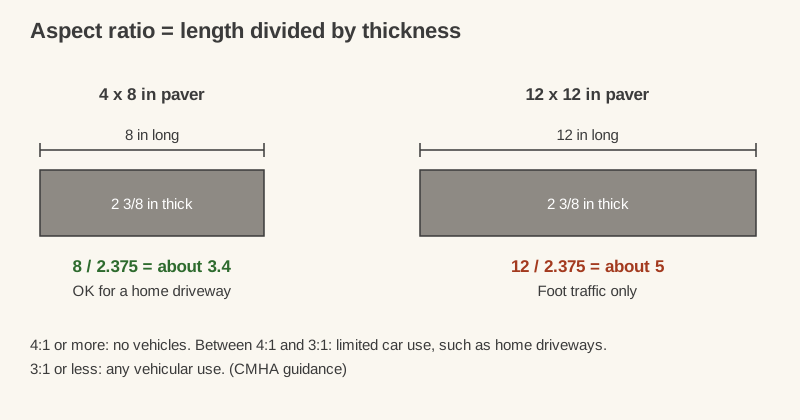
Thickness alone doesn't decide it. The paver's aspect ratio, its length divided by its thickness, matters as much. Long, thin units act like levers under a tire and crack or rotate. A tire is a very patient crowbar. CMHA's guidance:
- 4:1 or more: don't use for vehicles.
- Between 4:1 and 3:1: acceptable where car use is limited, such as a home driveway.
- 3:1 or less: suitable for any vehicular use.
A standard 4×8-inch paver at 2 3/8 inches thick has a ratio of about 3.4, which is fine for a home driveway. A 12×12 paver at the same thickness is about 5:1, so keep it for patios. Pattern matters too: CMHA recommends 45- or 90-degree herringbone where vehicles drive, because it interlocks best. Our paver driveway installation guide covers the base and edges a driveway needs.
1-inch-thick pavers belong on concrete
"1 inch pavers" usually means thin pavers about 1 to 1 3/4 inches thick, for resurfacing a slab or stepping-stone paths. CMHA describes thin 30 to 45 mm units used in overlays, sand-set or bonded to the concrete, and not recommended for any vehicular use.
Thin pavers make sense when:
- The existing concrete patio or porch is sound, with no heaving and only minor cracks.
- Raising the surface by a full 3 1/2 inches (60 mm pavers plus 1 inch of sand) would block a door threshold.
- Only foot traffic will use it.
Don't lay thin pavers directly on soil or gravel. They are too thin to spread loads and too light to stay put, so they rock and crack. The guide to laying pavers over concrete covers drainage holes, bedding and adhesive options.
Is a thicker paver always better?
No. Going thicker than the job needs mostly adds cost and work:
- Deeper digging. Every extra 3/4 inch of paver means 3/4 inch more excavation across the whole area.
- Heavier material. Thicker pavers weigh more per square foot: fewer square feet per pallet, more lifting.
- Harder cutting. An 80 mm paver takes a deeper saw pass than a 60 mm one.
- No gain on a weak base. A thick paver on a thin or poorly compacted base still sinks and ruts.
My one strong opinion: a thicker paver is not a stronger patio. Pavers spread the load and the stone underneath carries it, so 20 mm more concrete on top can't fix uncompacted stone below. I looked for a manufacturer who says a thicker paver lets you thin the base. None do. Spend on base depth and compaction first, then choose the thinnest paver that suits the traffic.
Mixing two thicknesses on one project
A common layout is a 60 mm patio meeting an 80 mm driveway. The surfaces must meet flush, so the difference goes into the base, not the sand.
- Measure the thickness difference, for example 3/4 inch between 60 mm and 80 mm pavers.
- Build the base under the thicker pavers lower by that amount, and compact it to the same standard.
- Keep the bedding sand the same thickness everywhere: a nominal 1 inch of ASTM C33 sand, screeded and left uncompacted (ICPI Tech Spec 2). CMHA warns against using sand to fill low spots in the base.
- Screed each zone separately, then compact across the joint between them.
Making up the difference with extra sand leads to settling along the transition.
Base thickness follows the paver
Paver thickness also sets the excavation depth. Add the compacted base, 1 inch of bedding sand and the paver:
- Patio: 4–6 in base + 1 in sand + 2 3/8 in paver = about 7 1/2 to 9 1/2 inches deep.
- Driveway with 80 mm pavers on an 8-inch base: 8 + 1 + 3 1/8 = about 12 inches deep.
ICPI Tech Spec 2 sets minimums of at least 4 inches for patios and walks and at least 6 for driveways, adding 2 to 4 where soil is wet or weak or winters freeze; CMHA's typical ranges are 4 to 6 and 6 to 8. The full paver base guide explains how to adjust depth for your soil.
Use 60 mm unless vehicles decide otherwise
For almost every patio, walkway and home driveway, 2 3/8-inch (60 mm) pavers are the right thickness, provided they are a sensible shape and the base is built properly. Step up to 3 1/8 inches (80 mm) for heavy or frequent vehicles, keep thin 1 1/4-inch pavers for overlays on sound concrete, and put any extra budget into the base.
If you were about to upgrade to thick pavers just to be safe, buy another load of gravel instead. The patio will never know, and that's the point.
FAQ
How thick are pavers usually?
Most concrete pavers are 2 3/8 inches (60 mm) thick. Vehicular pavers are 3 1/8 inches (80 mm), thin overlay pavers are about 1 1/4 to 1 3/4 inches, and porcelain pavers are about 3/4 inch.
Are 2-inch pavers thick enough for a patio?
Yes, for foot traffic on a properly compacted base. The standard 2 3/8-inch paver is the most common choice for patios and walkways, and going thicker adds little for foot traffic.
Can you drive on 2 3/8-inch pavers?
Yes, on a residential driveway, as long as the pavers aren't too long for their thickness (a length-to-thickness ratio under 4:1, such as a 4×8 paver) and the base is built for vehicles. For heavy trucks or frequent traffic, use 3 1/8-inch pavers.
Are 3-inch-thick pavers worth it for a driveway?
They're worth it where heavy vehicles, RVs or constant turning traffic will use the driveway. For ordinary cars on a well-built base, 2 3/8-inch pavers in a herringbone pattern perform well.
How thick is the base under pavers?
Typically 4 to 6 inches of compacted crushed stone under patios and walkways, and 6 to 12 inches under driveways, depending on soil and climate, plus 1 inch of bedding sand.