Last Updated on September 23, 2026 by Umar Farooq
A paver vacuum lifter is a tool that grips a paver or slab from the top face by suction, the only paver tool that works by doing nothing, very hard. Set its rubber-sealed pad on the unit, pull a vacuum, carry it and lower it into place without your fingers in the joint. It pays off with large-format slabs, porcelain and heavy steps, and on jobs with hundreds of repetitive lifts. For small 4 × 8 pavers it's rarely worth the setup, and it only works on faces smooth and dense enough to hold a seal.
How a paver vacuum lifter holds a slab
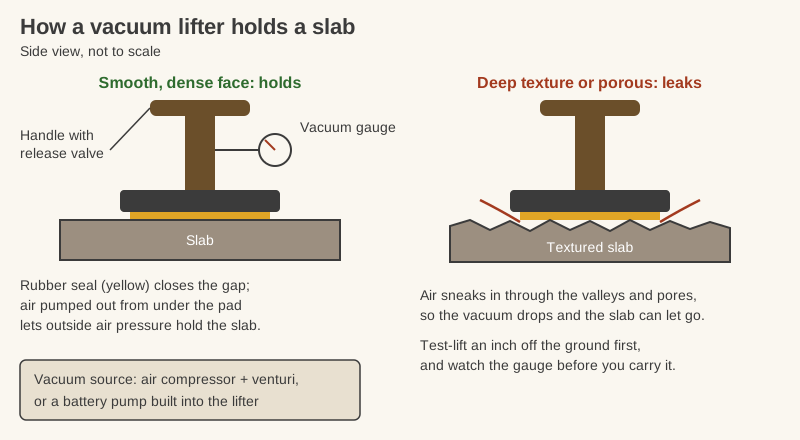
The pad has a soft rubber seal around its edge. When the vacuum source pulls air out from under it, ordinary air pressure pushes the pad and slab together. (The atmosphere does the lifting; the tool just takes the credit.) A trigger or valve lets air back in to release it.
Handheld lifters come in two main types:
- Compressor-driven (venturi). Compressed air running through a venturi creates the vacuum. One manufacturer's compressor-driven vacuum paver lifter lists an 88 lb capacity on its 4¾ × 8⅝ in pad. It needs a compressor supplying at least 5.2 cfm at 125 psi, so you'll be dragging an air hose around the job.
- Battery-powered. A pump built into the handle creates the vacuum, so there's no hose. Makers of handheld battery units list ratings in the hundreds of pounds on non-porous surfaces.
For big slabs, steps and curbs there's a third class: vacuum attachments for mini excavators, skid steers or lifting carts, for units no one should lift by hand.
Surfaces that hold suction, and those that don't
The seal decides everything. I appreciated that one maker's guide to its paver lifting tool states plainly that it does not work on porous stone. That kind of honesty is rarer than it should be.
| Surface | Grip |
|---|---|
| Porcelain pavers, polished or honed stone | Very good |
| Smooth-face concrete slabs | Good |
| Lightly textured concrete | Usually fine; test first |
| Tumbled, slate-texture, split-face, riven flagstone | Poor; air leaks through the valleys |
| Porous stone, dusty or wet faces | Unreliable |
Wipe off grit before setting the pad. Some units take larger or softer pads for textured faces; check that pad's rated capacity first.
Capacity and safety checks
A vacuum lifter is a below-the-hook lifting device, the category ASME B30.20 covers, so it deserves more respect than its cordless-drill looks suggest:
- Stay under the rated load for the pad and surface. Ratings assume a clean, smooth, dry face.
- Center the pad on the unit so it hangs level.
- Test-lift an inch and watch the gauge or indicator before carrying.
- Keep the load low and your feet clear. Never swing a slab over someone.
- Check the seal for cuts and hardening before each job, and charge or service the unit as the maker specifies.
Suction lifter vs clamp lifter
A mechanical clamp lifter, sometimes called a paver lift tool or paver tongs, grips a unit by its edges. The two tools suit different jobs:
- Clamp lifters don't care about texture, so they work on tumbled or split-face units, but the jaws need edge space, which makes tight joints hard.
- Suction lifters hold only the top face, so you can lower a slab straight into position next to its neighbors. That's why porcelain and large-format installers favor them.
Rent or buy
- Rent for a one-off patio of large slabs or porcelain, if a local yard or hardscape supplier stocks one. Ask about pad size, rated load and vacuum source; a compressor-driven unit also needs a suitable compressor.
- Buy if you set large-format units regularly: fewer crew per lift, less damage to edges and fingers.
- Skip it for small pavers, and on faces too textured to hold a seal. I'd go further: for a standard concrete-paver patio, don't buy one at all. A standard 2 3/8-inch (60 mm) paver is a one-hand lift, and setting the pad on each one is slower than picking it up.
Large units need a very flat bed, so screed carefully. See our guides to 24×24 pavers and porcelain pavers. The rest of the kit is in paver patio tools.
Worth it for big, smooth units only
A paver vacuum lifter earns its place on slabs that are heavy, smooth and set with tight joints: porcelain, large-format concrete and polished stone. On small or deeply textured pavers, a clamp or your hands will do the job. Your back will complain either way; your fingertips needn't.
FAQ
How much can a paver vacuum lifter lift?
It depends on the pad and vacuum source. One compressor-driven handheld unit is rated at 88 lb, battery units list several hundred pounds, and machine-mounted lifters more. Ratings assume a clean, smooth surface.
Do vacuum lifters work on textured pavers?
Poorly. Tumbled, slate-texture and split faces let air leak under the seal. Test-lift first, or use an edge clamp lifter instead.
Can you rent a paver vacuum lifter?
Some rental yards and hardscape suppliers do. Check rated load, pad size, and whether you need a compressor.
What is a paver suction tool?
It's another name for a handheld vacuum lifter: a sealed pad that grips a paver's top face by suction so you can place it without handling the edges.