


Last Updated on October 20, 2026 by Umar Farooq
On a diy vs contractor paver patio cost comparison, doing the work yourself saves you the labor line and nothing else, and that line is smaller than most people hope. Lawn Love puts installer labor at $5 to $15 per square foot, so the most a DIY patio can save on a 280-square-foot job is roughly $1,400 to $4,200. Then you buy the tools, rent the compactor, haul the debris and give up your weekends. For a small, flat, simple patio, DIY usually wins. For a large or complicated one, the gap closes fast.
I checked the cost guides rather than trusting the usual "DIY saves 50%" line, because the published numbers do not say that.
What the published numbers say
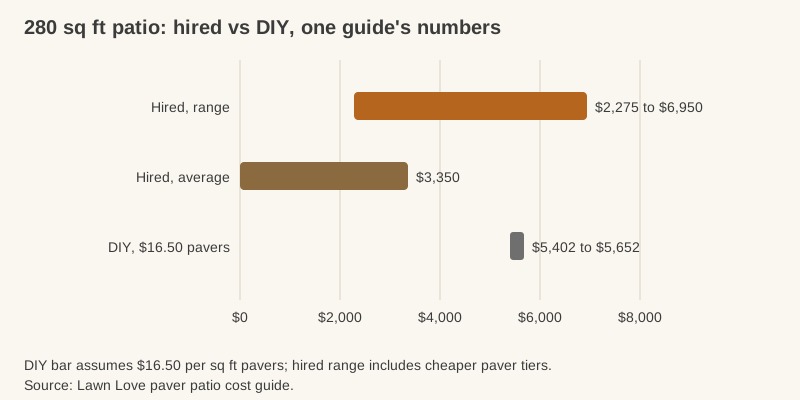
Lawn Love's paver patio guide gives the most open set of figures I found, for a 280-square-foot patio:
| Route | Total | Per sq ft |
|---|---|---|
| Hired, average | $3,350 | about $12 |
| Hired, range | $2,275 to $6,950 | about $8 to $25 |
| DIY, with $16.50 per sq ft pavers | $5,402 to $5,652 | about $19 to $20 |
Read that again. In their own table, the DIY patio costs more than the average hired one. That is not because DIY is a bad idea. It is because the DIY row assumes pavers at $16.50 per square foot, while the hired average mixes in cheaper materials (their paver range runs from $3 to $30 per square foot). The two rows are not buying the same patio, so do not read it as "pros are cheaper." Read it as "the paver you choose moves the total more than who lays it."
The method that holds up: price the same paver in both columns, then subtract labor from the hired total.
The labor line, worked out for your patio
Lawn Love lists installer labor at $5 to $15 per square foot, or $50 to $80 per hour for crews that bill hourly. Multiply by your area:
| Patio size | Labor at $5 to $15 per sq ft |
|---|---|
| 100 sq ft | $500 to $1,500 |
| 192 sq ft (12 x 16 ft) | $960 to $2,880 |
| 280 sq ft | $1,400 to $4,200 |
| 400 sq ft | $2,000 to $6,000 |
That is the ceiling on your savings, before you spend anything on tools or time. Unilock adds a useful reality check: the pavers are typically only about 20% of a project budget, with the other 80% going to labor, excavation, base preparation and materials such as joint sand, edge restraint and sealer. Everything in that 80% except labor, you still pay for yourself.
The costs DIY does not remove
Here is what turns a $3,000 labor saving into a $2,000 one, or less.
- Compactor rental. Lawn Love lists a plate compactor at $83 per day or $333 per week. The base needs it, and the pavers need it again after laying.
- Hand tools. Screed rails, a level, string line, rubber mallet, a saw or splitter for cuts. Our list of paver patio tools separates what to rent from what to buy.
- Excavation and disposal. Unilock flags equipment such as a mini-excavator and disposal fees for soil and debris. Haul-away is a separate cost.
- Delivery. Stone and pavers come on a truck, and Lawn Love notes that transporting materials adds cost.
- Supplies. Lawn Love's examples include polymeric sand at about $22 a bag and landscape fabric at about $22 a roll.
- Site grading. Lawn Love gives $770 to $3,000 depending on area if the yard needs real regrading.
(Nothing makes a patio feel expensive like discovering at 4 pm that the rental yard closes at 5 and you are missing a bag of sand.)
My firm view: rent the compactor, do not buy it. One patio does not pay back a purchase, and a rental of a day or two covers both the base and the final compaction if you plan the job to fit inside it.
What you pay a pro for that has no line item
You are not only buying labor from a contractor. Unilock lists base preparation expertise, design skills, and licensed, insured contractors, and says its authorized contractors carry a minimum two-year workmanship guarantee. Those are the things that do not show up in a materials list. The details are in our piece on paver patio materials list.
The base is the big one. A patio is a thin finish over a compacted stone layer, and the figures the industry works to are specific: at least 4 inches of compacted base under a patio on well-drained soil, 2 to 4 inches more where it freezes, and a screeded inch of loose bedding sand (ICPI Tech Spec 2). A crew that has built many patios hits those numbers by habit. A first-timer has to check each one.
That is also what a warranty is worth. See our paver warranty guide for what is and is not covered, and how to hire a paver contractor for the questions to ask before you sign.
Time: the cost nobody invoices
A homeowner does not bill for weekends, but they get spent anyway. Excavation, base, compaction in thin lifts, screeding, laying, cutting, edging and joint sand do not shortcut well. Our how long does it take to install pavers guide breaks it into phases so you can count your own days. If the job is going to occupy six weekends, ask what those weekends are worth to you.
DIY vs contractor paver patio cost by situation
| Your situation | Best route |
|---|---|
| Small, flat, simple patio, a strong back and free weekends | DIY |
| Large, curved, sloped or heavily cut layout | Hire |
| Poor soil, drainage concerns or a patio against the house | Hire, or at least pay for the design |
| Budget tight but you cannot dig | Hire out excavation and base, lay the pavers yourself |
| You want a warranty on the whole system | Hire an installer who gives one |
The split option deserves more credit than it gets. Excavation and base prep are the heavy, skilled, equipment-hungry part, and laying the pavers is the part a patient beginner does well. Be clear in writing about who is responsible for what.
DIY if it is small, hire if it is hard
The honest comparison is this: DIY saves the labor, which is $5 to $15 per square foot in the guide I trust most, and it costs you tools, rentals, disposal and time. If the patio is small and simple, that trade is clearly worth making. If it is large, curved, sloped or against the house, the pro's labor is buying you a correct base, which is the part of the patio you cannot easily fix later. Get two or three written quotes, price your own version with the same paver, and let the gap decide. The cheapest option is the one you only build once.
FAQ
Is it cheaper to install pavers yourself?
Usually, because you skip installer labor of about $5 to $15 per square foot (Lawn Love). The saving shrinks once you add compactor rental, tools, disposal and your time, and it can vanish on a large or complex patio.
How much does it cost to have a paver patio installed?
Lawn Love's average for a 280-square-foot patio is $3,350, with a range of $2,275 to $6,950. Unilock quotes $30 to $40 per square foot for a 400-square-foot patio built to its standards, so ask each contractor what their price includes.
What tools do I need to rent for a paver patio?
At minimum a plate compactor, and often a saw for cuts. Lawn Love lists a plate compactor at $83 per day or $333 per week.
Is DIY pavers worth it for a beginner?
For a small, flat patio, yes, if you are willing to do the base properly. For a large or sloped one, consider hiring the base work or the whole job.
Can I hire a contractor for part of the work?
Yes. Many homeowners hire out excavation and base preparation and lay the pavers themselves. Agree on the scope in writing.


