

Last Updated on October 20, 2026 by Umar Farooq
Leveling sand wet or dry is a trick question, because the answer is neither. Screed damp sand: it should hold a loose lump when you squeeze it, crumble when you poke it and leave no water on your palm. Dry sand runs off the board and won't hold a clean edge. Saturated sand clumps, smears and settles as it drains. ICPI Tech Spec 2 puts the hard limit plainly: frozen or saturated sand should not be installed. Don't compact it first, either way.
The sources are less tidy than that. One says "dry," one says "moist," and one writes "dry" while giving a moisture percentage that most people would call damp. Below is where they agree, where they don't, and what to do when the weather ignores your schedule.
Leveling sand wet or dry: what the sources say
| Source | Says about sand moisture |
|---|---|
| Western Interlock | Washed river sand is "commonly screeded moist"; cover it with pavers as fast as possible; in a wet climate, crushed aggregate retains no moisture |
| Magnolia Fence & Patio | Work on dry sand as much as possible; wet sand clumps and compacts unevenly |
| City of Regina unit paving spec | Laying course "dry (4-8% moisture content)" before pavers go on |
| ICPI Tech Spec 2 | No frozen or saturated sand |
| How to Hardscape | Sand washes out or goes uneven under rain, while screed chip can be used in rain |
Here is my reading, and it is only that: the Regina spec calls a 4 to 8 percent moisture "dry," which is plainly not bone dry, so "dry" and "moist" are probably describing the same sand from two sides. Note also that Regina's spec is a Canadian municipal document written for a 15 mm crusher-dust layer, not the 1-inch ASTM C33 bed ICPI describes. It tells you the range, not a rule for your driveway.
Both Western Interlock's and Magnolia's pages are installer marketing, so weigh them accordingly. They still agree on the part that matters: wet is wrong.
Do the squeeze test
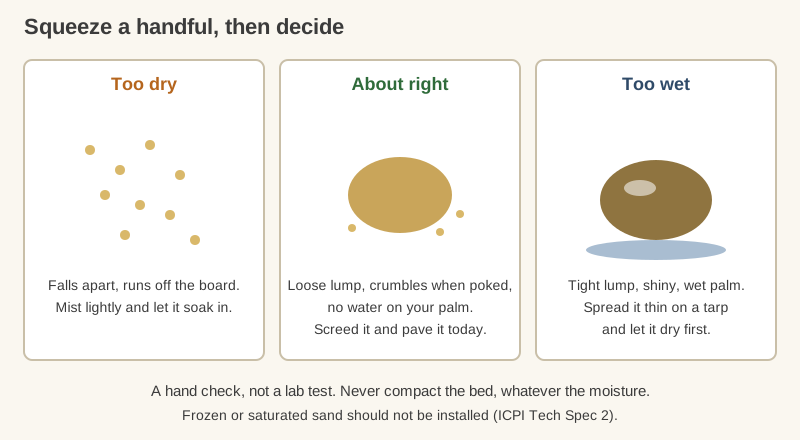
Take a handful from the middle of the pile, not the surface. The surface dries in the sun, and the pile's middle tells the truth. Squeeze it, open your hand and poke the lump. The chart above is a hand check I use for judging it, not a lab test, but the three results are easy to tell apart.
For the full moisture routine on gravel, see how to compact gravel, which uses a similar squeeze test for the stone below. The sand and the stone want the same thing: damp, never soaked.
Fix sand that is too wet or too dry
Too wet. Don't screed it and hope. ICPI's advice for wet joint sand is to spread it on a clean, hard surface to dry before using it, and the same idea works for a soaked bedding pile: spread it thin on a tarp in the sun and turn it. (A pile of wet sand is just a patient puddle.)
Too dry. Sand left uncovered in summer sun bakes dry, as Western Interlock notes. Mist it lightly while you turn the pile, wait for it to soak in and re-test. This is common sense rather than a spec.
Store it covered. The pile should sit under a tarp, weighted at the corners, from delivery day. That one habit prevents most of the problem. My opinion: before you buy another tool, buy a tarp. It costs a few dollars, and ICPI's own advice for rain threats is a waterproof covering.
When rain hits a screeded bed
Rain is the real test. How to Hardscape says screed sand will wash out or become uneven from the raindrops and have to be re-leveled. Here is what to do:
- Stop when rain threatens. ICPI says the remaining uncompacted edge can be covered with a waterproof covering, which prevents saturation of the bedding sand and minimizes removal and replacement of the sand and pavers.
- Cover the bed, not just the pallets. Weight the sheet down so wind can't lift it.
- Look before you lay. After rain, check for pocked, ridged or soggy areas. Re-screed minor damage. If the sand is saturated, remove it and replace it, since ICPI says saturated sand should not be installed.
- Leave laid pavers alone. Pavers already down and compacted shield the sand under them.
Rain that falls during the job is also a base problem. A wet base can pool in low spots and soften, as Journeyman HQ's paver sand tools article notes. See paver base in wet soil and paver base washout for the layers below.
When screed chip beats sand
Chip stone, usually 1/4-inch or 3/8-inch washed aggregate (ASTM No. 8 or 9), doesn't care much about moisture. How to Hardscape says it has no fines, so water flows freely through it, and that it can be used on rain days. Western Interlock's raised-patio screeding guide describes its 1/4-inch open bedding as having better drainage in rainy climates.
The trade-off is that it's a different material from the ASTM C33 sand ICPI describes, and some manufacturers specify one or the other. Check what your paver maker requires, especially for permeable pavers. Our screeding sand for pavers guide covers the rails and board, and sand for pavers covers which sand to buy.
Damp, covered and paved the same day
Screed damp sand, keep the pile under a tarp, test a handful before each session and don't screed more than you can pave before dark. Dry sand can be misted, and wet sand can be spread out to dry. Saturated sand should come out. The one thing nobody can fix after the fact is a bed that was compacted before the pavers went on, so keep your plate compactor off it. Treat the sand bed like fresh paint, and it will hold.
FAQ
Should you screed wet or dry sand for pavers?
Neither. Use damp sand that holds a loose lump and leaves your palm dry. Western Interlock says washed sand is commonly screeded moist, and ICPI says saturated sand should not be installed.
Is it okay to screed sand that is wet?
You can, but you shouldn't. Wet sand clumps and compacts unevenly, per Magnolia Fence & Patio, and saturated sand is ruled out by ICPI. Spread it on a tarp to dry first.
What happens if it rains on a screeded sand bed?
Rain can pock and wash out the surface, so it has to be re-leveled, says How to Hardscape. Cover the bed ahead of rain, and if it gets saturated, replace the sand before laying.
Should bedding sand be compacted before laying pavers?
No. ICPI Tech Spec 2 specifies an uncompacted nominal 1-inch bed, and CMHA's spec says "Do not disturb screeded sand."
Is it better to screed in the morning?
There is no source for a best time of day. What matters is that the sand is damp when you screed it and that you cover the pile and the bed. Sand left in direct sun can bake dry, as Western Interlock notes.


