


Last Updated on October 20, 2026 by Umar Farooq
A patio pulling away from house walls is almost always the patio moving, not the house, and the usual causes are a base that settled differently from the foundation, clay soil that swells and shrinks, or water washing out the support. First, measure the gap and check which way the patio tilts. A small, stable gap can be sealed with backer rod and flexible sealant. A gap that keeps widening, or comes with sticking doors, is a different conversation.
A house and a patio are not married. They were introduced, and one of them has a much deeper foundation.
Patio pulling away from house: is it stable or moving?
That is the only question that matters first, because the repair for each is different. A stable gap, the same width after a wet month and a dry one, is a movement joint that has opened. A growing gap is a settling problem that sealant will only hide.
A-1 Concrete Leveling lists the signs that it has gone past cosmetic: doors and windows sticking, steps pulling away from the porch, and the gap itself (A-1 Concrete Leveling). They add that porches are usually poured on a separate foundation from the house, so independent movement is normal.
Four reasons the gap opened
The first three come from EngineerFix and A-1. The fourth is my inference from how sand-set patios work.
- Different bases. The patio sits on a shallower, less prepared base than the house foundation, so it settles differently ("differential settling").
- Clay soil. Clay swells when wet and shrinks when dry and pulls away from the slab (EngineerFix).
- Water. Poor drainage at the wall saturates and erodes the base. A-1 blames non-compacted soil and erosion under the sub-material.
- A paver field creeping away. If it is a paver patio, open joints along its other edges suggest the field spread, and the wall gap is where it showed. Look at the edge restraint before anything else.
Measure before you caulk
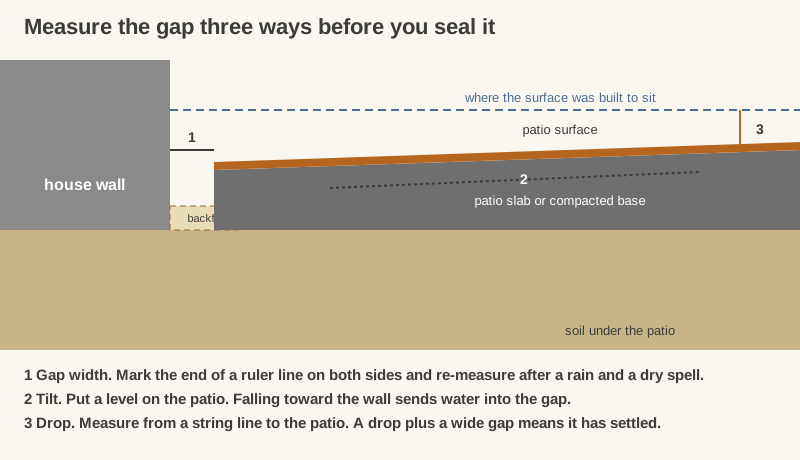
Three measurements, all with tools you own:
- Gap width. Measure at the top and bottom, then again after rain and dry weather.
- Tilt. Lay a level on the patio. If it falls toward the wall, water is running into the gap. The model code wants hard surfaces within 10 ft of the house to slope away at least 2% (IRC R401.3), about 1/4 inch per foot. Check your local adoption.
- Drop. String a line from the house and measure down to the patio.
If the patio dropped and tilts toward the wall, paver patio slope covers the regrade.
Water first, then the gap
EngineerFix warns that a gap lets water run down the foundation wall, raising pressure on basement walls, and gives pests access. So stop feeding it. Iowa State Extension, in a flood-safety sheet reposted by North Dakota, says downspout water must be spread far enough from the house not to enter the basement, and at least 5 to 10 feet from the house where there are basement water problems. Paver patio flooding has the hose tests.
Seal a stable gap properly
EngineerFix's method is for gaps up to 2 inches: clean the joint, push in closed-cell foam backer rod slightly wider than the gap, set it so the sealant is about 1/4 to 1/2 inch deep, then fill with a self-leveling polyurethane or silicone sealant made for horizontal joints. The rod keeps the sealant bonded on two sides only, because three-sided adhesion tears early. The paver expansion joints guide shows the same rod and sealant at other joints.
When the surface has dropped, not just parted
A gap plus a dip along the wall points to settled backfill. The rebuild is in pavers sinking next to house. For a settled concrete slab, A-1 describes leveling, where crews drill holes and pump in a compound to lift it, or piers when the settling is too severe. Foam under pavers is a separate story, and polyurethane foam under pavers explains why.
Stop and call someone
Sticking doors or windows, cracks running up the foundation or siding, a gap growing on the house side, or a patio that tilts hard toward the wall: stop and get a structural engineer or the contractor who built it. Photograph the gap with a ruler in the shot, dated, every few weeks.
What will not hold
- Sealant over a moving gap. It splits again.
- Loose sand or mortar packed in. I found no source recommending either for a gap that is still moving.
- Ignoring the downspout. The gap will keep reopening.
FAQ
Why is my patio pulling away from my house?
It is usually differential settling, clay moving with the seasons, or water washing out the base, per EngineerFix and A-1.
Is a gap between my patio and house a foundation problem?
Usually it is the patio. Doors that stick, wall cracks, or a gap widening on the house side mean call an engineer.
How do I fill a gap between my patio and house?
For gaps up to 2 inches, backer rod and a flexible sealant sized to 1/4 to 1/2 inch depth.
Will the gap keep growing?
If water is still reaching the base, probably. Fix the water first, then measure again.
Can I lift a settled concrete patio myself?
No. Leveling and piers are contractor work, per A-1.
Seal it only once it stops moving
Measure the gap now, again after the next rain, and again after a dry spell. If it is steady, backer rod and sealant will see you through the next season. If it moves, you are not fixing a gap, you are watching a patio leave.


