

Last Updated on October 20, 2026 by Umar Farooq
A paver splitter is a hand-operated tool that breaks a paver along a straight line: you mark the cut, set the paver on the tray, and pull a lever that drives a blade down onto it. The break takes seconds, makes no spinning-blade slurry and (according to Engineerfix) leaves no airborne dust. The trade-off is an edge that is rougher than a saw cut, and it only makes straight cuts. For a patio with lots of straight edge pieces, it is often the quickest way to finish.
Here is how the tool works, what it handles, how it compares with a wet saw or grinder, and how to get a decent result from it.
How a paver splitter breaks a paver along one line
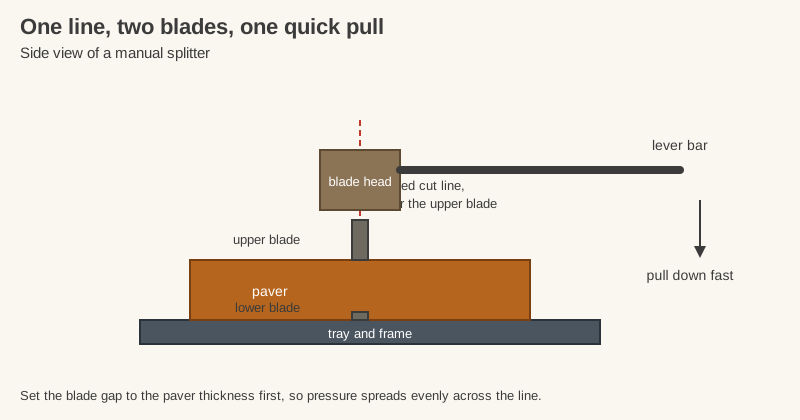
Family Handyman describes the splitter as a manual tool that uses hydraulic power to split pavers, bricks and blocks. Engineerfix explains the mechanism: the paver is scored on its top and bottom, a steel blade applies pressure, and the paver fractures along that line of stress. You do not saw anything. The blades pinch the line, the paver snaps, and you have two pieces.
The steps are the same on most machines:
- Mark the cut line on the paver.
- Put the paver on the tray and line the mark up under the upper blade.
- If the splitter has blade adjustment, set it to the paver's thickness.
- Pull the bar toward the ground and keep lowering it until the paver splits.
Engineerfix adds that the force should be rapid and decisive for a clean break, and that each cut takes about three to five seconds. A hesitant, slow squeeze is how you get a ragged break.
What a splitter cuts well, and what it won't
Engineerfix says manual lever splitters suit standard concrete or soft clay pavers, while hydraulic models, which can generate up to 20 tons, handle denser material and thick retaining wall blocks. It also lists the limits:
- Straight cuts only. No curves and no L-cuts.
- Rougher, chipped edges than a saw leaves.
- Not for hard natural stone such as granite.
The article gives no maximum thickness, so check the machine's own capacity before you buy or rent. Look for the blade width and the maximum cut depth, and make sure they exceed your largest paver. For thin or brittle stone, I'd test on a scrap first.
Splitter, wet saw or grinder: pick by the cut
| The cut | Best tool | Why |
|---|---|---|
| Straight edge cut on a standard concrete paver | Splitter | Fastest, no water, no slurry |
| Many identical straight cuts | Splitter | Three to five seconds each |
| Curves and circles | Angle grinder or wet saw | A splitter cannot follow a curve |
| L-shaped notch around a post | Saw, with relief cuts | Splitters cut straight lines only |
| Visible edge that needs to look crisp | Wet saw | The cleanest edge |
| Hard natural stone | Saw | A splitter is unsuited to granite |
For the full comparison of the saws, see paver cutting tools, and for the bench option specifically, the wet saw for pavers guide.
Where the splitter wins on safety and dust
OSHA's silica rule for handheld saws cutting masonry is water on the blade, and a respirator beyond four hours a shift outdoors, or at any duration indoors (29 CFR 1926.1153, Table 1 at Cornell LII). A splitter has no blade spinning through the paver, so it sidesteps the dust problem. That makes it a good fit for cuts near the house, a garage, or a neighbor's open window.
I wouldn't call it risk-free. A fracture can throw chips, so wear safety glasses and gloves, and keep your fingers out from between the blade and the paver. Engineerfix's sheet does not list splitter-specific protective gear, so this is my own judgment.
Rent a splitter before you buy one
Family Handyman notes that splitter rentals are available at home centers and hardware rental centers. For a single patio, rent one. You will use it for a weekend, and a hydraulic splitter is a heavy thing to store for the next fifteen years. Buying only makes sense if you build patios regularly or you are cutting many pieces of the same size, the kind of job where a splitter pays back in time saved.
Whichever you choose, bring a few spare pavers. Practice on two or three before you cut a piece you need.
Make the rough edge a hidden edge
Because the splitter's edge is rougher than a saw's, plan where it goes. Put the split face toward the border, where an edge restraint or the soil will cover it, and keep the factory edge facing the visible field. It's the same trick a tailor uses with a raw hem. For cuts that have to show, switch to a saw.
Avoid cutting thin slivers, which are fussy to break cleanly and look awkward in the finished edge. If the layout would produce a thin strip, adjust the row before you cut, as described in how to cut pavers.
Split the straight cuts and saw the rest
A splitter is the quiet, quick, dust-free answer for straight cuts in standard concrete or soft clay pavers. Rent it, put its rough edges against the border, and keep a saw or grinder for curves, notches and anything that has to look sharp. If you want a no-power route altogether, how to cut pavers without a saw covers the alternatives.
FAQ
What is a paver splitter?
It is a manual cutting tool that breaks a paver along a marked straight line using a lever-driven blade. It works fast and makes no airborne dust, but it cannot cut curves.
Is a paver splitter better than a wet saw?
It is faster and cleaner to work with for straight cuts, but the edge is rougher. A wet saw gives the cleanest edge and can make straight or curved cuts, at the cost of water, slurry and silica precautions.
Can a splitter cut granite?
Engineerfix says splitting is unsuitable for hard natural stone such as granite. Use a saw for that.
How long does a cut take?
About three to five seconds once the paver is lined up and the blade gap is set, according to Engineerfix.
Can I rent a paver splitter?
Yes. Family Handyman says rentals are available at home centers and hardware rental centers. Ask for the blade width and cutting depth, and check they suit your pavers.


