

Last Updated on October 20, 2026 by Umar Farooq
Pavers in cold climates do very well, and interlocking pavers tolerate winter movement better than poured concrete, but only if three things are right: a base deep enough and open enough to drain, pavers that pass the freeze-thaw test, and winter habits that do not wreck the joints. ICPI Tech Spec 2 says to add 2 to 4 inches to the base in cold climates and on wet or weak soil, on top of the standard 4 inches for a patio or 6 for a driveway. Most "frost damage" is actually water trapped under the pavers, which is a base problem, not a weather problem.
Here is what to specify, how to build it, and how to look after it once snow arrives.
What actually happens to pavers when the ground freezes
Frost heave needs three ingredients: fine soil, a steady supply of water and a freezing front. Take away any one and the heave stops. Water in the soil under the paver base freezes, expands, and lifts the surface in patches. When it thaws, the surface drops unevenly, and you get the dips and ridges that get blamed on "bad pavers".
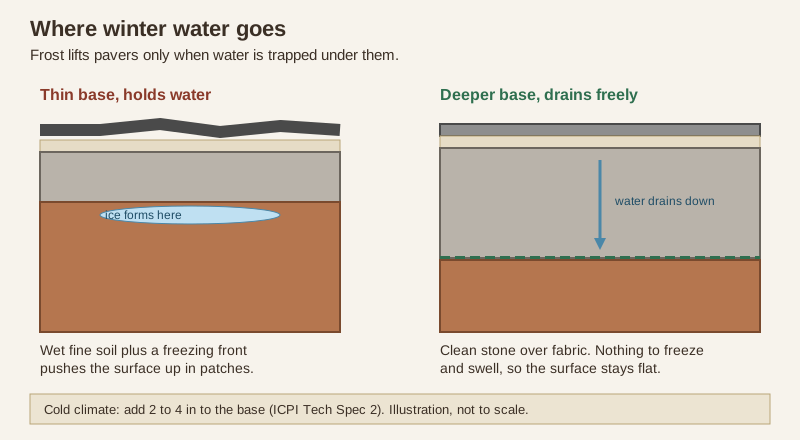
That is why the cold-climate advice reads like a drainage manual. You cannot stop the ground freezing, but you can build a base with nothing in it to freeze. Our guide to how much paver base you need has the full depth table.
Build the base deeper and keep it clean
The numbers to start from:
| Use | Standard base | Cold or weak ground |
|---|---|---|
| Patio or walkway | at least 4 in compacted | add 2 to 4 in |
| Residential driveway | at least 6 in compacted | add 2 to 4 in |
Source: ICPI Tech Spec 2. Rochester Concrete Products' cold-climate guide gives 4 to 6 inches for pedestrian areas and 8 to 12 inches for driveways, and cites up to 18 inches of open-graded base over clay or poor drainage, which is a heavy-duty case.
Three choices matter more than the exact depth:
- Use clean, open-graded stone with few fines. It drains and resists heave, where dense base with dust holds water. Avoid sand or stone dust as a base layer.
- Compact in lifts of 4 inches or less. Rochester says poor compaction is a common cause of settlement that gets blamed on frost. ICPI's 4-to-6-inch lift assumes a 7,000 lbf plate, and thinner lifts are needed for smaller ones.
- Put geotextile fabric over clay. It keeps the stone and soil from mixing. The details are in our guide to a paver patio on clay soil.
I would rather see an extra 3 inches of base in the budget than a pricier paver. The pavers are the finish. The base is the patio.
Slope and edges decide where meltwater goes
Water that cannot leave will freeze where it sits. Slope the finished surface at least 1.5% (ICPI Tech Spec 2), and 2% away from the house (IRC R401.3), which is about 1/4 inch per foot. Rochester's guide suggests that standing water should not stay on the surface more than a few hours after rain, and recommends surface drains where the grade cannot do it.
The edge restraint matters just as much. Ice and thaw push the outer row sideways every winter, and once the row moves the joints open and the sand washes out. Every open edge needs a restraint set on compacted stone, as covered in paver edging. The base should also run past the restraint spikes by its own thickness, up to 10 inches (CMHA PAV-GSP-011-21).
Choose pavers rated for freezing
Not every paver is equal in a hard winter. The standard to look for is ASTM C936 for concrete pavers, which, as quoted in the CMHA guide specification, requires:
- Average compressive strength of 8,000 psi, with no unit under 7,200 psi.
- Average water absorption of 5%, with no unit over 7%.
- Freeze-thaw test (ASTM C1645): no more than 225 g/m² of loss after 28 cycles, or 500 g/m² after 49 cycles.
If a supplier cannot show you the test results for the exact product, treat that as your answer. Dense, low-absorption concrete units are the safe default. For clay pavers, specify ASTM C902 Class SX where the units may freeze while saturated, per the Brick Industry Association's Technical Note 14.
Natural stone is a mixed bag. Porous limestone and some travertine can flake in freeze-thaw, so ask for frost data or choose another stone.
When to install, and what not to do in the cold
Late spring and early fall are the best windows. Rochester suggests starting fall jobs by mid-September, and only installing above freezing. Polymeric sand has its own floor: Alliance Gator's product data sheet says to install above 32°F, and Techniseal's HP NextGel wants temperatures above 32°F for 48 hours. A frozen base cannot be compacted either, so a mid-winter "quick" patio is a bad idea.
Snow, shovels and de-icer
This is where cold-climate patios get damaged by their owners.
- Shovel with a plastic blade. Metal scrapes chamfers and catches joint edges.
- Plows need protected edges. Rochester says plow blades should have rubber, polyurethane or raised steel edges, as standard steel can dislodge pavers.
- Go easy on de-icer. Sand or a gritty traction aid first. The sources disagree on rock salt itself: the CMHA calls it the least damaging de-icer for concrete, while Rochester's guide warns that it speeds moisture absorption and surface wear and lists calcium chloride, magnesium chloride and sand instead. Check your paver maker's warranty, and see salt on pavers for the full comparison.
- Rinse in spring. Washing away de-icer residue helps. Go gently, because a hard pressure wash can take the joint sand with it.
Salt does not make pavers unusable, but too much of it shortens the life of an unsealed surface.
Joint sand, sealer and spring checks
Polymeric sand reduces washout and keeps ants and weeds out. Refill any joints that lost sand over winter. Sealing is optional, though in northern climates Rochester suggests resealing every three to five years, in line with Belgard's rule of thumb of 3 to 5 years. Wait for the product's own minimum after installation, 30 days for Techniseal's natural-look sealer, and reseal when water stops beading. For the details, see paver sealing.
White haze that appears in the first winters is usually efflorescence, which is cosmetic and tends to fade.
Each spring, walk the surface and check for:
- Low spots or ridges that did not exist in autumn.
- Edge rows that have crept toward the lawn.
- Open joints, loose sand, or cracked units.
- Places where water sat after rain.
Fix small dips quickly. A cracked or sunken unit lets water into the base, and that water is next winter's heave.
Drain it, edge it, and go easy on the salt
A cold climate is not a reason to avoid pavers. Dig 2 to 4 inches deeper than the standard base, build it from clean open-graded stone in thin lifts, slope the surface to move water off, edge every open side and buy units with real freeze-thaw test results. Then shovel with plastic and keep de-icer to a minimum. Winter will test the base, and the base only needs to be dry to pass.
FAQ
Can pavers survive freezing winters?
Yes. Interlocking pavers flex slightly with ground movement and can be lifted and reset, which suits freeze-thaw climates better than rigid slabs. Survival depends on a deep, free-draining base, correct slope, edge restraint and units that meet ASTM C936 or C902 Class SX for clay.
How deep should the base be for pavers in a cold climate?
ICPI Tech Spec 2 says at least 4 inches under a patio or walkway and 6 under a driveway, then add 2 to 4 inches for cold climates and wet or weak soil. Some manufacturers go to 8 to 12 inches under driveways.
Why do pavers heave in winter?
Water trapped in fine soil or dense base freezes, expands and pushes the pavers up unevenly. A deeper open-graded stone base, separation fabric over clay and good surface slope remove the water, so there is nothing to freeze.
Is it okay to use salt on pavers?
The sources disagree. The CMHA calls rock salt the least damaging de-icer for concrete, while Rochester's guide says it speeds moisture absorption and surface wear. Sand gives traction without chemicals, and calcium chloride or magnesium chloride are the milder choices if you need melting. Use any de-icer sparingly.
Can you install pavers in winter?
It is not a good idea. A frozen base cannot be compacted properly, and polymeric sand needs temperatures above freezing. Late spring and early fall are the best windows.


