Last Updated on September 23, 2026 by Umar Farooq
Paving stones, or pavers, are individual units of concrete, fired clay, natural stone or porcelain laid side by side on a bed of sand or mortar to make a patio, walkway, driveway or pool deck. Unlike a poured concrete slab, a paver surface is made of many small pieces, so it flexes with the ground instead of cracking, and any damaged piece can be lifted out and replaced. Concrete pavers are the most common and lowest-cost type. Clay brick, natural stone, porcelain and permeable pavers each solve a particular problem better. (The showroom will show you all five under flattering lighting. It will not show you the gravel, which is the part that decides whether any of them stay flat.)
This page is the overview. It explains how paving stones work, gives each type a short profile, and compares them side by side so you know which one to read more about.
What are paving stones, exactly?
The Wikipedia entry on pavers defines a paver as a paving stone, sett, tile, brick or brick-like piece of concrete used as exterior flooring. The terms overlap in everyday use:
- Paving stones and pavers mean the same thing in the US. "Paving stone" is also often used for concrete pavers in particular.
- Patio stone pavers usually means pavers sold for patios, often in larger or stone-look formats.
- Setts and cobbles are small blocks, traditionally granite.
- Slabs are thin, large-format units, 12 inches and up on a side.
I read four glossaries trying to find a firm line between these words and found mostly shrugs. What unites them is the method. Standard pavers are not glued down. They rest on a compacted base and a thin bed of sand or fine stone, are held at the edges by a restraint, and are locked together by the sand in their joints.
Why a paver surface flexes instead of cracking
A poured slab is one rigid piece. When the ground below it shifts, freezes or settles, the slab cracks, and a crack in concrete is permanent.
A paver surface is segmental. Hundreds of units, each able to move a tiny amount, share loads through the sand in their joints. This "interlock" is why pavers handle frost heave and heavy loads well, and why modern interlocking pavers were developed on the soft ground of the mid-1940s Netherlands.
The practical benefits:
- Repairs are invisible. Lift the stained or broken units, fix what is underneath, and relay them.
- Utility access. Trench through, then put the same pavers back.
- No curing time. A sand-set paver patio can be walked on as soon as it is compacted.
The weakness is also the method. Everything depends on the base and the edge restraint, which we come back to below. Pavers without a restraint are not a patio. They are a patio with plans to travel.
Concrete pavers: the everyday paving stone
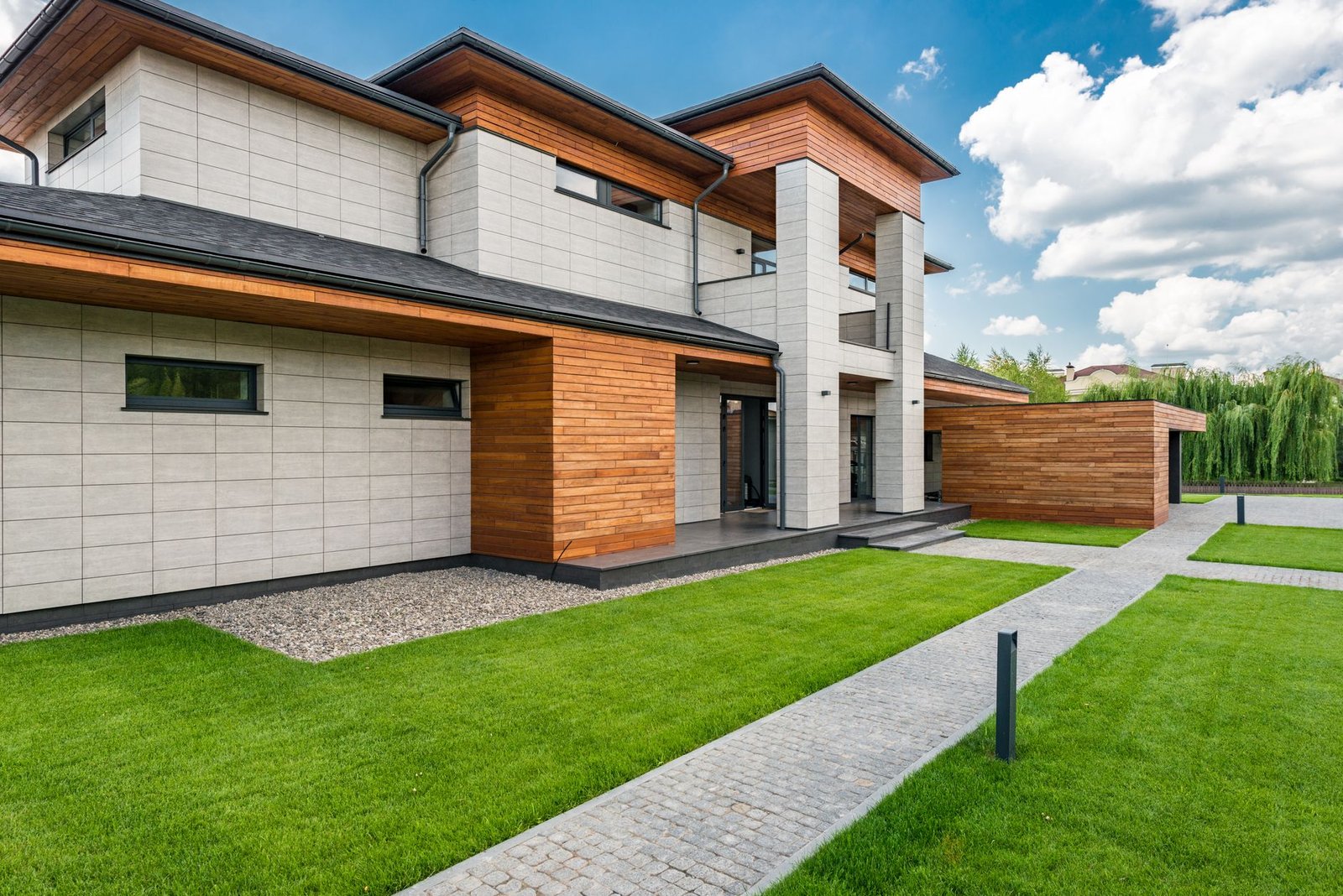
Most paving stones sold in the US are concrete pavers, also called precast concrete pavers because they are made in a factory, not poured on site. A zero-slump mix of cement, sand, aggregate and pigment is pressed into steel molds under vibration, then cured.
- Strength. ICPI's Tech Spec 2 on construction of interlocking concrete pavements says concrete pavers made in the US should meet ASTM C936. The current CMHA guide spec puts that at an average of 8,000 psi with no unit under 7,200, average absorption of 5% with no unit over 7%, and a freeze-thaw loss of no more than 225 g/m² after 28 cycles. (Tech Spec 2 still says "50 cycles," which is older wording. I checked both because they disagreed, and the guide spec wins.)
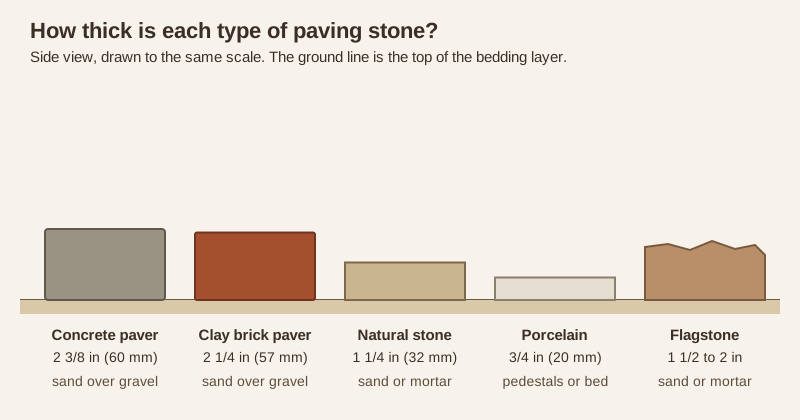
- Thickness. 2 3/8 inches (60 mm) for patios, walkways and residential driveways, and at least 3 1/8 inches (80 mm) for streets and heavy loads.
- Range. Everything from 4 x 8 inch bricks to large slabs, in smooth, tumbled and stone-look faces.
- Cost. Usually the lowest cost per square foot of any paver type.
The trade-off: color sits in the cement paste, so the surface can lighten over the years as sun and traffic wear the face. Some owners seal to hold the color, though a new patio doesn't need it in its first month.
Clay brick pavers
Clay pavers are fired in a kiln, like traditional brick, but made denser and harder for paving. The Brick Industry Association notes that the color is fired through the whole unit at almost 2,000°F, so clay pavers do not fade, and most exceed 10,000 psi in compressive strength.
They come mainly in 4 x 8 inch rectangles, in reds, browns and buffs, with a few squares and tumbled or antique finishes. The choice is narrower than concrete, and the hard edges can chip if struck. Buy ASTM C902 Class SX pavers anywhere they may freeze while wet, never wall brick. (Wall brick in a patio is a very slow way of making gravel.) Our guide to paver bricks covers clay vs concrete brick, Holland stone, sizes and grades.
Natural stone: granite, bluestone, travertine and more
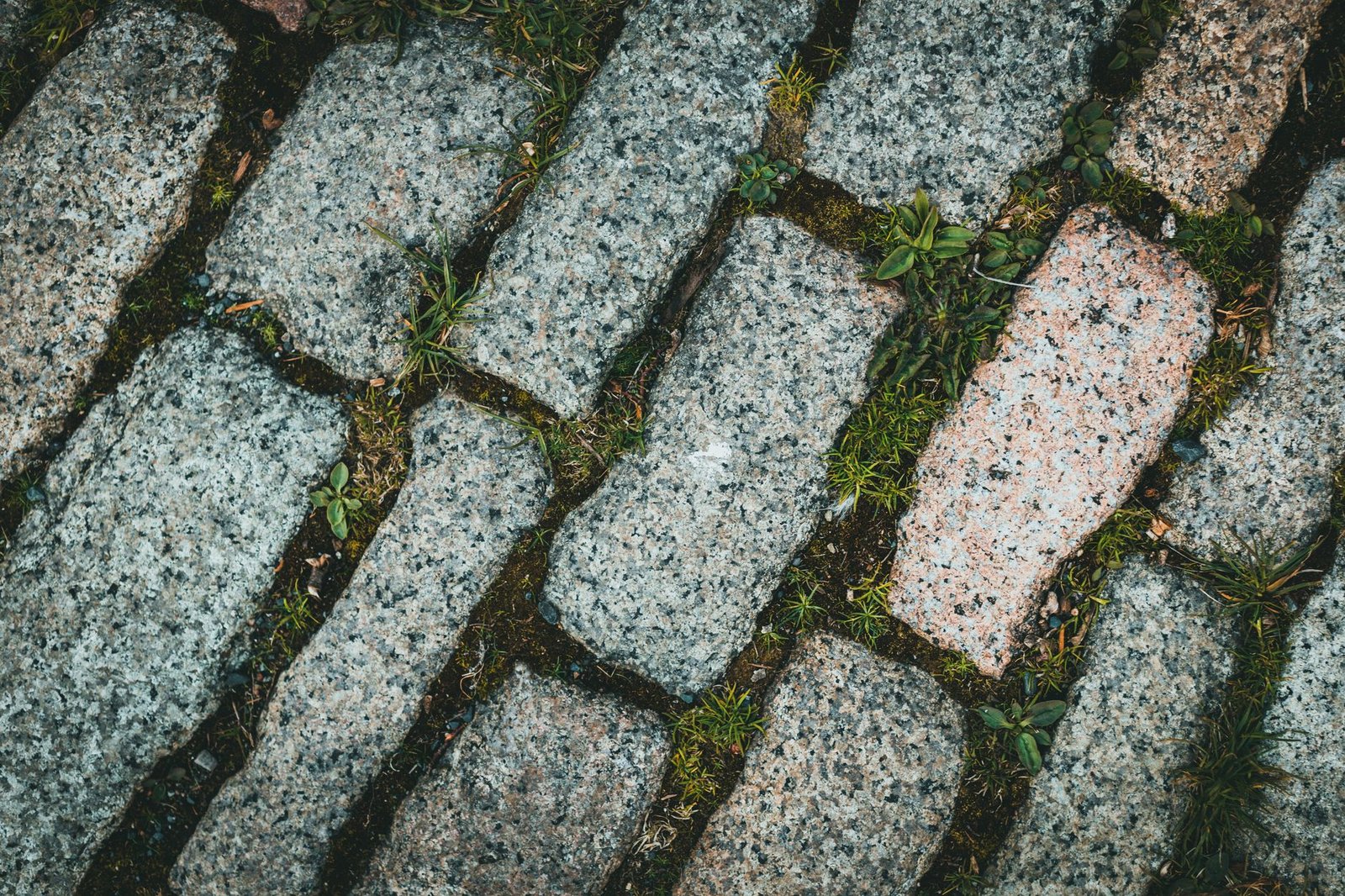
Natural stone pavers are cut from quarried rock. The main types are:
- Granite. The hardest wearing, and a good choice for driveways and cold climates.
- Bluestone. A dense blue-gray sandstone and the classic northern patio stone.
- Travertine. Stays cool underfoot, the traditional pool deck stone, sensitive to acids.
- Slate, sandstone and limestone. Rich color, but softer or more porous, so they need sealing and suit patios more than drives.
Sand-set stone pavers are usually about 1 1/4 inches (3 cm) thick, thinner than concrete, so the base must be flatter. Stone costs more and varies piece to piece, which is exactly its appeal. See our comparison of natural stone pavers for how each rock handles frost, heat, finishes and sealing.
Flagstone is not a separate rock. It is natural stone split into thin, flat, often irregular slabs, laid dry on sand or mortared onto concrete. The natural stone guide links to our flagstone page.
Porcelain: thin, dense and sealer-free
Porcelain pavers are outdoor slabs of kiln-fired porcelain, usually 2 cm (about 3/4 inch) thick. They absorb almost no water, so they do not stain, fade or need sealing, and their faces are printed to look like wood, stone or concrete.
They can be laid on adjustable pedestals over roof decks, dry-laid on a sand or gravel bed, or bonded to a concrete slab. Porcelain is rigid and thin, so it needs a very flat, stable base, a wet diamond saw to cut, and in most product lines it is not rated for driveways. Our porcelain pavers guide explains each installation method.
Permeable pavers let rain through
Permeable pavers are usually concrete units with wider joints or spacer lugs. Instead of sand, the joints are filled with small, clean crushed stone, and the whole system sits on a deep base of open-graded stone with no fines. Rain drains through the joints into the base, where it is stored and soaks into the soil or is piped away.
They cost more because the base is deeper washed stone, but they cut runoff and in some towns count toward stormwater requirements. Joints need occasional vacuuming to stay open. Grass pavers, or turf blocks, are a related open-cell type with soil and grass in the voids.
Slabs, cobbles and other shapes
Material is one choice. Shape is another, and it changes how a surface looks and performs:
- Rectangles and bricks suit herringbone, running bond and basketweave patterns.
- Large-format slabs (24 x 24 inches and up) give a modern look with fewer joints, but show every bump in the base.
- Cobbles and setts, in granite or concrete, give an old-world texture with many joints. They are strong under cars.
- Interlocking shapes such as the zig-zag "unipaver" lock together on all sides and are built for driveways.
- Multi-piece kits mix three or four sizes for a random, stone-like pattern without cutting.
Paving stones compared side by side
| Type | Typical thickness | Driveway? | Color over time | Sealing | Relative cost |
|---|---|---|---|---|---|
| Concrete paver | 2 3/8 in (60 mm); 3 1/8 in (80 mm) for heavy loads | Yes | Can lighten as the face wears | Optional | Lowest |
| Clay brick paver | 2 1/4 in; 2 5/8 in for heavy traffic | Yes, with the right grade | Does not fade | Not needed | Moderate |
| Natural stone | About 1 1/4 in sand-set | Granite and thick units only | Natural weathering | Often, for porous stones | Highest |
| Porcelain | 2 cm (3/4 in) | Rarely; only if the maker approves | Does not fade | Not needed | High |
| Permeable concrete | Similar to concrete pavers | Yes | As concrete | Optional | Higher than standard concrete, due to the base |
| Flagstone | 1 1/2 to 2 in dry-laid | No | Natural weathering | Often | Moderate to high |
"Relative cost" is a general ranking for materials only. Prices vary by region, supplier and product line, and the base and labor often cost as much as the pavers.
Picking paving stones for a patio, walkway, driveway or pool
- Backyard patio. Almost anything works. For the best pavers for a backyard patio, match the house first and the budget second.
- Walkway. Choose a surface that grips when wet: textured concrete, tumbled clay, flamed or cleft stone, or wet-rated porcelain.
- Driveway. Use 3 1/8 inch (80 mm) concrete pavers, heavy-duty clay, or granite, laid in a herringbone or interlocking pattern. Avoid thin stone and most porcelain.
- Pool deck. Choose cool, slip-resistant surfaces: travertine, light-colored concrete, or porcelain rated for wet exterior areas.
- Cold climates with salt. Clay SX pavers, granite and bluestone hold up best. Keep de-icing salt away from soft limestone and sandstone.
Checking paving stones at the supplier's yard
A few minutes with a sample and the spec sheet beats any brochure photo:
- Ask for the standard. Concrete pavers should list ASTM C936. Clay should list ASTM C902 or C1272, with Class SX where you get frost. Porcelain and stone suppliers should give exterior absorption and slip data. No standard, no sale.
- Check the thickness. Measure units from different pallets. Concrete should be the full 2 3/8 or 3 1/8 inches. Sand-set stone should be calibrated, or you will spend the day shimming.
- Look at a broken edge. A face-mix concrete paver shows gray when it chips.
- Match lot numbers. Color varies between runs. Buy the whole job, plus 5 to 10 percent extra, from one lot.
- See it wet and dry. Splash a sample; many pavers darken dramatically.
Keep the spares. A matching replacement from your garage in ten years beats the closest color the yard sells then.
The foundation every paving stone needs
Whatever the top layer, a sand-set paver surface is built the same way:
- Remove sod and topsoil down to firm soil and compact it.
- Build a crushed-stone base in compacted lifts. ICPI Tech Spec 2 calls for at least 4 inches under patios and walks and at least 6 under a residential driveway, plus 2 to 4 inches more on wet, weak or freezing ground. Its 4 to 6 inch lifts assume a 7,000 lbf plate; smaller rental plates need thinner lifts.
- Screed 1 inch of ASTM C33 concrete sand flat and leave it loose. Not stone dust, not mason sand.
- Lay the pavers, add edge restraint, sweep in joint sand and compact.
Thin units such as porcelain and 1 1/4 inch stone need the flattest base, and nothing will save a patio built on loose or organic fill.
Here is the opinion I'll stand behind: the mid-range concrete paver is fine. ASTM C936 sets the same floor, an 8,000 psi average, for the plain gray one as for the one with a French name, so the extra money buys looks, not strength.
Default to concrete, spend on stone where it shows
For most patios, walkways and driveways, concrete paving stones give the best mix of strength, choice and cost. Step up to clay for color that never fades, stone for character, or porcelain for a surface that never needs sealing. Choose permeable pavers where drainage is a problem. Pick the one you like looking at, check the standard on the pallet tag, and keep a few spares in the garage. Future you, holding a cracked paver, will be quietly delighted.
FAQ
What is the difference between pavers and paving stones?
In the US there is no real difference. Both words mean individual units of concrete, clay, stone or porcelain laid on sand or mortar. "Paving stones" is sometimes used for concrete pavers specifically, and "pavers" as the umbrella term.
What are the main types of pavers?
The main types are concrete pavers, clay brick pavers, natural stone pavers (granite, bluestone, travertine, slate, sandstone and limestone), porcelain pavers, and permeable pavers. Flagstone and cobblestone are natural stone formats.
What are the most durable paving stones?
Granite and clay pavers are the most durable. Clay pavers rated SX keep their color and resist freeze-thaw, and granite resists wear, stains and acids. Concrete pavers made to ASTM C936 and laid on a good base also last for decades.
Are pavers better than a concrete patio?
Pavers cost more to install than a plain slab but flex instead of cracking, can be repaired piece by piece, and offer far more design choice. A poured slab is cheaper up front, but its cracks are permanent.
What paving stones are best for a patio?
Concrete pavers are the best all-round choice for most patios. Choose clay brick for a traditional brick look, natural stone for a premium look, or porcelain for a low-maintenance modern look.
How long do paving stones last?
A well-built paver patio or driveway can last for decades. Clay and granite can outlast the house. The paving stones rarely fail first; problems almost always start with a thin or poorly compacted base.