Last Updated on September 23, 2026 by Umar Farooq
What is a tamper? In landscaping and hardscaping, a tamper (or hand tamper) is a flat, heavy steel plate on a long handle. You lift it and drop it to pack loose soil, sand or gravel into a firmer layer. It has no engine; the only force is the tool's weight plus whatever you add, which by the fortieth drop is not much. It is the right tool for small areas, corners and edges. For a whole patio base, you need a plate compactor. (A coffee tamper works on the same principle, with considerably less gravel.)
Hand tamper sizes, weights and builds
Most hand tampers have a square steel head and a handle about 4 feet long, of wood, fiberglass or metal, as Family Handyman's guide to tampers describes.
| Head size | Typical weight | Best for |
|---|---|---|
| 8 x 8 in | Around 10–12 lb | Post holes, narrow strips, edges beside walls |
| 10 x 10 in | Around 15–17 lb | Small pads, stepping stones, general soil and gravel |
These weights come from typical all-steel models on retail listings; I compared more listings than a steel square on a stick deserves. Check the spec of the one you buy. A smaller head concentrates the same weight on less area, so an 8 x 8 hits harder per square inch but covers ground more slowly.
A rolling tamper is a drum you fill with sand or water, used mostly on lawns. Powered tampers, the rammer and the plate, are machines. See jumping jack vs plate compactor for how those compare.
What is a tamper used for around a patio?
- Pads for stepping stones, where each stone needs a small, firm bed of base and sand. See how to lay stepping stones.
- Edges and corners a plate compactor can't reach: along the house wall, around posts, inside tight curves.
- Post holes and small footings, tamping the bottom and the backfill in layers.
- Patching, such as re-bedding a few sunken pavers or filling a small dip in a gravel path.
- Small landings of a few dozen square feet.
When is hand tamping gravel enough?
Hand tamping can get a small area firm, but not a large area uniformly dense. Over a big patio your blows get lighter as you tire, so density varies from spot to spot. Pavers are very honest about that variation. They show it later as dips. How to Hardscape's hand tamper vs plate compactor comparison says it plainly: a hand tamper doesn't apply enough compaction force or frequency for primary hardscape base work.
My firm line: buy the tamper, rent the plate. Hand tamping is enough for a landing or a path of stepping stones. Anything you would call a patio or walkway gets a rented plate compactor.
Tamping gravel by hand, strike by strike
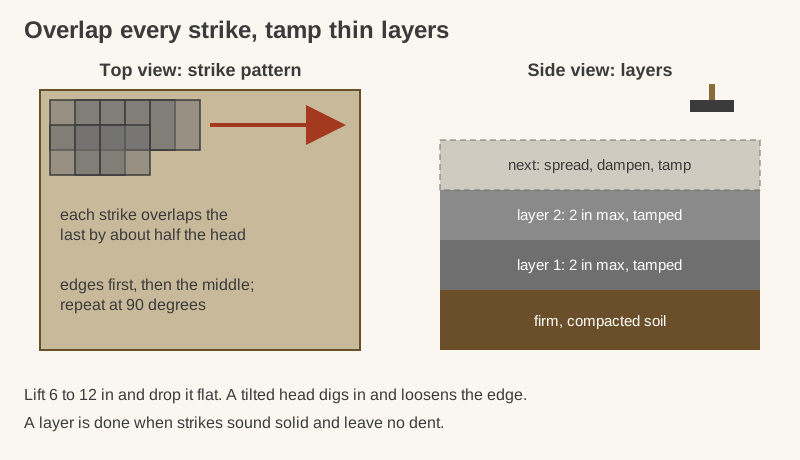
- Start on firm soil. Remove topsoil and roots, then tamp the soil at the bottom of the hole first.
- Spread a thin layer. Rake no more than about 2 inches of loose crushed stone. A hand tamper only compacts the top of a thicker layer.
- Dampen it. Mist until the stone darkens but no water pools. Damp stone packs, while dry stone stays loose.
- Drop, don't slam. Lift the tamper 6 to 12 inches and let it fall flat. Keep the head level. A tilted edge digs in and loosens stone.
- Overlap each strike by about half the head width. Do the edges first, then the middle, then go over the whole area again at 90 degrees.
- Check it. A finished layer sounds solid, not crunchy, and a boot heel barely marks it. Then add the next layer.
Hand tamper vs plate compactor: where each one wins
| Hand tamper | Plate compactor | |
|---|---|---|
| Power | Your arms and the tool's weight | Engine-driven vibration |
| Area it suits | A few dozen square feet | Whole patios, walkways, driveways |
| Layer thickness | About 2 in at a time | Thicker lifts, depending on the machine |
| Reaches edges | Yes | Not closely |
| Sets pavers | No; tap single pavers with a rubber mallet | Yes, with a urethane pad |
"Depending on the machine" matters: ICPI's 4 to 6 inch lift assumes a 7,000 lbf plate, and smaller rental plates need thinner lifts. Most DIY jobs use both tools: the rented machine for the field, the tamper for what it can't reach. What a plate compactor is explains how the machine works.
Keep a tamper for the corners, rent the plate for the field
A hand tamper is cheap, needs no fuel and fits anywhere, which makes it the right tool for stepping stones, post holes, patches and patio edges, and the wrong tool for an entire base. Tamp thin, damp layers with flat, overlapping drops. When the job grows into a real patio, bring in a plate compactor, and let the tamper return to being the most patient tool in the shed.
FAQ
What is a tamper used for?
A tamper packs loose soil, sand or gravel into a firmer layer, under stepping stones, in post holes, along patio edges, for small patches, and anywhere a plate compactor can't reach.
Can I use a hand tamper instead of a plate compactor for pavers?
Only for very small areas like a landing or stepping stones. For a patio or walkway, a hand tamper can't compact the base evenly enough, so the pavers are likely to settle. Rent a plate compactor for the main area.
How thick a layer can you tamp by hand?
Keep each layer to about 2 inches of loose gravel. Thicker layers end up firm on top and loose underneath, and that loose stone settles later.
What size hand tamper should I buy?
A 10 x 10 inch tamper is the most useful all-rounder for soil and gravel. An 8 x 8 inch head fits post holes and narrow strips and hits harder per square inch.
Should gravel be wet when tamping?
Damp, not soaked. Light misting helps the fines coat the larger stones so they pack tightly. Soaked gravel shifts and squishes under each strike.