Last Updated on September 23, 2026 by Umar Farooq
24×24 pavers are 2-foot square slabs, usually concrete about 2 inches thick or porcelain about 3/4 inch (20 mm) thick. Each one covers 4 square feet, so 25 of them cover 100 square feet, which is the kind of arithmetic that makes a Saturday look short right up until you lift the first one. They go down faster and look cleaner than small pavers, but they're heavy, they bridge any bump in the base instead of settling into it, and uneven edges (lippage) show at once. Get the base flatter than you would for bricks and a large format patio looks sharp for decades.
The same rules apply to the bigger sizes in this family: 24×36, 36×36 and the in-between 20×20.
Large format paver sizes, weights and coverage
"Large format" has no strict cutoff; I checked a handful of supplier catalogs and most use it for anything with a side of 18 inches or more. Nominal sizes are rounded. Lowe's sells a gray concrete patio stone listed as 24 x 24 inches that measures 23.6 inches. Measure a sample before setting string lines.
| Nominal size | Area per piece | Pieces per 100 sq ft | Rough weight, 2 in concrete |
|---|---|---|---|
| 20 x 20 in | 2.8 sq ft | 36 | about 65 lb |
| 24 x 24 in | 4 sq ft | 25 | 80–100 lb |
| 24 x 36 in | 6 sq ft | 17 | about 145 lb |
| 36 x 36 in | 9 sq ft | 12 | about 215 lb |
The weights are simple arithmetic for normal-weight concrete at roughly 145 lb per cubic foot. A 2-inch 24×24 slab holds two-thirds of a cubic foot, so it lands near 95 lb. Moda Concrete's 24×24 wet-cast grade-set paver is 1 3/4 inches thick and lists 84 lb per slab, which fits. Porcelain is far lighter for its size: Dynamic Stone Tools puts a 24×48-inch, 20 mm porcelain paver at around 40 to 45 lb.
Add 5 to 10 percent for cuts and breakage, and round up; large slabs waste more per cut.
Why 24×24 pavers need a flatter base than bricks
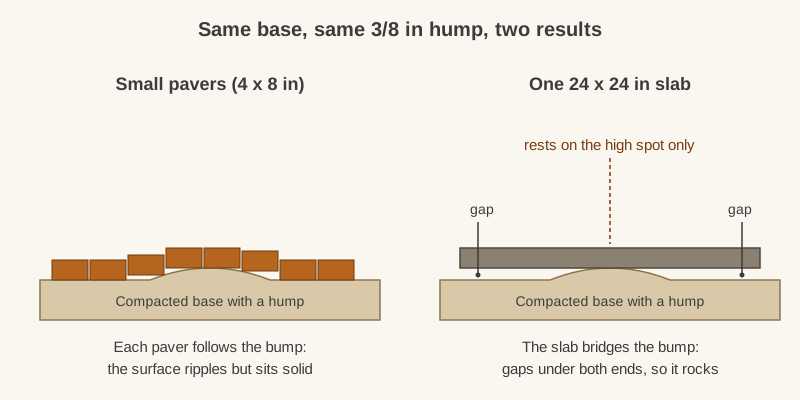
This is why large format jobs fail. A 4×8 brick follows a slight hump in the base; the compactor pushes it into the sand and the surface ripples a little. A 24-inch slab can't. It spans the high spot, touches at one point, and rocks when someone steps on a corner. (It is, briefly, a seesaw. Nobody ordered a seesaw.)
This is the article where my one strong opinion earns its keep: the slab is the finish, and the base is the patio. Pavers only spread the load; the gravel carries it, and a big slab shows every place the gravel didn't.
The Concrete Masonry & Hardscapes Association (CMHA) base tolerance for ordinary pavers is ±3/8 inch under a 10-foot straightedge. Fine for bricks, marginal for big slabs. Aim for about half that:
- Compact the base in thin lifts sized to your plate, as for any paver base. The 4 to 6 inch lifts in ICPI's spec are sized for a reversible plate of 7,000 lbf; with a smaller rental plate, keep each layer to 2 or 3 inches. Loose stone under a big slab settles, and the whole slab tilts.
- Check the base with a long straightedge in several directions, and fix highs and lows in the stone, not in the sand.
- Keep the bedding sand a uniform, loose 1 inch of ASTM C33 concrete sand, not stone dust. Screeding off rails gives the flattest bed; see screeding sand for pavers for the rail setup.
- Build the slope into the base. Moda asks for at least 2 percent (1/4 inch per foot) of fall on its slabs.
ICPI's floor for a patio is a 4-inch compacted base, no less; on soft, wet or freezing ground add 2 to 4 more, plus a geotextile. A big slab spreads load, but it can't hide settlement.
Lippage: the edge you trip on
Lippage is the height difference between neighboring paver edges. On a brick patio, a 1/16-inch step disappears into the chamfers. On smooth 24×24 pavers with square edges and tight joints, the same step catches light, collects dirt and catches toes.
Moda's spec sheet asks for flatness within ±1/16 inch between adjacent units and no more than 1/4 inch of lippage. ICPI Tech Spec 2 is stricter for pedestrian routes at 1/8 inch, and on smooth slabs I'd aim for that. Three things cause most of it:
- A lumpy base or bed, covered above.
- Warped units. Big pieces can bow slightly. Sight down a few edges before laying, and put curved ones where you'll cut anyway.
- Offsets that land on the high point of a bow. That's why a half-offset running bond is risky with long slabs; see the patterns below.
Check each new slab with a short level across the joint. Tap high corners down with a rubber mallet, or lift the slab and adjust the sand. Don't pound on the middle, where a thin slab can crack.
Setting large patio pavers without cracking them
Most 24×24 concrete slabs sold for patios are wet-cast and about 2 inches thick. They're strong in compression but can snap over a void or under a plate compactor. Read the manufacturer's sheet. Some allow a compactor with a urethane pad; many thin slabs are bedded by hand with a mallet.
You have three setting methods:
- Sand-set on dense-graded base. The standard patio method: compacted crushed stone, 1 inch of concrete sand, slabs bedded with a mallet. Moda specifies at least 4 inches of compacted aggregate and 1 inch of concrete sand for its 24×24.
- Open-graded base. Polycor's XL granite slab installation guide builds the base from 3/4-inch clean stone (ASTM No. 57) compacted in 2- to 4-inch lifts, then a 1-inch layer of 3/8-inch chip stone (No. 8) to set on. Clean stone drains fast and is easy to fine-grade.
- Mortar bed or pedestals. Large slabs can also go on a mortar bed over concrete, and 2 cm porcelain can sit on pedestals over a roof or deck. That's beyond this guide.
Whichever you pick, start from a straight, square edge at the house or a string line, and keep a restraint on every open side.
Handling 80-pound slabs safely
A 24×24 concrete slab is a full-effort lift for one person, and 36×36 slabs can top 200 lb. Polycor puts it bluntly: don't move its XL pavers by hand at all.
- Carry on edge, two people. A slab carried flat can flex and crack.
- Use a slab lifter. A clamp-style or vacuum lifter sets the slab straight down without dragging the sand bed out of level.
- Set, don't drop. Lower one edge against the neighbor's joint spacer, then roll the slab down into place.
- Wear toe protection and gloves. Edges are sharp, and a dropped corner breaks toes.
Plan cuts for the least-seen edges. A diamond cutoff saw handles concrete; porcelain needs a porcelain blade, used wet.
Spacing between 24×24 pavers
Joint width depends on the material and the setting bed:
| Material and method | Typical joint |
|---|---|
| Concrete slabs, sand-set, polymeric sand | 1/8 to 3/16 in (Moda: 3/16 in max) |
| Porcelain on gravel or sand | at least 3/16 in, 1/4 in where temperature swings are large |
| Granite slabs on open-graded stone | about 3/8 in, set with spacers (Polycor) |
| Stepping-stone look with grass or gravel joints | 2 to 4 in |
Wide joints with polymeric sand crack and wash out, so stay inside the product's range.
Patterns for 24×24, 24×36 and 36×36 pavers
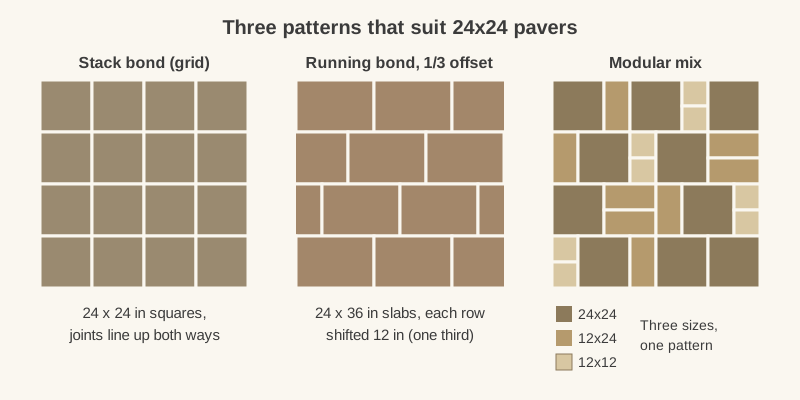
Big slabs look best in simple patterns.
- Stack bond (grid). Joints line up both ways. Clean and easiest to lay, but it shows every wandering joint, so snap string lines every few rows.
- Running bond. Offset each row. With 24×36 or longer slabs, limit the offset to one third of the length instead of half. Tile setters use this rule because a half offset lines up the slightly high middle of one slab with the ends of the next.
- Modular mix. Combine 24×24 with 12×24 and 12×12 pieces from one product line to hide size variations.
- Diagonal. A grid turned 45 degrees looks bigger, but every edge piece is a triangle cut, which wastes the most material with large slabs.
Most 2-inch patio slabs are rated for foot traffic only, and the arithmetic says why: 24 inches long divided by 2 inches thick is an aspect ratio of 12. CMHA says anything at 4:1 or above stays off the driveway. For a driveway, use a paver built for vehicles.
Flatten the base first, then buy the big slabs
24×24 pavers reward precision and punish shortcuts. Build a compacted base that's flatter than a brick patio needs, keep the sand bed an even inch, handle each slab with two people or a lifter, and choose a stack bond or a one-third offset. Get those right and large format pavers give you a calm surface with few joints to weed. Your back will file a complaint either way; the patio, at least, won't.
FAQ
How much does a 24×24 paver weigh?
A 2-inch concrete 24×24 paver weighs roughly 80 to 100 lb, depending on thickness and mix. Moda Concrete's 1 3/4-inch slab is listed at 84 lb. Porcelain versions weigh much less for the same size.
How many 24×24 pavers do I need for a 10×10 patio?
A 10×10 patio is 100 square feet and each 24×24 paver covers 4 square feet, so you need 25 pavers. Add 5 to 10 percent for cuts and breakage, which makes 27 or 28.
What is the spacing between 24×24 pavers?
For sand-set concrete slabs filled with polymeric sand, keep joints between 1/8 and 3/16 inch. Porcelain needs at least 3/16 inch. For a stepping-stone look with grass or gravel between slabs, leave 2 to 4 inches.
Can you lay 24×24 pavers on sand?
Yes, on a 1-inch screeded sand bed over a compacted crushed-stone base. Never set them on sand over bare soil. A large slab on an unstable bed tilts and rocks as the soil moves.
Can you drive on 24×24 pavers?
Usually not. Most 2-inch patio slabs are rated for foot traffic only, and a large, thin unit cracks under wheel loads. Check the manufacturer's rating, and use thicker vehicle-rated pavers for driveways.
Do 24×24 pavers need edge restraint?
Yes. Every open edge needs a restraint, just as with smaller pavers. Large slabs have fewer joints to lock them together, so an unrestrained edge row can creep outward over time.