

Last Updated on October 20, 2026 by Umar Farooq
Alliance Gator Maxx G2 polymeric sand is a wide-joint polymeric sand for concrete pavers, clay pavers and natural stone. It's rated for joints from 1/8 inch up to 4 inches on a normal gravel base, or up to 2 inches over a concrete slab. It needs at least 1 1/2 inches of joint depth, installs above 32°F, and is rain safe 15 minutes after watering. It comes in 50 lb bags in Beige, Slate Grey, Ivory and Black Diamond, and a bag covers 65 to 85 sq ft of narrow joints or 22 to 42 sq ft of wide ones. Buy it for flagstone, wide joints, overlays and uncertain weather. For ordinary tight paver joints it's more sand than you need.
Page one of Google for this product is mostly store listings, so I went to the source: Alliance's six-page data sheet for Maxx G2, its sister sheet for Super Sand G2, and the jointing-material FAQ, which is longer than some novellas and considerably more useful.
Alliance Gator Maxx G2 polymeric sand at a glance
| Spec | Gator Maxx G2 |
|---|---|
| Joint width, gravel base | 1/8 in to 4 in |
| Joint width, concrete overlay | up to 2 in |
| Minimum joint depth | 1 1/2 in |
| Fill line | at least 1/8 in below the paver top or chamfer |
| Rain safe | 15 minutes (gravel base), 24 hours (overlay) |
| Install temperature | above 32°F |
| Colors | Beige, Slate Grey, Ivory, Black Diamond |
| Bag | 50 lb, 56 bags per US pallet |
| Coverage, 2 3/8 in pavers | 65–85 sq ft (1/8–3/8 in joints); 22–42 sq ft (3/4–1 1/4 in joints) |
| Surfaces | concrete pavers, wet-cast, clay pavers, natural stone, pool decks, driveways |
| Warranty | 15 years residential, 1 year commercial, limited |
Two details are easy to miss. Black Diamond covers less, 58 to 76 sq ft for narrow joints and 20 to 38 for wide ones. And the sand is graded to ASTM C144, like ordinary joint sand, which is why a sand rated to 4 inches still slides into 1/8-inch joints.
What the intelligent polymers change, and what they don't
Alliance sells Maxx G2 on four promises: no dust, no haze, no blower, and one watering. Older polymeric sands needed a careful blower pass and several mistings, and punished you with a grey film if you rushed either. What the data sheet still asks for is more revealing than the slogans:
- Dry pavers and dry joints, no exceptions. A damp surface makes the polymers stick to the paver face, and damp joints stop the sand packing densely.
- Compaction. You vibrate the sand in with a plate compactor, with a rubber pad, "in several directions". A roller is recommended for slabs. Alliance's FAQ puts it in capitals: never skip compaction, because 30 to 50 percent of the sand is missing from uncompacted joints.
- Sweeping off the excess. First a hard-bristle broom, then a soft one, before any water. The "no blower" claim means you can skip the blower, not the sweeping.
- A test patch on clay pavers. Clay holds moisture and can look dry while it's still damp, which activates the sand on the surface.
Alliance's FAQ calls haze rare, "possibly caused from installing on a damp surface." The polymers reduce the risk. They don't make a wet paver dry.
The 4-inch rating comes with conditions
The 4-inch joint only applies to compacted crushed stone with a sand bed. Over a concrete slab the limit drops to 2 inches, and rain-safe time stretches from 15 minutes to 24 hours, because water in the bedding sand has nowhere to go.
For overlays, the data sheet follows ICPI's approach and calls for drainage holes through the slab. They should be 2 inches in diameter, roughly every 10 feet, at the low points, filled with 3/8-inch stone and covered with a square of filter fabric. Skip the holes and trapped water keeps the joints soft, the most common way an overlay ends up with sand that never hardens.
Two base types rule Maxx G2 out entirely:
- Open-graded stone with large voids. The sheet allows open-graded stone only if it "locks or chokes" itself. Otherwise the sand simply drains away into the gaps.
- A stone-dust bedding layer. Alliance's FAQ is blunt: its polymeric sand "cannot be installed in pavers placed on stone dust," because stone dust holds moisture and the sand fails. A patio laid on screenings has a base problem to solve first.
The sheet also says mortar, not polymeric sand, is mandatory at pool coping. The rest of the pool deck can take Maxx G2, provided it slopes at least 1/8 inch per foot away from the pool edge.
Beige, Slate Grey, Ivory or Black Diamond?
Maxx G2 has four colors, two more than Super Sand G2.
- Beige suits tan, brown, red and buff pavers and most sandstone.
- Slate Grey matches charcoal and grey concrete and bluestone.
- Ivory is the lightest. It suits cream travertine and light limestone, and it makes every joint visible on a dark paver.
- Black Diamond gives a crisp outline on grey and black stone and hides dirt. As noted above, it covers about 10 percent less per bag.
Alliance's FAQ warns against adding your own colorant, because nobody has tested how it reacts with the polymers and it may stain the pavers. For choosing between the shades against your paver color, see our guide to gray vs tan polymeric sand.
How the 30-30 watering works
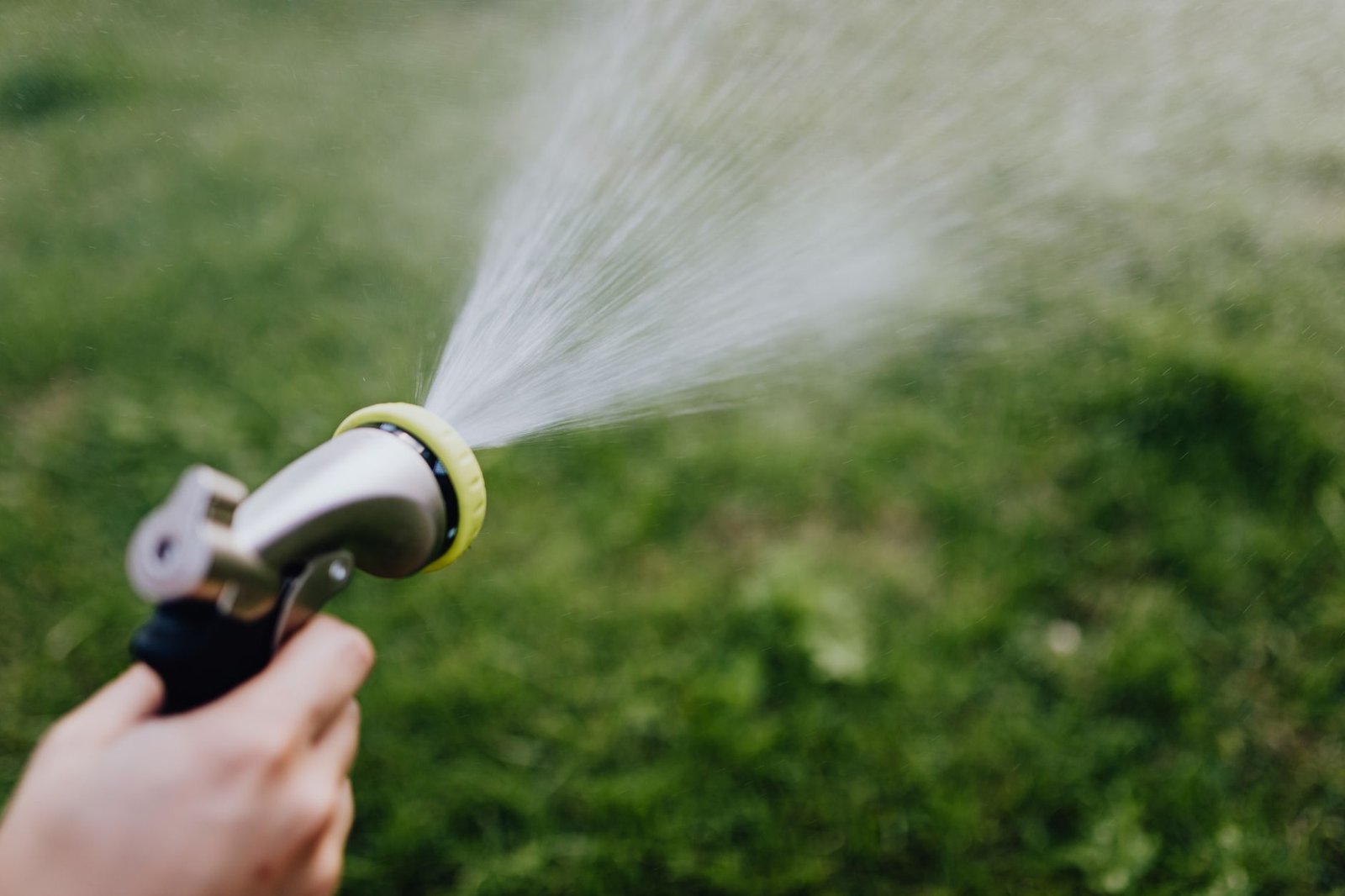
Maxx G2's "one watering" is a single measured soak: the 30-30 method, 30 seconds of shower for every 30 sq ft.
- Set the nozzle to shower, not jet and not mist.
- Start at the lowest point of the patio and work uphill, so runoff never crosses sand that hasn't been watered yet.
- Shower each 30 sq ft for at least 30 seconds, or until the sand repels the water and it starts to pool on the joints. That pooling is your signal to move on.
- Don't let the watered area dry out while you're still working. The sheet is explicit about that.
- Don't wash sand out of the joints. If you can see grains moving, the spray is too hard.
Thirty square feet is roughly a 5 x 6 ft patch, so a 12 x 16 ft patio is about seven sections. The easy mistake is treating "one watering" as "one quick spray". Alliance's FAQ says under-watering shows up as a crust over soft sand. The remedy is a sprinkler for about an hour, poking small holes through any crust, and replacing the sand if it still hasn't hardened after a few days of good weather.
Rain safe in 15 minutes is not cured in 15 minutes
The 15-minute rain-safe rating means a shower 15 minutes after watering won't wash the sand out. It doesn't mean the joint is finished.
Alliance's FAQ says dry joints can take foot and car traffic within 24 hours, and damp joints won't harden. It also explains the part that alarms people: a cured G2 joint "is designed to transition from hard and dry to soft when wet." That's how it self-heals small movements. A joint that softens after rain and hardens again as it dries is working as designed. A joint that is soft on a dry day, a week after installation, has a moisture or installation problem.
Maxx G2 or Super Sand G2?
Both G2 sands share the polymer technology and 15-minute rain rating. They differ here:
| Super Sand G2 | Maxx G2 | |
|---|---|---|
| Maximum joint | 2 in | 4 in (2 in over concrete) |
| Overlays | not listed | yes |
| Colors | Beige, Slate Grey | Beige, Slate Grey, Ivory, Black Diamond |
| Coverage, narrow joints | 65–85 sq ft | 65–85 sq ft (Black Diamond 58–76) |
If your joints are under 2 inches, you're on a gravel base, and you want beige or grey, Super Sand G2 does the same job. Choose Maxx G2 for wide flagstone joints, a slab underneath, or one of the two extra colors. For how G2 stacks up against Techniseal, SEK, Dominator and the big-box brands, see our polymeric sand for pavers comparison.
The 15-year warranty, read closely

This is the one opinion I'll push. The 15-year warranty is the least useful number on the bag, and it shouldn't sway your purchase.
Read page six of the Maxx G2 data sheet and three things stand out:
- The remedy is a refund of the purchase price. The sheet excludes "removal or reinstallation of sand or pavers." At the $43.50 to $53.00 a bag one dealer lists, a failed 200 sq ft patio might get you a few hundred dollars back. The labor to dig the joints out and redo them is entirely yours.
- It only applies to a specific build: at least 6 inches of compacted 0 to 3/4 inch crushed stone, no more than 1 inch of bedding sand, and an edge restraint. Plenty of older DIY patios don't qualify.
- Moss, mold and mildew are excluded, which are the problems people most often blame on joint sand.
Most polymeric sand warranties read the same way. The warranty assumes a well-built patio, and a well-built patio is what makes the sand last anyway. Alliance's own FAQ estimates about 15 years of life with a proper installation and regular maintenance, and says cracking in cured joints comes from paver movement, not from the sand. Spend your attention on the base and the watering, not the warranty card.
Reviews and complaints, checked against the data sheet
The reviews I could open were on dealers' own product pages, where Maxx G2 scores uniformly five stars. That tells you more about who hosts the reviews than about the sand. The complaints elsewhere follow a pattern, and each has an answer in Alliance's documents.
- "It wasn't dust free." Sand is still sand, and pouring a 50 lb bag raises some. Wear a dust mask: the dry dust, not the cured joint, is the part of polymeric sand that can be toxic.
- "It didn't set in 15 minutes." Fifteen minutes is the rain-safe rating, not the set or cure time. See the section above.
- "The joints are soft." Usually under-watering, a stone-dust or poorly draining bed, or checking a joint that is still damp. The FAQ notes that soft patches beside hard ones usually mark areas that drain more slowly.
- "White film after a week." Either polymer residue from a damp install or efflorescence drawn out of the pavers by the watering. Alliance says its efflorescence cleaner removes both.
What I couldn't find was a pattern of Maxx G2 failing on a well-built base with a correct install. Fair enough; that's also the kind of patio nobody writes a review about.
Where to buy it and what it costs
Maxx G2 is a dealer product: SiteOne stocks it by the bag and 56-bag pallet, hardscape yards carry it, and third-party sellers list it on Amazon and Walmart. One landscape supply dealer lists Beige at $43.50 a bag, Grey at $47.25, Black Diamond at $50.75 and Ivory at $53.00, so the color you pick changes the price by about 20 percent.
Freight on 50 lb bags is expensive, so buy online only for a color your yard lacks. Check the bag is intact: a torn bag that has taken on moisture has started to activate. For bag counts, measure the joint width and use the coverage rows in the table above, then add one bag. Application follows the same logic as any polymeric sand, covered step by step in how to apply polymeric sand.
Buy Maxx G2 for wide joints and wet forecasts, not the warranty
Alliance Gator Maxx G2 polymeric sand earns its price in three situations: joints over 2 inches, stone set over a concrete slab, and weekends where the forecast can't promise a dry afternoon. On a tight-jointed concrete paver patio, Super Sand G2 or any decent standard sand does the same job for less. Whichever bag you buy, the patio's future is decided by the base under it and the 30 seconds per 30 sq ft of shower on top. The bag can promise 15 minutes. The hose still needs a patient person on the end of it. Worth a read next: outdoor shower pavers.
FAQ
How wide a joint can Gator Maxx G2 fill?
Up to 4 inches on a compacted gravel base with a sand bed, and up to 2 inches over a concrete slab. The minimum width is 1/8 inch, and the joint must be at least 1 1/2 inches deep.
How long before Gator Maxx G2 can get rained on?
Fifteen minutes after watering on a traditional base, and 24 hours on an overlay. That's the point where rain won't wash it out. It still needs to dry fully to harden, which Alliance puts at around 24 hours before normal traffic.
How many square feet does a bag of Gator Maxx G2 cover?
On 2 3/8-inch pavers, a 50 lb bag covers 65 to 85 sq ft with 1/8 to 3/8 inch joints and 22 to 42 sq ft with 3/4 to 1 1/4 inch joints. Black Diamond covers slightly less: 58 to 76 and 20 to 38 sq ft.
Why is my Gator Maxx G2 soft after rain?
It's designed to soften when wet and harden again as it dries, which lets it flex with the pavers. If it stays soft on dry days, the joint was probably under-watered, laid over a stone-dust bed, or is sitting on a base that doesn't drain.
Can you put Gator Maxx G2 over old polymeric sand?
No. Alliance says to remove the existing joint material to at least 1 1/2 inches deep, without disturbing the bedding sand, and let the pavers dry completely before refilling. Mixing it with regular sand, or laying it thin on top, causes flaking and voids the warranty.


