

Last Updated on October 20, 2026 by Umar Farooq
How much space between pavers? For standard sand-set concrete pavers, 1/16 to 3/16 inch (2 to 5 mm), which is about the thickness of two stacked coins at the wide end. ICPI's Tech Spec 2 gives that range, and most concrete pavers set it for you with small spacer nibs on their sides, so you butt them together and the nibs make the gap. Wider joints belong to tumbled pavers, natural stone and slabs, following the manufacturer. For the full picture, see grout for pavers.
The standard joint for concrete pavers
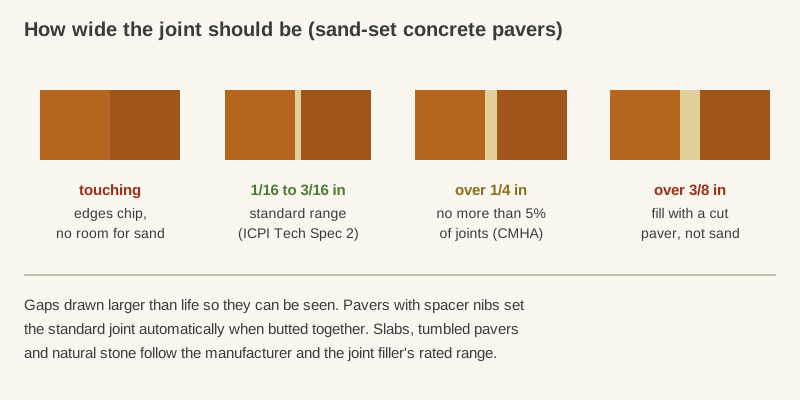
I checked the two documents contractors actually build to. ICPI's Tech Spec 2 says joints "should be consistent and be between 1/16 and 3/16 in." CMHA's guide specification repeats the range, allows no more than 5% of joints over 1/4 inch, and tells you to check the paver manufacturer for its own figure. Tech Spec 2 adds that gaps over 3/8 inch get a cut piece of paver, not more sand.
Joint width by paver type
| Paver type | Typical joint | How it's set |
|---|---|---|
| Concrete pavers with spacer nibs | 1/16–3/16 in | Butt together; the nibs set it |
| Concrete pavers without nibs | 1/16–3/16 in | By eye, checked with string lines |
| Tumbled or rustic concrete | Wider, irregular | Follow the manufacturer |
| Large slabs and porcelain | Per manufacturer | Spacers or clips |
| Natural stone, flagstone | Wider, varies with the stone | Match the joint filler's range |
For wide or irregular joints, the filler sets the limit. Alliance Gator's SuperSand G2 data sheet rates it for joints 1/8 to 2 inches wide, so a joint outside a product's range needs a different product. Which sand goes where is covered in sand for pavers, and big-slab spacing in 24×24 pavers.
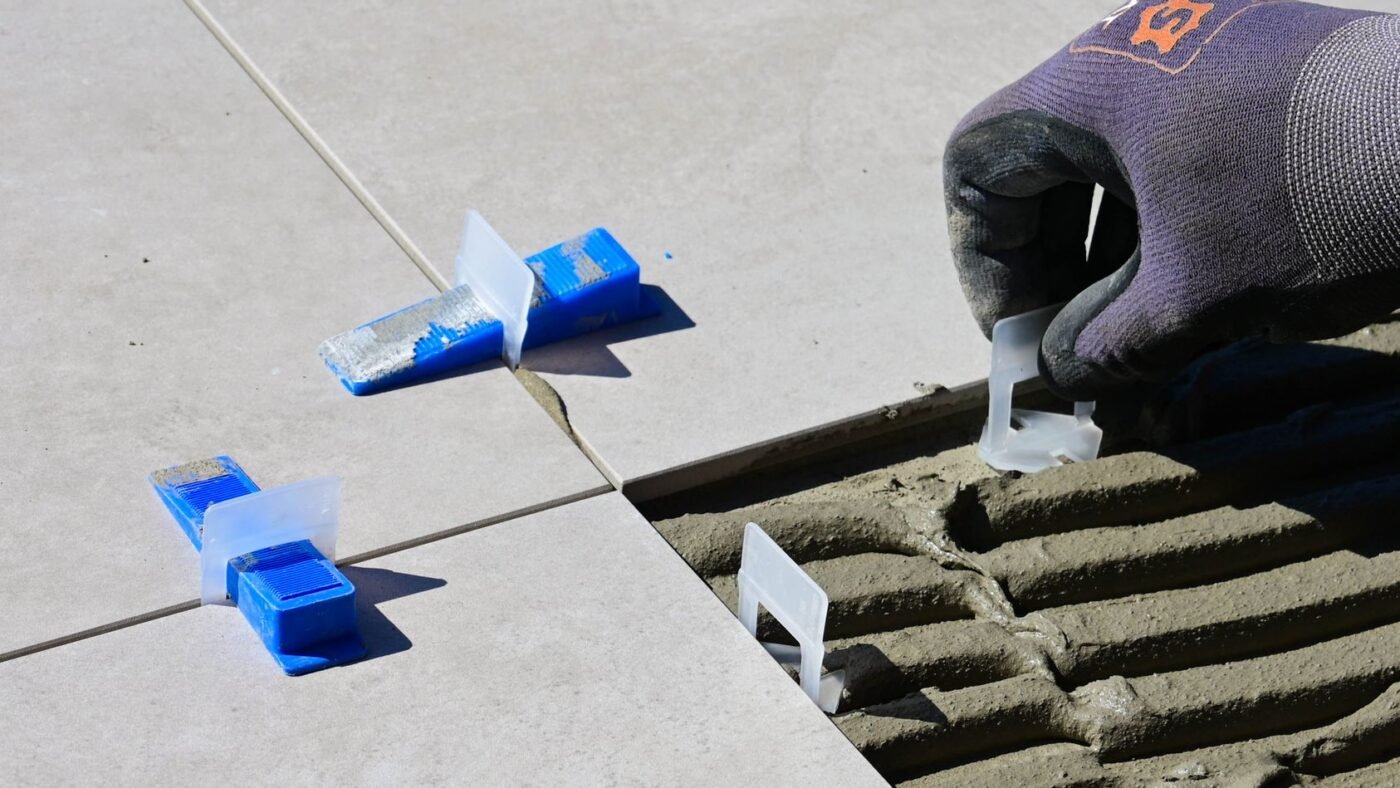
Spacers for pavers: when you need them
Here's my view: if the paver has spacer nibs, don't add spacers. Tech Spec 2 explains that the nibs "maintain a minimum joint width, allowing the sand to enter between each unit." Plastic spacers on top of nibs just double the joint. You can read more in the guide to paver spacers.
Spacers earn their keep on slabs without nibs, porcelain and cut stone, especially when set in mortar. For nib-less pavers on sand, string lines work better than spacers: set a line every few feet and nudge rows straight with a flat bar.
Too tight or too wide: how to tell
Too tight. Pavers hammered hard together have no room for joint sand, so they lose the sand that locks them. Under compaction or traffic, edges touch and chip. Unilock's install guide warns against hammering pavers tight for exactly this reason. If a knife blade won't slide into the joint, it's too tight.
Too wide. Joints over about 1/4 inch hold loose sand that washes and gets tracked out, pavers shift, and bond lines wander. If joints are opening up over time rather than being laid wide, that's movement, and how to keep pavers from moving walks through the causes. Wide joints also give weeds a comfortable place to live.
Uneven. A joint that grows from 1/8 inch to 3/8 inch across a patio means the rows drifted. Check with a string line every few rows while laying, while it's still a nudge and not a rebuild.
Keep the joint tight and consistent
For almost every concrete paver job, the right gap is the one the spacer nibs give you when the pavers just touch. Keep it between 1/16 and 3/16 inch, keep it even with string lines, and save wide joints for stone and slabs that call for them. The joint is small, but it's where the patio holds hands.
FAQ
How much space between pavers for a walkway?
The same as a patio: 1/16 to 3/16 inch for concrete pavers, per ICPI's Tech Spec 2. Pavers with spacer nibs set this automatically when laid touching.
Should pavers be touching?
Their spacer nibs should touch, but the faces shouldn't be forced together. Paver faces jammed together leave no room for joint sand and chip at the edges.
Do you need spacers for pavers?
Not for concrete pavers with built-in spacer nibs. Use spacers or clips for slabs, porcelain and stone without nibs, particularly when setting them in mortar.
What happens if the gap between pavers is too big?
The joint sand washes out more easily, pavers can shift, and weeds find a home. Gaps over 3/8 inch should be filled with a cut paver rather than sand.


