

Last Updated on October 20, 2026 by Umar Farooq
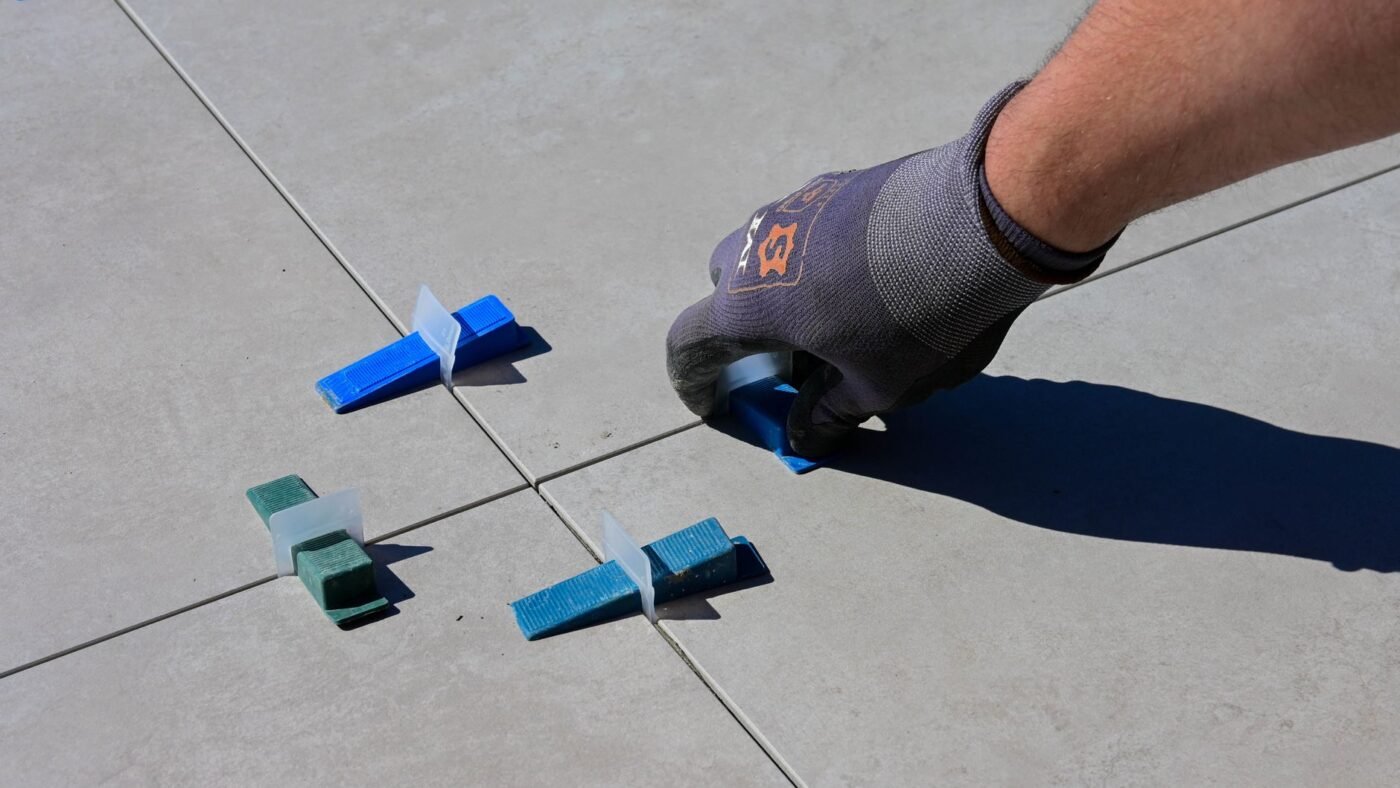
Paver spacers are small plastic crosses, T shapes or wedges that hold a consistent joint between pavers while you lay them. Most concrete pavers do not need them, because the spacer bars molded into their sides set the joint when the units touch. You need spacers for pavers and slabs without nibs, particularly porcelain and cut stone, and they are cheap enough that buying a bag for those jobs makes sense.
How wide the joint should be is covered in how much space between pavers. This page is about the spacers themselves.
Look at the paver sides before you buy any spacers
ICPI's Tech Spec 2 says joints between pavers should be between 1/16 and 3/16 inch (2 to 5 mm), and that "most pavers are made with spacer bars on their sides." Those bars "maintain a minimum joint width, allowing the sand to enter between each unit." If your pavers have them, you are done: butt the pavers together and the nibs do the spacing for you.
Adding plastic spacers on top of molded nibs just makes the joint wider than the manufacturer intended. (The hardest part of a spacer purchase is not making one.)
Cross spacers and T spacers: where each one sits

Paving Expert describes its hollow spacer in two formats, T and cross, which cover the common layouts (it says they work with random, stack bond and stretcher bond patterns):
- Cross (+) spacers sit where four units meet in a stack bond or grid, one at each corner.
- T spacers sit where one joint ends against the side of a paver, as in running bond, so they suit offset layouts.
Spacers come in thicknesses such as 2.5 mm, 3 mm and 10 mm in Paving Expert's range, so buy the one that matches your joint.
Porcelain and slabs need real spacers
Slabs and porcelain do not come with nibs, and they are usually laid more tightly or with a wider, designed joint. Ovaeda, a porcelain supplier, says spacers "keep slabs level and aligned" and recommends a minimum gap of 3 mm, with 4 to 8 mm for the best balance of looks and function. That is a supplier's guide, so treat it as a starting point and read the manufacturer's sheet for your slab.
Porcelain is covered further in porcelain pavers.
Nibless pavers on sand: skip the spacers, pull a string
ICPI notes that pavers without spacer bars "are generally not placed snug against each other since string lines guide consistent joint spacing." So on a sand-set patio with nibless units, set a string line every few rows and nudge each row to it. (A 1/8 inch hex key is a better ruler than a thumb.)
Pull the spacers or bury them?
In loose, sand-filled joints the question is whether a spacer blocks the sand that locks the pavers. Paving Expert makes the case for leaving a hollow design in: the spacers can stay in the joint after laying, and their hollow structure lets jointing material flow into and around them. It warns against timber, which can become a trip hazard, get knocked over, or rot and leave voids, and against solid plastic packers, which stop jointing material filling the full depth of the joint.
My rule from that: if the spacer is hollow and sits below the paver face, it can stay under polymeric sand. If it is a solid shim, or it sits high enough to be seen, pull it before the sand goes in.
Spacers earn their place on slabs, not on nibbed pavers
For ordinary interlocking concrete pavers, the spacers are already molded into the paver, and the right gap is the one they leave. Buy a bag of cross and T spacers only if you are laying porcelain, cut stone or other units with no nibs, and lean on a string line for everything else. The best spacer is the one you do not have to pick up afterward.
FAQ
Are spacers needed between concrete pavers?
Not for pavers that have spacer bars molded into their sides, which is most concrete pavers. You need spacers for slabs, porcelain and stone without nibs.
What size spacers do I use for pavers?
Match the joint to the paver maker's guidance. ICPI gives 1/16 to 3/16 inch (2 to 5 mm) for concrete pavers, while a porcelain supplier suggests a minimum of 3 mm and 4 to 8 mm for best results.
Can I leave paver spacers in?
A hollow spacer that sits below the paver face can stay, according to Paving Expert, because jointing material flows around it. Pull solid shims and any spacer that shows above the joint.
How do you keep pavers straight without spacers?
Use string lines. ICPI says pavers without spacer bars are guided by string lines for consistent joint spacing. Pull one every few rows and nudge each course to it.


