

Last Updated on October 20, 2026 by Umar Farooq
Grout for pavers is the right answer in only two situations: pavers bonded to a rigid concrete slab, and large porcelain or natural stone pavers that the maker says to grout. On a normal paver patio built over compacted stone and sand, the joint fill is polymeric sand or plain joint sand, not grout. The word "grout" gets used for all of it, so here is how to tell which one you need.
The pages I opened ran 400 to 850 words. This one covers what they cover and adds what they skip: why a rigid joint can wreck a flexible patio.
What people mean by grout between pavers
Paver grout is not one product. Planner5d's explainer describes grout as a paste or mortar that fills gaps so the pavers are held and protected, and it splits the job into dry and wet grouting. Hunker's guide treats sand as the usual way to fill the gaps. Beesley and Fildes, a UK stone supplier, talks about cement-based pointing and brush-in grout for porcelain paving. Three vocabularies, one question: what goes in the joint?
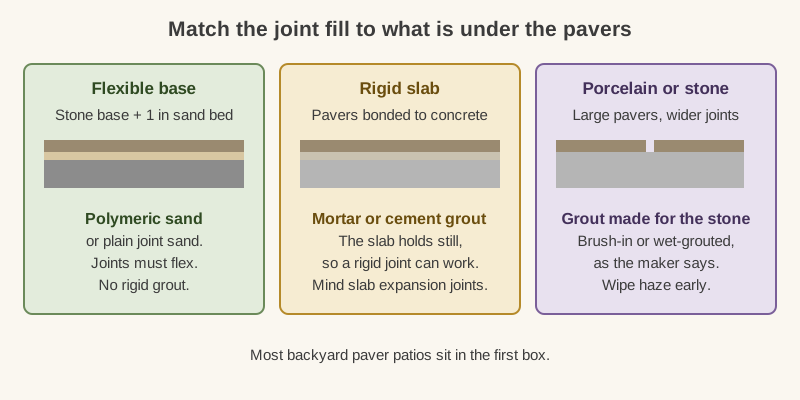
Match the joint fill to what is under the pavers
The diagram above is the whole decision. Pavers laid on a compacted base and 1 inch of bedding sand are a flexible pavement: the joints let the field flex and share load. A rigid cement joint on top of that cracks, because the base moves a little and the grout does not. Hunker agrees from the other side, noting that dry mortar is labor-intensive, porous, and can break down after prolonged rain. My sibling article on mortar between pavers goes into why mortar fails on sand bases and where it does work.
Where grout belongs:
- Pavers on a rigid concrete slab, where nothing underneath moves.
- Porcelain pavers and some natural stone, where the manufacturer specifies it.
- Wide joints, where sand struggles to hold. See paver joint compound for resin options.
Where it does not belong: a typical backyard patio, a walkway or a driveway of concrete pavers on a stone base. There, sand is the right fill.
Sand, polymeric sand or cement grout
| Option | Best for | What to know |
|---|---|---|
| Plain joint sand | Flexible paver fields | Easy, cheap, washes out over time |
| Polymeric sand | Flexible paver fields | Hardens with water, joints 1/8 to 2 in on one maker's data sheet |
| Cement or mortar grout | Rigid slab, some stone | Cracks if the base moves |
| Resin or polymer jointing compound | Wide joints, natural stone | Costs more, see the sibling article |
Hunker says sand is easier, less messy and can last longer than mortar. Polymeric sand contains additives that harden when wet. One data sheet I have on file (Alliance Gator SuperSand G2) calls for joints at least 1 1/2 inches deep and finished 1/8 inch below the paver top, and says 30 to 50 percent of the sand drops after the first compaction. Your bag will say its own numbers. For the method, see how to apply polymeric sand, and for what it is, the what-is-polymeric-sand article here.
Dry grouting and wet grouting
If you do land in grout territory, there are two ways to apply it.
- Dry grouting. A sand and cement mix is swept into the joints with a soft brush. Planner5d says it is easy and does not stain, but joints may need several passes and topping up about once a year. Beesley's brush-in method is the same idea, and the page calls it simpler on larger patios.
- Wet grouting. Planner5d recommends it for pool surrounds and for joints wider than 3 mm, and says it is not recommended for patterned or decorative stone because it can leave concrete residue. Beesley describes pushing mortar in with trowels, shaping it with a pointing iron, then cleaning with a soft brush and damp sponge. That page's traditional mix is 4 parts sharp sand to 1 part cement, with water added until it balls in the hand. It is a UK page, so check the grout maker's own mix before copying it.
Beesley adds a timing rule: the bedding under the pavers must be fully dry first, about 24 hours, and the weather should be dry with no risk of frost. For anything cement-based, follow that, and wipe off haze early.
Seal after you grout, but not straight away
Hunker suggests two coats of paver sealer to reduce staining, and says new pavers may need a month or longer before sealing so trapped moisture can evaporate. For the product-specific wait, the data sheet wins: Techniseal's natural-look sealer says 30 days after polymeric sand. See sealing paver joints if you are deciding whether to seal over the joints at all.
Sand on a flexible base, grout only on a slab
If your pavers sit on stone and sand, skip grout and use polymeric sand. If they sit on concrete or are large porcelain, grout is right, and the maker's instructions are the real spec. In either case, the joint is the cheapest part of the job and the one that decides how the patio ages. Fill it with the right thing once and it will mostly leave you alone, which in a patio is the highest compliment.
FAQ
What is the best grout for pavers?
It depends on the setup. For concrete pavers on a stone and sand base, polymeric sand or plain joint sand is the usual joint fill, not grout. For pavers on a rigid slab or for porcelain, a cement-based or stone-specific grout suits better.
Can you use regular grout between pavers?
Only on a rigid base, such as a concrete slab. On a sand base the joints need to flex, and rigid grout tends to crack when the base shifts.
Is polymeric sand the same as grout?
No. Polymeric sand is sand with additives that harden when wet, and it stays slightly flexible. Cement grout is rigid. They suit different bases.
What is the difference between dry and wet grouting?
Dry grouting sweeps a sand and cement mix into the joints with a brush. Wet grouting pushes or pours a mixed paste into the joints and wipes the surface clean. Wet grouting is usually recommended for pool surrounds and wider joints.
How wide should joints be for grout?
One source recommends wet grouting for joints wider than 3 mm (about 1/8 inch). Polymeric sand data sheets often list 1/8 to 2 inches, so check the product. See how much space between pavers for patio joints.
Can you grout cobblestone pavers?
Cobblestones are usually filled with crusher dust swept into the joints and misted with water, according to one source, because their shape rules out the usual grouting methods.


