

Last Updated on October 20, 2026 by Umar Farooq
A basketweave paver pattern sets two rectangular pavers side by side to make a square block, then turns the next block 90 degrees, so the surface reads like woven cane. It only works with pavers exactly twice as long as they are wide, such as 4 x 8 inch, and it is best for patios and walkways rather than driveways.
The pattern is simple to lay, and the arithmetic behind it is the part most guides skip. That arithmetic is where you save cuts.
How a basketweave paver pattern is built
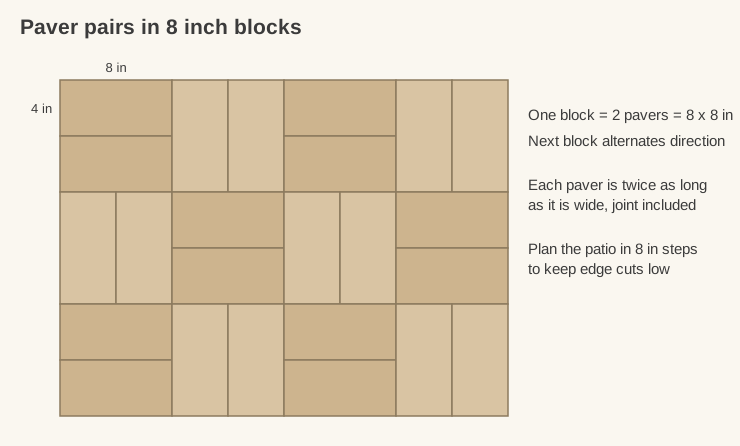
Western Interlock's pattern guide describes it as laying stones in pairs and alternating direction instead of running them in straight lines. Unilock calls the same layout parquet: two pavers laid vertically, then two laid horizontally, repeating into alternating rows.
With 4 x 8 pavers, each pair makes an 8 x 8 inch block. Blocks alternate like a checkerboard: horizontal pair, vertical pair, horizontal pair. Every joint is short, and the eye reads the squares first.
Belgard files it under retro looks, suited to courtyards, garden paths and rustic tones. I would add cottage and traditional house styles, where a woven surface looks like it belongs.
The 2:1 rule that decides everything
The pattern closes up only if two pavers side by side exactly equal one paver's length. That means a paver whose length is twice its width, joint included.
- Works: 4 x 8 inch, 6 x 12 inch, and any true 2:1 rectangle.
- Does not work: 6 x 9 inch (a 3:2 ratio), or any paver with a different ratio. The blocks never meet at the corners and the gaps wander.
Nominal sizes hide the joint. A "4 x 8" paver may measure a hair under, with the joint making up the difference, so lay a dry 3 x 3 block before you order a pallet. If the pairs do not form a square, the pavers are not true 2:1 and the pattern will fight you all the way across the patio.
Size the patio in 8 inch steps
Each block is 8 inches, so a dimension that divides by 8 inches ends on a whole block with no edge cuts. A few dimensions that work:
| Dimension | Inches | Blocks | Cuts at that edge |
|---|---|---|---|
| 8 ft | 96 | 12 | none |
| 10 ft | 120 | 15 | none |
| 12 ft | 144 | 18 | none |
| 14 ft | 168 | 21 | none |
| 11 ft | 132 | 16.5 | half-block cut |
So 10, 12 and 14 foot patios work cleanly, and an 11 foot one adds a row of cut pairs. If your yard allows it, nudge the size. Add 5 to 10% for waste on a rectangle, as in paver patterns, and use how many pavers do I need for the count (4.5 pavers per square foot for 4 x 8).
Laying a basketweave patio, block by block
Base and sand are the standard build: 4 inches of compacted base minimum on well-drained soil and 1 inch of loose screeded bedding sand (ICPI Tech Spec 2). Then:
- Set a square corner. Check it with a 3-4-5 triangle, since the pattern shows any drift as a stepped edge.
- Lay the first block in the corner: two pavers side by side, tight to the string lines.
- Add the next block turned 90 degrees. Keep alternating across and down.
- Check the block corners with a string every few rows. They should fall on straight lines both ways.
- Cut last. Lay all whole blocks, install the edge restraint, then cut the border pieces.
Cutting technique is in how to cut pavers. Keep every cut piece at least a third of a paver; slivers work loose.
Strength, and where basketweave does not belong
Basketweave interlocks better than stack bond but not as well as running bond or herringbone. The edges of the blocks form a continuous grid of joints running both ways, which gives a load a straight path to slide along. For foot traffic that hardly matters. Under turning tires it does.
My rule: basketweave for patios, courtyards and walks; herringbone for driveways. The pattern also needs a solid edge restraint on every side, spiked into the base or a concrete toe, because without one the outer blocks roll and the weave unravels. Paver edging covers the options.
Variations worth knowing
- Single basketweave. Pairs only, as above. The standard version.
- Boxed or bordered basketweave. A soldier course around the field in a second color. It hides the cut edge and gives the pairs a frame.
- Half basketweave. Several sources describe versions that mix basketweave blocks with a different pattern, so check the manufacturer's sheet before you order.
- Two-tone weave. Alternate block colors for a checkerboard. It looks bold. It also shows every misaligned block from across the yard, which is what in-laws are for.
Pick the weave for the house, not the patio
Choose a basketweave paver pattern when the house is traditional, the paver is a true 2:1 rectangle, and the surface will see feet, not tires. Size it in 8 inch steps, cut last, and edge it properly. If the style does not fit, running bond is the safer all-rounder.
FAQ
What size pavers do you need for a basketweave pattern?
Pavers exactly twice as long as they are wide, including the joint. The classic is 4 x 8 inch, and 6 x 12 inch also works. A 6 x 9 will not close the pattern.
Is basketweave good for a patio?
Yes. It looks traditional, needs few cuts when the size fits, and is easy to lay. It is a weaker choice for driveways because its joints line up along both axes.
Is basketweave the same as parquet?
They describe the same pairs-turned-90-degrees layout. Unilock uses parquet as the name for its basketweave pattern.
How many pavers do I need for a basketweave patio?
The same as any pattern with 4 x 8 pavers: about 4.5 per square foot, plus 5 to 10% for cuts and breakage.
Is basketweave harder to lay than running bond?
Slightly. Running bond only needs rows kept straight, while basketweave needs every block turned correctly. Neither is hard if the base is flat.


