

Last Updated on October 20, 2026 by Umar Farooq
The best polymeric sand for pavers is the one rated for your joint width and your weather window, and the brand comes a distant third. For ordinary 1/8 to 1/2 inch concrete paver joints, Techniseal EZSand, Alliance Gator Super Sand G2, SEK Surebond PolySweep and Sakrete PermaSand all do the job. For flagstone and joints wider than 1 inch, you need a wide-joint formula such as Gator Maxx G2, SEK PolySweep X-Treme, Dominator or Techniseal HP NextGel. If rain keeps threatening, pick the sand with the shortest rain-safe time on its data sheet: Gator's G2 sands are rated at 15 minutes, while most others want 12 to 24 dry hours. The details are in our piece on dog friendly paver patio.
I downloaded the current technical data sheets for six brands and lined up the numbers, because no store shelf will do it for you. Every bag promises to stop weeds, deter ants and resist washout. Read six of them in a row and it feels like interviewing candidates who all handed in the same résumé. The differences are in the small print, and the small print is what decides whether your joints set.
If you're still deciding whether you want polymeric sand at all, start with what polymeric sand is and when to skip it. Plain joint sand is cheaper and forgiving, and on a tight-jointed patio with good edge restraint it's a perfectly respectable choice.
Polymeric sand for pavers: six brands on one page
These figures come from each manufacturer's own technical data sheet, not from a retailer listing. Where a brand sells more than one grade, both are shown.
| Product | Joint width | Min. joint depth | Rain-safe after | Install temperature | Vehicles after |
|---|---|---|---|---|---|
| Techniseal EZSand | 1/8–1/2 in | 1.5 in | plan 24 h dry | above 32°F for 48 h | 24–48 h |
| Techniseal RG+ | 1/16–1 in | 1.5 in | 90 min (plan 24 h) | above freezing for 48 h | per bag |
| Techniseal HP NextGel | 1/16–4 in | 1.5 in | 60 min (24–48 h to dry) | above 32°F for 48 h | 48–72 h |
| Alliance Gator Super Sand G2 | 1/8–2 in | 1.5 in | 15 min | above 32°F | per bag |
| Alliance Gator Maxx G2 | 1/8–4 in | 1.5 in | 15 min | above 32°F | per bag |
| SEK PolySweep (regular) | up to 3/4 in | 1.5 in | 12 h dry | average above 35°F for 48 h | per bag |
| SEK PolySweep X-Treme | up to 4 in | 1.25 in | 12 h dry | average above 35°F for 48 h | per bag |
| Dominator (Black Diamond) | 1/8–4 in | 1 in | 24 h dry | above 50°F, 48 h before and after | 48–72 h |
| Sakrete PermaSand | 1/4–1 1/2 in | full depth | 24 h dry | above 40°F | light vehicles 72 h |
| Sakrete Paver Set | up to 1 1/2 in | 1 in | per bag | per bag | per bag |
| Quikrete HardScapes | up to 2 in | per bag | per bag | per bag | per bag |
"Per bag" means the figure wasn't on the sheet I could open. The bag you buy is the one that counts anyway, because formulas get revised.
Two patterns jump out. First, the minimum joint depth is 1 to 1.5 inches across the board. None of these products is designed to sit as a thin layer on top of old sand. Second, the temperature rules vary more than people expect. Dominator's 50°F floor for two days on either side of the job rules out a surprising amount of spring in the northern states. Gator and Techniseal only ask for above freezing.
Measure the joint before you pick a bag
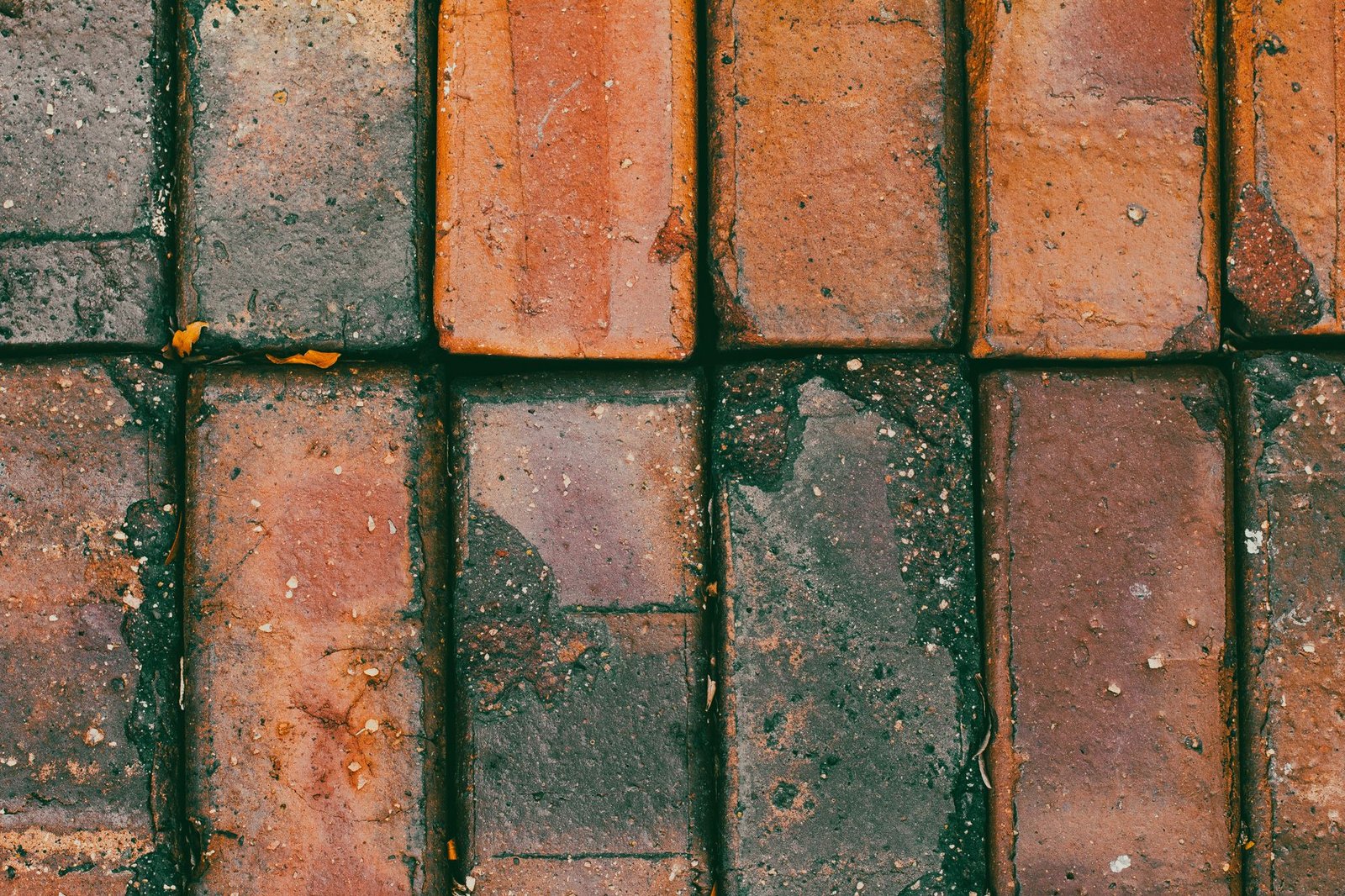
Most failed polymeric joints I read about trace back to a sand used outside its rated width. A narrow-joint sand in a 1 1/2-inch flagstone gap doesn't have enough binder structure to bridge it, so it cracks and washes out. A wide-joint sand works in narrow joints, but you pay more for capability you don't use.
So measure first. Put a tape across five or six joints in different parts of the patio and note the widest. Concrete pavers with spacer nibs usually sit at about 1/8 to 3/16 inch. Tumbled pavers vary more because their edges are irregular. Natural stone and irregular flagstone can run anywhere from 1/2 inch to 3 inches in the same patio.
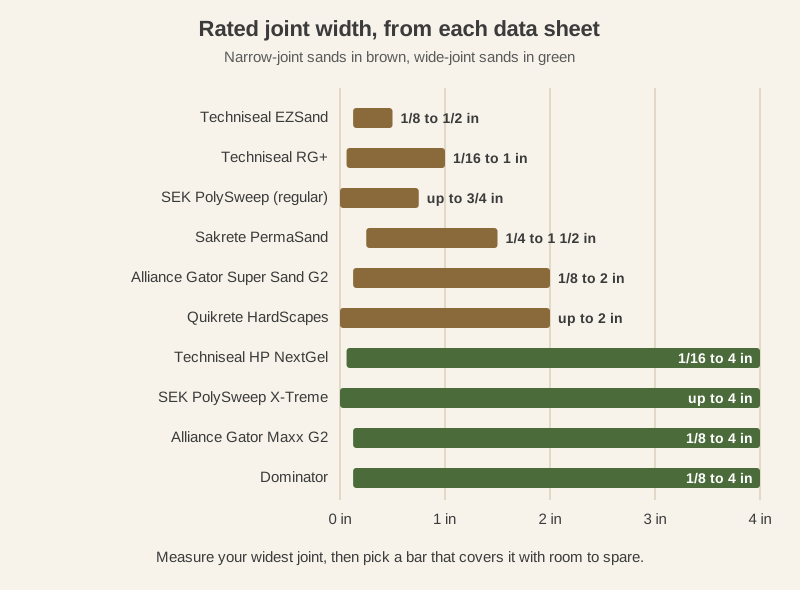
Then choose by the widest joint, not the average:
- All joints under 1/2 inch: any standard sand. Buy on price, color and availability.
- Some joints between 1/2 and 1 inch: Techniseal RG+, Gator Super Sand G2, Sakrete PermaSand or Quikrete HardScapes. SEK's regular PolySweep stops at 3/4 inch.
- Anything over 1 1/2 inches: a wide-joint formula only. That means Gator Maxx G2, PolySweep X-Treme, Dominator or HP NextGel.
Depth matters just as much. On an existing patio, rake the old sand out to at least the depth your chosen bag asks for. The bag count is simple arithmetic once you know joint width and paver thickness.
Alliance Gator: Super Sand G2 and Gator Maxx G2
Alliance Gator's G2 sands are the ones built around a short rain window. The Super Sand G2 data sheet rates it for joints from 1/8 to 2 inches, with a minimum depth of 1 1/2 inches. It's rain safe 15 minutes after water activation, and it installs above 32°F. The same sheet expects 30 to 50 percent of the sand to drop after the first compaction, which is a useful warning to buy enough.
Gator Maxx G2 is the wide-joint sibling. Its technical data sheet takes it to 4 inches on a traditional base, 2 inches over a concrete overlay, and lists four colors: Beige, Slate Grey, Ivory and Black Diamond. A 50 lb bag covers 65 to 85 sq ft of narrow joints on 2 3/8-inch pavers, or 22 to 42 sq ft of 3/4 to 1 1/4-inch joints. Alliance also markets it as needing only one watering and no blower, which is a genuine labor saving if it performs as described on your pavers.
Choose Gator when rain is the risk you can't control. The detailed specs, colors and the complaints people report are in our Gator Maxx G2 review.
Techniseal EZSand, RG+ and HP NextGel
Techniseal sells a ladder of products rather than one bag, which is useful once you know which rung you're on.
- EZSand is the homeowner bag you find at big-box stores. Its data sheet limits it to 1/8 to 1/2 inch joints and at least 1.5 inches of depth. It says to plan on 24 hours without rain and warns it can take up to 72 hours to harden. Mechanical compaction is marked mandatory, with a rubber mallet as the fallback if you have no plate.
- RG+ covers 1/16 to 1 inch. It resists an unexpected shower 90 minutes after installation, though Techniseal still asks for 24 dry hours. Its sheet says to use HP2 instead for joint replacement on existing patios.
- HP NextGel is the professional grade. It goes from 1/16 inch to 4 inches, withstands rain at 60 minutes, and needs 24 to 48 hours to dry fully. Its sheet also sets a minimum wait of 7 days, and up to 30, before you clean or seal.
A detail worth knowing: Techniseal's sheets say joints "become soft when humid but become hard again when dry." That's normal behavior for the product, not a defect, and a lot of worried forum posts would be shorter if more people had read that line. The full range is broken down in our Techniseal polymeric sand guide.
SEK Surebond PolySweep and its X-Treme wide-joint version
SEK Surebond's PolySweep is common at hardscape dealers in the Midwest and Northeast. The PolySweep technical data sheet splits it into two products:
- Regular PolySweep: joints up to 3/4 inch, minimum depth 1.5 inches. A 50 lb bag covers 50 to 75 sq ft of joints up to 1/4 inch, falling to 15 to 25 sq ft at 1/2 to 3/4 inch.
- X-Treme Wide Joint: joints up to 4 inches, minimum depth 1.25 inches. It's aimed at natural stone, and it isn't sold in the Pearl color.
The sheet asks for at least 12 hours without rain and an average air temperature above 35°F for 48 hours afterward. It's also the only sheet here that tells you how many waterings to plan for: mist no more than 500 sq ft at a time, three or four passes about 5 minutes apart, with more water each pass.
Two claims on that sheet deserve a raised eyebrow. SEK says PolySweep beats "the competition" on cohesion by a factor of six (180 psi against 30 psi at 12 hours) without naming the competition. And it markets "Clear Set Technology" as haze free. Both may well be true, but a comparison against an unnamed rival is the kind of number I can't check, so I'd treat it as marketing until someone publishes the other side.
Dominator by Black Diamond Coatings: cement-free, but warm-weather only
Dominator is sold mostly online and does well in reviews, partly because of its color range. The product page lists six colors (Camel Brown, Charcoal Gray, Natural Ivory, Gray Beige, Titanium Gray and Midnight Black). It comes in 10 and 40 lb containers, and it's rated for joints from 1/8 to 4 inches.
The data sheet has three conditions that other brands don't share:
- Temperature above 50°F for 48 hours before and after. That's the strictest rule in this comparison. It makes Dominator a late-spring-to-early-fall product in cold climates.
- A 1-inch minimum depth, shallower than the 1.5 inches most others want. That helps on thin pavers or overlays.
- Compaction "only if necessary." Most other brands make a plate compactor mandatory, so this is a real difference in method, not just wording.
It also asks for 24 hours without rain, allows vehicles after 48 to 72 hours, and wants 14 days before you clean or seal. The formula is cement-free, which matters if you're worried about the alkali burns that cement-bearing products can cause on wet skin.
Sakrete Paver Set and PermaSand
Sakrete makes two different bags, and they're easy to confuse on the shelf.
Paver Set is the older, cheaper product. Its data sheet caps joints at 1 1/2 inches with a minimum depth of 1 inch. It wants a draining sand bed underneath and four misting applications at 10 to 20 minute intervals. The safety panel is the giveaway. It warns about "alkali in Portland cement," so this is a cement-modified sand, not a pure polymer one. That's why its haze, when it happens, behaves more like cement film than polymer residue.
PermaSand is the polymer product. The PermaSand data sheet calls for joints from 1/4 to 1 1/2 inches, filled to full depth, installed above 40°F with no rain forecast for 24 hours. It opens to foot traffic in 24 hours and light vehicles in 72. It shouts its most important instruction in capitals: failure to remove all the dust may cause staining, and the sheet adds that this is "especially critical with red and textured pavers."
Note the 1/4-inch minimum. On tight concrete pavers with 1/8-inch joints, PermaSand is outside its range, and EZSand or Gator Super Sand G2 is the better fit.
Quikrete HardScapes polymeric jointing sand
Quikrete's HardScapes Polymeric Jointing Sand (item 1175-56) is sold in 50 lb bags and rated for joints up to 2 inches. Quikrete describes it as a polymer-modified graded sand that hardens after it's swept in and dampened. Its detailed data sheet wouldn't open for me, so I can't give you its rain window or temperature floor, and I'm not going to guess them.
Quikrete also sells a separate PowerLoc jointing sand meant for narrower joints. If you pick up a Quikrete bag, turn it over and read the width and depth limits before you buy four more.
The rain window decides your weekend
For most DIY jobs, the rain-safe time matters more than the joint width, because it decides whether you can work this weekend at all.
- 15 minutes: Alliance Gator Super Sand G2 and Maxx G2.
- 60 to 90 minutes against a surprise shower: Techniseal HP NextGel (60) and RG+ (90). Both still want 24 hours dry for best results.
- 12 hours: SEK PolySweep.
- 24 hours: Techniseal EZSand, Sakrete PermaSand, Dominator.
Here's where people go wrong. "Rain safe" means the sand won't wash out of the joint. It doesn't mean the joint has cured. Techniseal's HP sheet is honest about this, saying the sand resists rain after 60 minutes but needs 24 to 48 hours to dry and polymerize fully. If a 15-minute sand is hit by a storm an hour after watering, it stays put, but it'll take longer to harden. Worth a read next: patio heater placement.
The practical rule: if the forecast gives you less than a full dry day, buy a fast-set sand. If you have two clear days, buy whichever one fits your joints.
How to read the haze-free claims
Almost every product now claims to be haze free, dust free, or both. Gator Maxx G2 and HP NextGel are marketed on it, PolySweep has Clear Set, and Dominator says it "rinses easily."
Read the same data sheets a little further, though, and each one still tells you to get every grain off the paver faces before water touches them. EZSand's sheet says it outright: if the procedure isn't followed, "a light haze may be left on the surface." The formulas reduce the risk. None of them repeal the physics of dust glued to a wet paver.
Haze risk goes up with:
- Textured, tumbled and clay pavers. Their pores hold dust, and clay holds moisture. Gator's sheet says to test first on clay.
- Dark pavers with a light sand, or red pavers with any sand. Contrast makes a thin film obvious.
- Damp surfaces. Every sheet here bans installing on wet pavers.
If you already have a grey film, it can be dissolved off, but prevention is far cheaper than removal.
What the reviews complain about
Buyer reviews for every brand here fall into the same four complaints, and I checked each one against the manufacturers' own troubleshooting notes:
- Joints stayed soft. Usually too little water reached the bottom of the joint, or the joint was too shallow. Sakrete's PermaSand sheet warns that if the top hardens but the bottom stays dry, "the PermaSand will eventually fail."
- Haze on the pavers. Dust left on the faces, or the paver was damp.
- Cracking or crumbling after a winter. Often a narrow-joint sand used in a wide joint, or sand laid thin over old material.
- Weeds anyway. Seeds land in the dust that collects on top of the joint. No bag prevents that, and several data sheets say so.
What the reviews rarely show is a brand failing when its own instructions were followed. That doesn't prove every product is equal. It does suggest that a star rating tells you more about how carefully people read the bag than about the sand inside it.
Where to buy polymeric sand

Where you buy it largely decides which brands you can choose from.
- Big-box stores (Home Depot, Lowe's, Ace): Sakrete, Quikrete and Techniseal EZSand are the usual stock. Both Home Depot and Lowe's host Sakrete's Paver Set data sheet, and EZSand is listed at Home Depot and Ace. Selection runs toward narrow-joint products and one or two colors.
- Hardscape dealers and landscape supply yards: this is where Gator, Techniseal RG+ and HP NextGel, and SEK PolySweep live, in more colors. Paver brands often sell the sand next to the pavers. Techo-Bloc's online shop, for example, carries SEK's X-Treme Wide Joint. Dealers also keep sealed pallets outdoors, so check that the bag isn't torn.
- Online: Dominator sells direct, and specialist stores ship most brands. Freight on a 50 lb bag adds up fast. Online makes sense for a color the local yard doesn't stock, not to save a few dollars a bag.
Whatever you buy, check the bag is intact and dry. A bag that has taken on moisture has already started activating. SEK gives its product a 24-month shelf life, Sakrete one year. If the bag looks lumpy, leave it on the shelf.
Buy one extra bag rather than coming up short halfway through a section. Leftover sealed sand keeps, while a half-filled patio with rain coming does not. Coverage depends on joint width and paver thickness, so use the chart on your own bag rather than a rule of thumb.
Buy for the joint and the forecast, then pick the brand
The best polymeric sand for pavers is chosen in this order. Measure your widest joint and buy a product rated past it. Check the forecast and the temperature floor, and choose a fast-set sand if you can't count on a dry day. Only then worry about brand and color. Techniseal EZSand and Gator Super Sand G2 cover most concrete-paver patios. Gator Maxx G2, PolySweep X-Treme, Dominator and HP NextGel are for stone and wide joints. The quiet winner in every comparison is whoever read the back of the bag before opening it.
FAQ
What is the best polymeric sand for pavers?
For standard concrete pavers with joints under 1/2 inch, Techniseal EZSand or Alliance Gator Super Sand G2 are easy to find and well documented. For joints wider than 1 1/2 inches, use a wide-joint product such as Gator Maxx G2, SEK PolySweep X-Treme, Dominator or Techniseal HP NextGel.
Which polymeric sand is best for wide joints?
Four products in this comparison are rated to 4 inches: Alliance Gator Maxx G2, SEK PolySweep X-Treme Wide Joint, Dominator and Techniseal HP NextGel. Gator Maxx G2 drops to 2 inches when the stone is laid over a concrete slab.
Is Sakrete or Alliance Gator polymeric sand better?
They suit different jobs. Sakrete PermaSand needs joints of at least 1/4 inch and 24 dry hours. Gator Super Sand G2 works from 1/8 inch and is rain safe after 15 minutes. Sakrete Paver Set contains Portland cement, which Gator's sands don't.
Can you mix two brands of polymeric sand?
No. Every data sheet here says not to mix the product with any other material, and the binders are formulated differently. If you run out, finish a whole section with one brand and start the next with the other.
Where can I buy polymeric sand?
Home Depot, Lowe's and Ace usually stock Sakrete, Quikrete and Techniseal EZSand. Hardscape dealers and landscape supply yards carry Alliance Gator, Techniseal's professional grades and SEK PolySweep. Dominator is sold mainly online.


