


Last Updated on October 20, 2026 by Umar Farooq
Brick paver edging is a row of clay or concrete brick pavers set along the outside of a walk, patio or bed to define its edge. Dig a trench at least 6 inches deep, add 2 to 3 inches of compacted paver base and about 1 inch of stone dust or sand, then set the bricks flush with the ground. The part most guides gloss over: a brick row set in soil is a border, not a restraint. If it edges a paver surface, something hidden behind it has to stop the pavers spreading.
I read three how-to guides (magazine, project site and a manufacturer) and checked the clay paver grading against the Brick Industry Association's tech note. They agree on the trench and disagree on mortar, spikes and brick grade. For the big picture, see patio edging, and for the hidden restraint, paver edging.
Two jobs a brick edge can do
A brick edge does one of two jobs. It marks a line, between a bed and a lawn or a path and a flower border, or it holds a paver surface in.
For a mowing edge or a garden border, This Old House's method is a trench, a compacted base and bricks set flush so a mower wheel rolls over them. For a paver walk, Family Handyman puts the bricks on gravel and sand and then nails plastic edging along their outside face. That edging is the restraint. Our plastic vs metal paver edging guide compares the materials.
Here is my one strong opinion. A brick row beside a paver patio does not replace edge restraint. Interlock only works when the field cannot spread, and a loose row of bricks can spread with it. Put the restraint behind or under the row, and let the brick be the neat part.
Pick the brick: pavers, not wall brick
Use clay paving brick or concrete brick pavers, not wall brick. Our paver bricks guide explains the difference. This Old House says to use clay pavers rated for severe weather, often labelled SW, so they survive freeze-thaw.
The paver standard calls its freezing-climate class SX, not SW. The Brick Industry Association's Technical Note 14 says ASTM C902 Class SX is for pavers that may freeze while saturated, Class MX is for outdoor use with no freezing, and Class NX is not acceptable outdoors. Where it freezes, ask the yard for SX and ask them what their SW label means. Also measure a few bricks first, since sizes vary slightly (This Old House).
Dig for the brick, not for the lawn
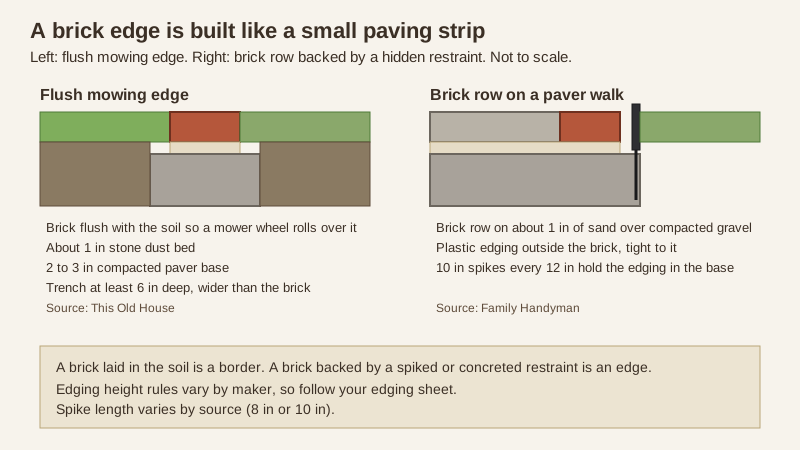
This Old House says the trench should be at least 6 inches deep and several inches wider than the brick, with straight sides, dug past the topsoil. Under the brick go 2 to 3 inches of compacted paver base, tamped in small batches, and a bed of about 1 inch of stone dust.
Family Handyman builds a bigger trench for a walk edge: 14 inches wide and 8 inches deep for typical 4 x 8 inch pavers about 2 1/4 inches thick, with 3/4 inch minus gravel compacted in two 3 inch lifts and a bed of a little over 1 inch of sand. It extends the compacted base 6 inches beyond the brick and 6 inches below it, so the bricks do not tip under a mower. Place the bricks 1/4 to 1/2 inch above the walkway, then tamp them flush.
Our paver base guide covers the depth rules. The ICPI figure for a walk or patio on well-drained soil is at least 4 inches.
Mortar or dry-set: the guides disagree
This Old House beds the bricks in a mix of stone dust and portland cement at 6 to 1, misted lightly rather than soaked, and fills the joints with polymeric sand. Family Handyman uses no mortar at all: gravel, a sand bed and dry sand swept in.
Mortar gives a firmer line. Dry-set is easier to repair, because a brick that heaves can be lifted and relaid, which is the quiet superpower of paving. If you use polymeric sand, This Old House says apply it only in dry conditions, since rain within a couple of days can leave it stuck to the brick faces.
Spikes disagree too. Pavestone's edging guide uses 8-inch nylon spikes and Family Handyman uses 10-inch spikes every 12 inches, and our paver-edging guide uses 10 inches. Follow your edging maker's sheet.
Curves, cuts and how many bricks to buy
On a curve, This Old House says to keep bricks close but not touching, with the widest point of a triangular gap no wider than one brick. Cut keystones, which are the tapered bricks, with a circular saw and a segmented diamond blade, with water trickling on the cut, and test on scrap first. OSHA's rule for masonry saws is water on the blade every time (29 CFR 1926.1153).
Quantity is simple. Family Handyman says multiply linear feet by 3 for 4 inch wide bricks. This Old House divides the length in inches by the brick width and adds 10 percent. For 40 feet, my arithmetic is 480 inches divided by 4, which is 120 bricks, or 132 with the extra 10 percent.
What it costs
Pavestone puts its plastic edging job at $80 to $100 for a small area. That is the restraint, not the bricks, and I found no current sourced price for brick edging itself. Bricks are a small cost beside the digging and base, so if the budget is tight, skip a fancier brick and never skip the restraint.
Let the brick be the border and the hidden edge do the holding
Brick paver edging is worth building where you want a classic, mower-friendly line: path borders, bed edges and patio frames. Choose SX clay pavers where it freezes, dig the trench to at least 6 inches, compact a base, set the bricks flush and fill the joints. Then check that something solid sits behind the row beside any paver surface. A pretty row of bricks with nothing behind it is a patio with a nice hat and plans to travel.
FAQ
How deep should brick paver edging be?
This Old House says the trench should be at least 6 inches deep, for 2 to 3 inches of paver base, about 1 inch of stone dust and the brick set flush. Family Handyman digs 8 inches for a walk edge. Dig deeper where the ground is wet or freezes.
Do you need mortar for brick edging?
Not always. This Old House uses a stone dust and cement bed, while Family Handyman lays bricks dry on gravel and sand. Mortar gives a firmer edge. Dry-set is easier to repair.
Can brick edging hold pavers in place?
Not on its own. A loose row of bricks can move with the pavers, so a hidden restraint, such as plastic edging spiked into the base, or a concrete haunch, should sit behind or under it.
What brick is best for edging?
Clay paving brick or concrete brick pavers, not wall brick. Where winters freeze, ask for ASTM C902 Class SX clay pavers, as described in the Brick Industry Association's tech note.
How many bricks do I need for edging?
Divide the edge length in inches by the brick width, then add 10 percent. Family Handyman's shortcut for 4 inch wide bricks is to multiply linear feet by 3.
Should brick edging sit flush or raised?
Flush for a mowing edge, since a mower wheel can roll over it. Raised gives a slight curb that holds mulch. Bricks beside a walk should sit 1/4 to 1/2 inch above it before tamping, per Family Handyman.


