

Last Updated on October 20, 2026 by Umar Farooq
The cheapest alternatives to pavers are gravel, wood mulch and plain poured concrete. One cost guide I opened quotes gravel at $1 to $3 per square foot, mulch at $2 to $4 and concrete at $6 to $10. But the cheapest surface is only cheap if it suits what you will do on it, and every option below still needs a dug-out, compacted base to stay flat.
Cheap paver alternatives are easy to find. Ones that survive a table, a grill and two winters are the interesting part, so that is the lens here.
What the price ranges look like, and why to distrust them
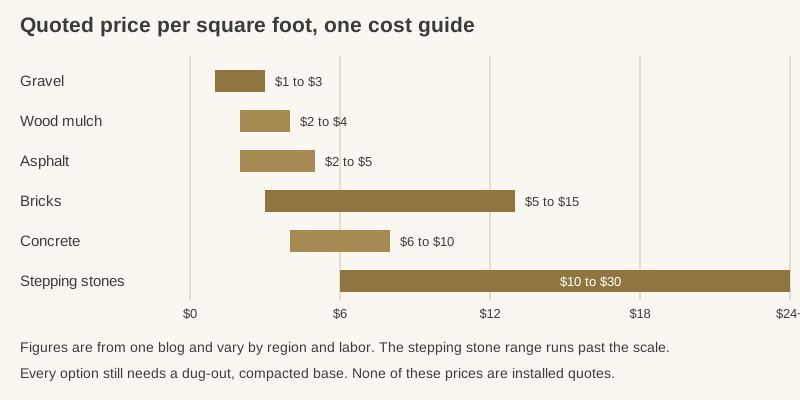
The chart uses the table from Boom and Bucket's paver alternatives guide. The author says the numbers are general comparisons and that location, labor and site conditions move them. I would treat them as an order-of-magnitude guide, not a quote. A second source I read, a Hunker piece on pallet patios, puts a paver patio at $20 to $45 per square foot and pallets at $10 to $25, which sit on a different scale entirely (the page does not say what is included, and it writes pallets "per foot"). Sources disagree, so price your own yard with local quotes.
Two things the chart cannot show. First, labor: a $2 material that you rake in an afternoon beats a $1 material that needs a day of edging. Second, the paver itself is not the big cost on a paver job, which is why the savings below rarely come from swapping the paver alone. Our cheapest pavers for patio guide covers the cheapest paver itself and where an install budget actually goes.
Gravel: cheapest, but it wants edges and it moves
Gravel tops every list because it is the lowest quoted price, $1 to $3 per square foot in the guide above. It also drains well, and you can build it in a weekend. The catch is that loose stone travels. Boom and Bucket notes it "requires occasional maintenance to prevent displacement" in its pros and cons, and I would go further: without a hard edge, gravel ends up in the lawn, the mower and the dog's paws.
The fix is the same one pavers need. Dig out, lay a compacted base, edge every side, then top with stone. That is the part to read up on in how to compact gravel. A gravel patio is not a shortcut around the base. It is a patio with fewer layers on top.
If you like the idea of gravel around hard surfaces, pea gravel paver patio and paver walkway with gravel show how to mix the two.
Wood mulch and rubber mulch
Mulch is the second-cheapest, $2 to $4 per square foot for wood and $5 to $9 for rubber in that same guide. It suits a play area or a path where nobody rolls anything. It also rots, floats and blows around, so it is a seasonal surface, not a patio. Rubber lasts longer and costs more. Neither suits a table and chairs, because the legs sink.
Stepping stones across a gravel or lawn bed
Stepping stones are the budget answer when you only need a path, not a floor. Fresh Patio's budget list notes plain 12 inch square concrete step stones for under $2 each at the author's last check, which is under $2 per square foot of stone (my arithmetic, since a 12 x 12 inch stone is one square foot). The same guide describes mixing them with decorative rocks to cut the stone count further.
Boom and Bucket's table lists stepping stones at the high end, $10 to $30 per square foot, probably because it prices decorative, natural-stone types. That gap is a good reminder that "stepping stones" is a category, not a price. See stepping stones for walkway for sizing and how to lay stepping stones for the install.
Red brick and thin brick
Fresh Patio found a basic red Holland-style unit, 7.75 x 4 x 1.75 inches, for under $0.70 each, and works out about $3.15 per square foot at 4.5 bricks per square foot. That is the author's arithmetic. Boom and Bucket quotes bricks at $5 to $15, so the real range depends on the unit and the supplier.
Brick is a paver in everything but name, so it is a cheap paver, not an alternative to the method. It needs the same base, bed and edge. The saving is in the unit price, not in skipping a step.
Poured concrete and decorative concrete
Concrete is the cheapest hard surface that stays flat under furniture, quoted at $6 to $10 per square foot, and $8 to $12 for decorative or stamped. It beats gravel for wheeled loads and chairs, but it cracks, as even the cost guide admits. You cannot lift a section and reset it, which is the quiet superpower of pavers. Read paving stones or concrete and pavers vs stamped concrete before choosing, since concrete's low sticker price shifts once it cracks or needs a full replacement.
Recycled, salvaged and secondhand material
Boom and Bucket lists recycled materials at $2 to $8 per square foot, without saying which ones. Reclaimed brick or leftover pavers from a neighbor's project are the obvious candidates. Check any salvaged unit for cracks before it rides home in the truck. Salvaged units rarely match, so plan a border or a patchwork look. Pallet wood is the cheapest of all on paper, but Hunker's piece is only about 400 words and gives no rot or maintenance data. I would not build on it without checking how long untreated wood lasts outdoors.
Which one fits what you will do on it
- A path or a spot for a fire pit chair: gravel or stepping stones.
- A table and chairs: brick, concrete or pavers. Gravel is wobbly for chair legs.
- Rolling loads (grills, carts, wheelchairs): concrete or pavers.
- A play area: mulch, rubber or fine gravel.
- A parking area: see gravel vs paver driveway.
Where cheap alternatives quietly cost more
Three costs hide behind a low price per square foot. Edging for gravel and mulch. Replacing cracked concrete. And labor if you hire it out. I could not find a published figure for how often cheap surfaces fail, only blogs asserting it, so I will not hand you a failure rate. The mechanism is easy to explain: a surface laid straight on soil moves with the soil.
ICPI's minimum for a patio base is 4 inches of compacted stone on well-drained soil (ICPI Tech Spec 2). Whatever you lay on top, the base is the patio. Spend your money and effort there, and the surface on top can be modest.
Buy the base, rent the compactor, pick the cheapest surface that fits
My rule after reading the lot: build the best base you can afford, rent the compactor for a day rather than buying one, and choose the cheapest surface that can carry the use. If you only walk on it, gravel or stepping stones. If you eat on it, pavers or brick. And if you think a bare lawn is cheaper than all of them, it is, until the first rainy barbecue.
FAQ
What is the cheapest alternative to pavers?
Gravel, at $1 to $3 per square foot in the cost guide I opened, followed by wood mulch and asphalt. Prices vary by region, and gravel needs edging and a compacted base to stay put.
Is gravel cheaper than pavers?
Yes, in material cost. Gravel has the lowest quoted price per square foot, and it is easy to install. It is less stable under chairs and tables, and it spreads without a hard edge.
What is the cheapest alternative to pavers for a driveway?
Gravel or asphalt are the lowest quoted. Our gravel vs paver driveway guide compares them with pavers for weight and drainage.
What is the cheapest patio material?
For a small seating area, gravel. For a hard surface, plain poured concrete or red brick. Material-only prices and installed prices are different numbers, so compare like with like.
Can I install paver alternatives myself?
Most of them, yes. Gravel, mulch and stepping stones are the most DIY-friendly. Poured concrete is harder to do well and impossible to un-pour.


