

Last Updated on October 20, 2026 by Umar Farooq
The cheapest pavers for patio projects are plain concrete pavers in a standard gray or single color: rectangles or squares with no tumbling, texture or blended color. Stone Center puts concrete pavers at $2 to $8 per square foot for material, and the plain ones sit at the bottom of that range. Lay them in a simple rectangle with few cuts and they stay cheap to install too. But the paver is the smallest part of the bill. Building it yourself, trimming the square footage and keeping the shape simple each save more than the cheapest paver does.
Here's where the money goes on a patio, what's actually cheap, and the few things you shouldn't cut to hit a number.
Cheapest pavers for patio use, by material
Stone Center's paver cost breakdown lists material-only prices per square foot:
| Paver material | Material cost per sq ft | Cheapest version |
|---|---|---|
| Concrete pavers | $2–$8 | Plain gray holland or square units |
| Brick (clay) pavers | $4–$15 | Standard red wire-cut brick |
| Permeable pavers | $6–$18 | Only worth it if you need drainage |
| Natural stone | $8–$30 | Local flagstone, bought by the ton |
| Porcelain | $10–$22 | Rarely a budget option |
Concrete wins on price because it's made locally in huge volumes, in one shape, by machine. The price climbs with every extra treatment: tumbling, a textured or smooth face, color blends and larger formats.
Plain concrete doesn't mean poor quality. A paver made to ASTM C936 has to average 8,000 psi in compressive strength and absorb no more than 5% water on average. Those are the same numbers whether it's the cheapest gray holland stone or a premium tumbled line. Check the pallet or spec sheet for the standard. Thin cast "patio stones" and stepping stones sold loose aren't always made to it, so they're a different product at a similar price.
Why the paver is only a small part of the bill
Unilock's paver patio cost guide says buying the pavers is typically about 20% of the project budget. The other 80% goes to labor, excavation, base preparation and materials like sand and sealer. That's the opinion I'll defend here: cut labor, square footage and fuss before you cut paver quality. The cheaper paver saves the least. Worth a read next: budget backyard paver ideas. If this applies to your yard, our guide to paver patio cost calculator goes into more detail.
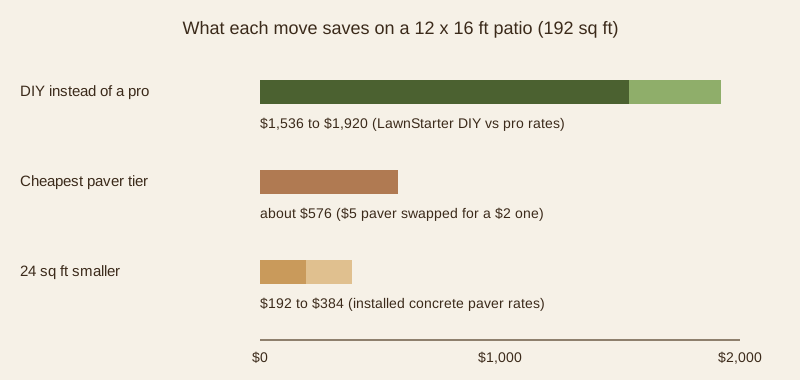
The chart runs the numbers on a 12 x 16 foot patio (192 square feet), using LawnStarter's paver patio price guide. It puts DIY at $12 to $17 per square foot and professional installation at $20 to $27.
- Doing it yourself saves about $8 to $10 per square foot, or $1,536 to $1,920.
- Swapping a $5 paver for a $2 one saves $576.
- Trimming 24 square feet off the size saves $192 to $384 at LawnStarter's installed concrete rate of $8 to $16.
The cheapest paver still helps, and you should buy it. It just isn't the biggest lever.
Keep the shape simple and sized to the paver
Cutting pavers costs time, blades and waste. A few layout choices keep it down:
- Rectangles beat curves. Every curved edge means a cut on every paver along it, plus more overage. Unilock lists simple square and rectangular shapes among its cost-saving tips.
- Size to the paver. Pick patio dimensions that are whole multiples of the paver, so the field ends on full units. A 12 x 16 foot patio of 12 x 12 pavers needs almost no cuts.
- Pick a forgiving pattern. Running bond and stack bond need few cuts. Herringbone and 45° layouts cut every edge piece.
- Skip the border. A contrasting soldier course looks good but adds a second product and another row of cuts. Add it later if the budget recovers.
Where people go wrong is picking the cheapest paver and then laying it in a curved herringbone. That quietly spends the savings on cuts.
DIY, and rent the heavy tools
The biggest single saving is labor, and a small rectangular patio on flat, well-drained ground is a reasonable DIY job. The LawnStarter guide lists typical rental prices: a plate compactor at $106, a wet masonry saw at $79 and a sod cutter at $79. Renting all three for a day costs less than a few square feet of professional labor. Buying them for one patio makes no sense.
What a DIY budget still has to cover:
- Crushed stone base and bedding sand, delivered.
- Edge restraint and spikes.
- Joint sand.
- Dumpster or haul-away for the dug-out soil.
A pro is worth the money when the site slopes toward the house, sits on wet clay, has poor access, or needs a retaining wall. Our patio pavers price guide breaks down what an installer's quote includes, so you can compare.
Buy smarter: pallets, overstock and pickup
- Buy by the full pallet. Suppliers price loose pavers higher per piece than full pallets. Size the patio so the order lands near whole pallets.
- Ask about discontinued colors and overstock. Landscape supply yards often discount the last pallets of a line or a color. Buy all you need at once, plus spares, because you can't get more later.
- Compare delivery fees. A pallet is heavy, and delivery can be a noticeable part of a small order. For a small patio, check whether the yard's trailer rental or a local pickup saves money.
- Look at reclaimed brick. Salvage yards and online listings sometimes sell used clay pavers cheaply; our reclaimed pavers guide covers what to check. Check that they're paving brick, not wall brick. Where the ground freezes, the Brick Industry Association points you to ASTM C902 Class SX.
Cheaper than pavers: gravel and stepping stones
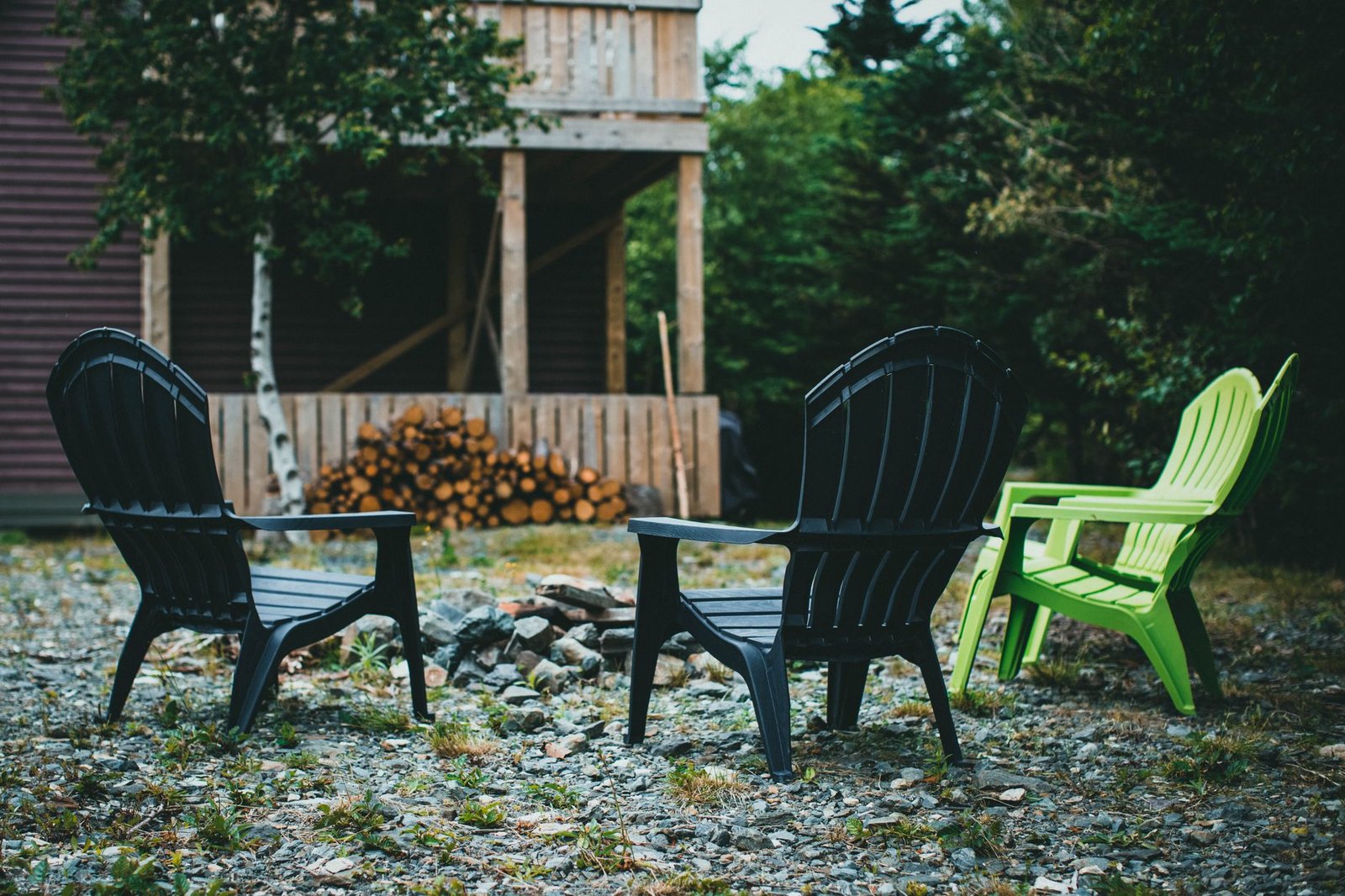
If the budget truly can't stretch to a paved surface, gravel is cheaper per square foot than pavers. It works well for a fire pit area or a small seating spot.
- Crushed gravel locks together better than round pea gravel and is easier on chair legs.
- Stepping pads in gravel give you a solid surface for chairs and a path, with only a fraction of the area paved.
- An edge still matters. Gravel migrates into the lawn without a solid border.
We cover the combination in detail in pea gravel paver patio. A gravel patio can be upgraded to pavers later by digging out, adding base and laying over it.
Cheap stone pavers: when natural stone competes
Natural stone is rarely the cheapest paver, but there's one exception worth checking: local flagstone bought by the ton. When a quarry is nearby, irregular flagstone can cost less per square foot of material than a mid-range concrete paver, because you're paying for rock and trucking, not manufacturing.
The catch is labor. Irregular stone has to be fitted piece by piece like a puzzle, and thickness varies from stone to stone, so every piece needs its bed adjusted. That time is cheap if it's yours and expensive if it's a crew's. Cut, gauged stone installs faster but costs more to buy. If you're pricing stone against concrete, our sibling guide to the cost of flagstone pavers compares the installed numbers, dry-laid and mortared.
(There is a certain irony in the cheapest stone being the one that takes longest to lay. Nobody said rock was fair.)
Small cheap patio paver ideas
For a tight budget and a small space:
- A 10 x 10 foot pad of 12 x 12 or 16 x 16 concrete pavers in stack bond, with no cuts on a straight layout. Big enough for a table and four chairs.
- A paver landing at the back door with gravel around it, extended into a full patio later.
- A fire-pit circle of gravel ringed with one row of paver edging.
- Stepping stones to a bench instead of a full patio.
What not to cut to save money
These are the lines where a cheaper patio becomes a more expensive one later:
- The base. ICPI's Tech Spec 2 calls for at least 4 inches of compacted crushed stone under a patio on well-drained soil, more on wet, weak or freezing ground. Base stone is cheap per ton. Redoing a sunken patio isn't.
- Edge restraint. Without it, the outer rows creep and the joints open.
- The right sand. Use concrete sand (ASTM C33) for bedding, not play sand or stone dust.
- Compaction. Rent the plate compactor, and compact in thin, damp layers.
Plain concrete, simple shape, your own labor
The cheapest pavers for a patio are plain concrete units, but the cheapest patio comes from doing the labor yourself with rented tools. Keep a simple rectangle sized to the paver, buy full pallets, and build a full base. Put gravel where you don't need a solid surface yet. The pavers will look the same in five years either way. What makes a cheap patio still flat in five years is the gravel underneath, and that part was never where the savings were.
FAQ
What is the cheapest type of paver for a patio?
Plain gray or single-color concrete pavers in standard rectangles or squares. Stone Center prices concrete pavers at $2 to $8 per square foot for material, and the plain units sit at the low end.
Is it cheaper to pour concrete or lay pavers for a patio?
A plain concrete slab usually costs less to install than pavers. Pavers cost more up front but can be repaired a few units at a time. DIY pavers can close much of the gap because the labor is manageable without special finishing skills.
What is the cheapest way to build a patio?
A gravel patio with a solid edge is cheapest. For pavers, build it yourself with plain concrete units in a simple rectangle, rent the compactor and saw, and don't skimp on the base.
Are cheap pavers less durable?
Not if they meet ASTM C936. That standard sets the same strength and absorption limits for every concrete paver made to it, whatever the price. Thin cast patio stones not made to the standard are more likely to crack or wear.
How can I make a paver patio cheaper without it sinking?
Save on labor, size and layout, not on the base. Keep at least 4 inches of compacted crushed stone under a patio on good soil, use a proper edge restraint, and compact in thin, damp layers.


