


Last Updated on October 20, 2026 by Umar Farooq
Cutting pavers around pipes is mostly a planning job: shift the layout so the pipe lands where it costs the fewest cuts, mark the opening with a template, cut it with a diamond blade and water, then compact the base around the pipe before the pavers go back. The cut itself takes minutes. The mistakes that show up later, such as thin slivers, a sunken ring and sand washing out around the pipe, come from skipping the planning and the compaction.
I looked at the top-ranking paver cutting guides for this. They all cover how to cut a paver. None of them covers what a pipe stub, a sprinkler riser or a hose bib does to the layout around it. That is the gap this guide fills.
Decide where the pipe lands before you lay a single paver
A pipe sticking out of the ground is a fixed point. The pavers are not. So place the layout around the pipe, not the other way round. Before any bedding sand goes down, dry-lay a few pavers around the pipe, on the base, and see where it falls against the joints.

The diagram shows the three common outcomes in a running bond layout:
- Pipe where several pavers meet. Each paver gets a notch, so you cut three pieces and the notches must line up. This is the hardest to get tidy.
- Pipe inside one paver. One round hole in one paver. Nothing else changes. Simplest to get right.
- Pipe on a joint line. Two half-round notches that meet. Easy to mark, and the joint hides the seam.
If you can nudge the starting line by a few inches so the pipe moves from a corner to the middle of a paver, do it. It is the cheapest fix in the whole job. Our guide to how to cut pavers explains why you lay the field whole and cut last.
Mark a template, then mark the paver
Round openings are where people get impatient. Do not hold the paver up and eyeball it. Make a template.
- Press a piece of cardboard against the pipe and its neighbors and trace the outline of the pipe and the adjacent pavers.
- Cut the template out and test it in the opening.
- Lay the template on the paver, in the position the paver will sit, and mark the cut line with a permanent marker.
- Mark which side is waste. It is surprisingly easy to cut the wrong half.
Add a little room around the pipe so the paver does not press against it. How much? I could not find a paver manufacturer's figure for the gap around a riser or stub, so I am not going to give you one I cannot back up. A joint the width of your other joints is the logical target, since it takes sand like the rest. If the pipe is a drain or gas line, follow the utility's or the manufacturer's instructions first.
Three ways to take a round or square notch out of a paver
Pick by the size of the opening and the tools you already own.
Relief cuts and a chisel. Make straight cuts in toward the line, then break out the waste with a hammer. Straight cuts are the easiest to control, and the broken bits can be cleaned up afterward. The same trick works for a curved cut.
An angle grinder with a diamond blade. Family Handyman's guide to cutting pavers says to draw the line with a permanent marker, clamp the paver on a stable surface, score the line first so you do not lose it, make long back-and-forth passes, and hit the waste side with a hammer to finish (Family Handyman). Keep the guard on. The angle grinder for pavers article covers blades and technique.
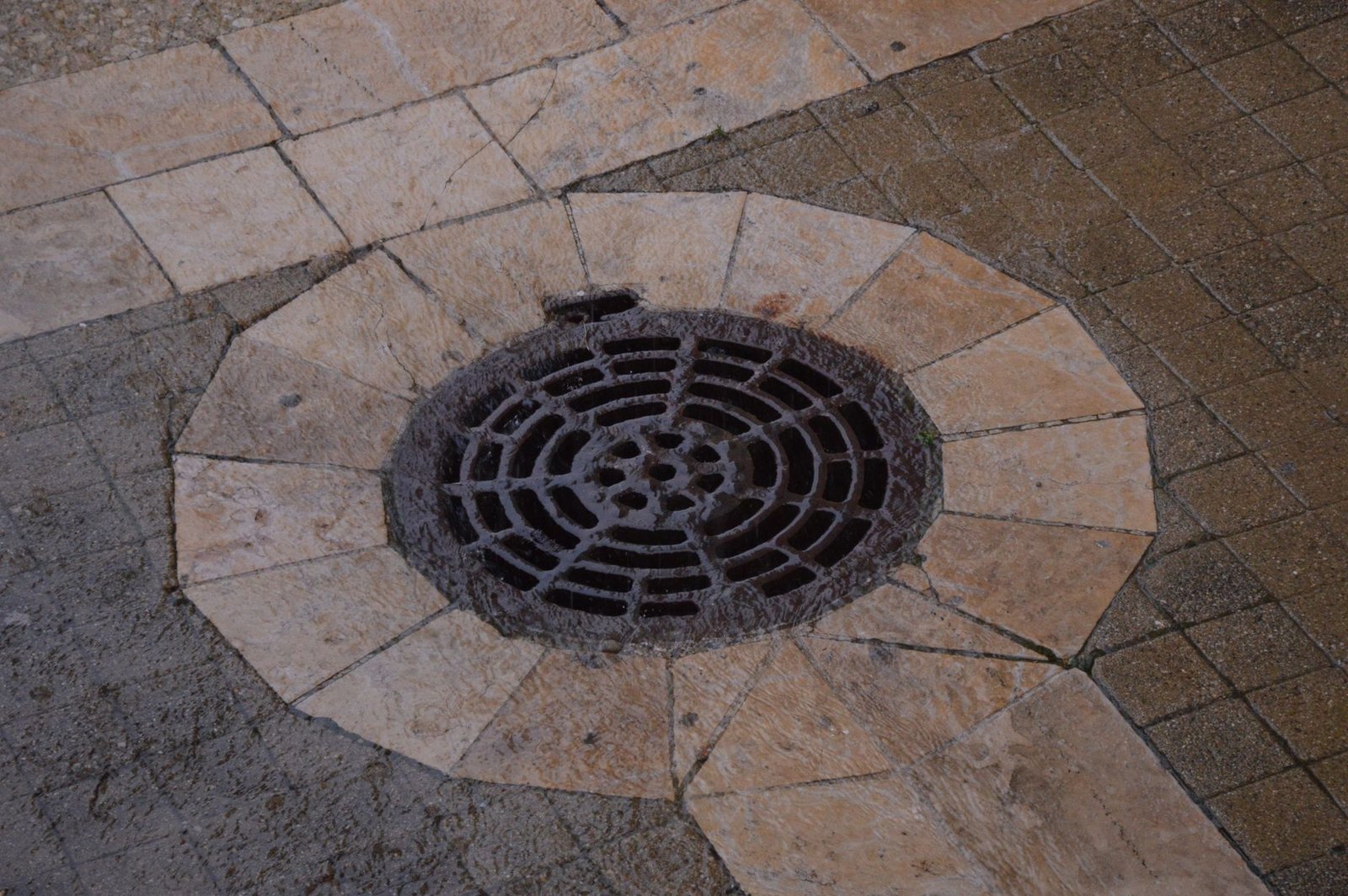
Frame it with whole pavers. If the opening is a square or round object and you want fewer cuts, lay a square of whole pavers around it and fill the corner gaps with small cut pieces. This is the same approach used around a drain cover, and it is fast.
A diamond core drill bit can make a round hole directly. I did not find a paver maker's guidance on using one, so I am mentioning it only as something to ask your supplier about, not recommending it.
Set the pipe height, then the paver height
Where the pipe top ends up relative to the paver surface is a decision to make before the sand goes down, not after. A pipe that stands proud of the pavers is a trip hazard and a lawn-mower hazard. One that finishes well below the surface becomes a hole that collects leaves and sand.
The paver surface has its own rules. CMHA's guide specification says pavers may sit 1/8 to 1/4 inch above the final grade before compaction, to allow for settlement, and ICPI Tech Spec 10 says final elevations around drains should not exceed 1/4 inch in pedestrian areas. Adjusting the riser height, or fitting an extension, is a plumbing or irrigation job. Check the product's own instructions before cutting or extending anything.
Compact the base around the pipe, then keep the sand in
The ground around a pipe is where compaction gets skipped, because the plate compactor will not fit tight against it. ICPI Tech Spec 10 is blunt that the density recommendations "for areas next to curbs, utility structures, lamp bases, and other protrusions in the pavement are essential to minimize settlement" (CMHA Tech Spec 10). The pavers beside a pipe are the ones that sink first when this is missed.
Use a hand tamper in the tight spots, in thin layers, and pass the compactor over everything it can reach.
The same document recommends geotextile adjacent to drains and utility structures, turned up against vertical surfaces to contain the bedding sand, so sand does not migrate into the gap. For a pipe stub, a collar of fabric around the pipe does the same job. Our paver base article covers the layers.
Cutting pavers around pipes without leaving slivers
A notch can leave a thin strip of paver beside the pipe. Strips break. ICPI Tech Spec 2 says to fill gaps greater than 3/8 inch with cut pavers, and that for street applications you should not cut pavers to less than one third of their original size, using two cut pieces instead (ICPI Tech Spec 2). That is written for streets, but the logic holds on a patio: small pieces work loose.
If your notch leaves a sliver, do not cut it narrower. Re-plan: shift the layout, or split the area into two larger cut pieces. Sliver is a polite word for "the piece you will be digging out in two summers".
Cut it wet, and keep your lungs out of the slurry
Paver dust contains respirable crystalline silica. OSHA's construction rule (29 CFR 1926.1153) says a handheld saw cutting masonry needs a water-delivery system, and a respirator is added indoors or when you cut for more than four hours a shift outdoors. Wet cut, wear eye and hearing protection, and clamp the paver. Do the cutting away from the finished pavers so slurry does not stain them. Our how to cut pavers guide covers dust control in detail.
Plan the pipe, then the pattern
Cutting pavers around pipes goes well when the pipe was part of the plan: move the layout so it lands inside one paver or on a joint, template the opening, cut wet, set the height, compact tight against it and fill the joints like any other. Do that and the pipe disappears into the patio. Skip it and the pipe becomes the one thing everyone looks at.
FAQ
How do you cut a paver to fit around a pipe?
Make a cardboard template of the pipe and the neighboring pavers, transfer it to the paver with a marker, then cut with a diamond blade, using relief cuts and a hammer to remove the waste. Cut wet, and clean the edge with the grinder.
Can I cut pavers around a pipe without a saw?
Yes, for small notches. A masonry chisel and hammer will do it. Score the line first, work from both faces, and expect to dress the edge afterward. A saw gives a smoother result.
How much gap should I leave around a pipe?
I could not find a manufacturer figure for this, so I would follow the joint width you are using elsewhere and the instructions for the pipe or fitting. Check with the product's installer if it is an irrigation or drainage part.
What if the pipe is where four pavers meet?
Try moving the starting line a few inches so the pipe falls inside one paver or on a joint. That cuts the number of notches and makes the fit simpler.
Do I need to compact around the pipe?
Yes. ICPI says density recommendations next to utility structures and other protrusions are essential to minimize settlement. Use a hand tamper where the plate will not reach.


