Last Updated on September 23, 2026 by Umar Farooq
Here is how to cut pavers for curves, with the small complication that no saw blade has ever cut one. Lay the field pavers straight out past the planned edge. Mark the curve on top with a garden hose or bent PVC pipe and a crayon. Then cut each paver along the mark with a wet saw and diamond blade, in short straight passes instead of steering the blade. Don't let any cut piece shrink below roughly a third of a unit, and finish with a flexible restraint. For fewer cuts, choose small units or a pattern that bends on its own.
Lay past the line, then mark the curve on top
Lay the pattern as if the patio were a rectangle, every course running a few inches past the curve, as Western Interlock's curve cutting tips recommend. The joints stay true to the edge.
Then set out the curve:
- Lay a garden hose or PVC pipe on the pavers in the shape you want and pin it. Adjust it until it looks right from the kitchen window.
- For a true arc, such as a round patio, use a string tied to a center stake as a compass.
- Mark along the inside of the guide with crayon or chalk. With a border course, mark the field cut one border width inside the final edge.
- Number or photograph the pavers if you'll lift them to cut.
How to cut pavers for curves in straight facets
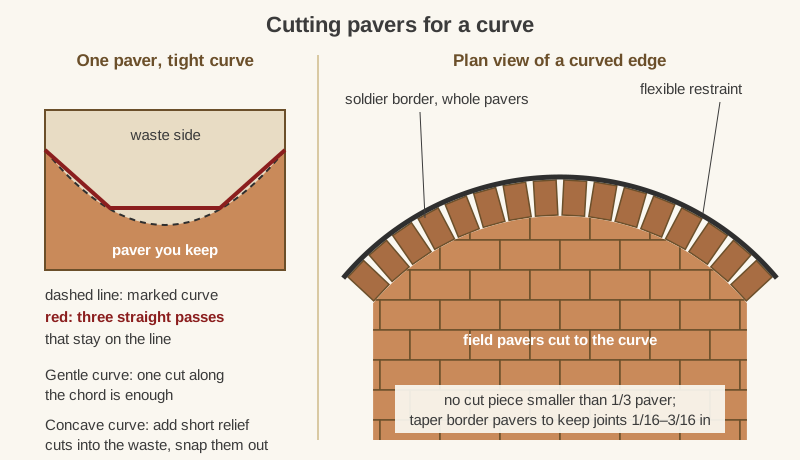
A saw blade only cuts straight, so a curve is really a polygon with good manners: short straight facets that stay on the marked arc, one per paver on a gentle curve, two or three on a tight radius.
- Convex curves (edge bulges outward). Cut along the chord, then a shallow pass at each end to round it off. I cross-checked How to Hardscape's curve cutting guide, which adds a useful detail: angle the saw away from the patio on convex edges.
- Concave curves (edge dishes inward). Make short relief cuts into the waste up to the line, then break them out.
- Score first, then cut through. A light first pass keeps you on the line before water washes it off.
Keep the blade wet for silica dust. On a small circle, a grinder beats a big cut-off saw. Our how to cut pavers guide covers cutting in place versus lifting the pavers.
Keep the slivers out of a curved edge
A curve drawn across a straight pattern leaves small wedges. A piece under one-third of a paver lacks bearing area and cracks or shifts under load. (Curved patios photograph beautifully from above, the one angle that hides the wedges.)
Three ways to avoid slivers:
- Move the cut back one course. Remove the last full paver too and cut the two together so both pieces end up larger.
- Add a border course. A soldier row of whole pavers hides and protects the field cuts.
- Nudge the curve. If a few inches clears a run of slivers, move the hose.
Curved paver edging: border and restraint
Whole rectangular pavers set around a curve open into V-shaped joints on the outside of the arc. Standard sand-set joints are about 1/16 to 3/16 inch; if border joints open wider, taper each border paver with two angled cuts. On a large radius the gaps may be small enough to leave.
Behind the border, the edge needs a restraint, full stop. Every border paver on a curve is a wedge with its wide end facing out, and those wedges hold only while something stops the field spreading. The lawn won't hold them. Plastic restraint made for curves has a notched back flange; cut at the notches and it bends to the arc. Spike it closer on curves than on straight runs. Aluminum and steel edging bends too, but tighter curves need relief cuts. Spike spacing, concrete toe restraints and the other edging options are covered in our paver edging guide.
Patterns for a curved paver walkway without cutting (or with far fewer cuts)
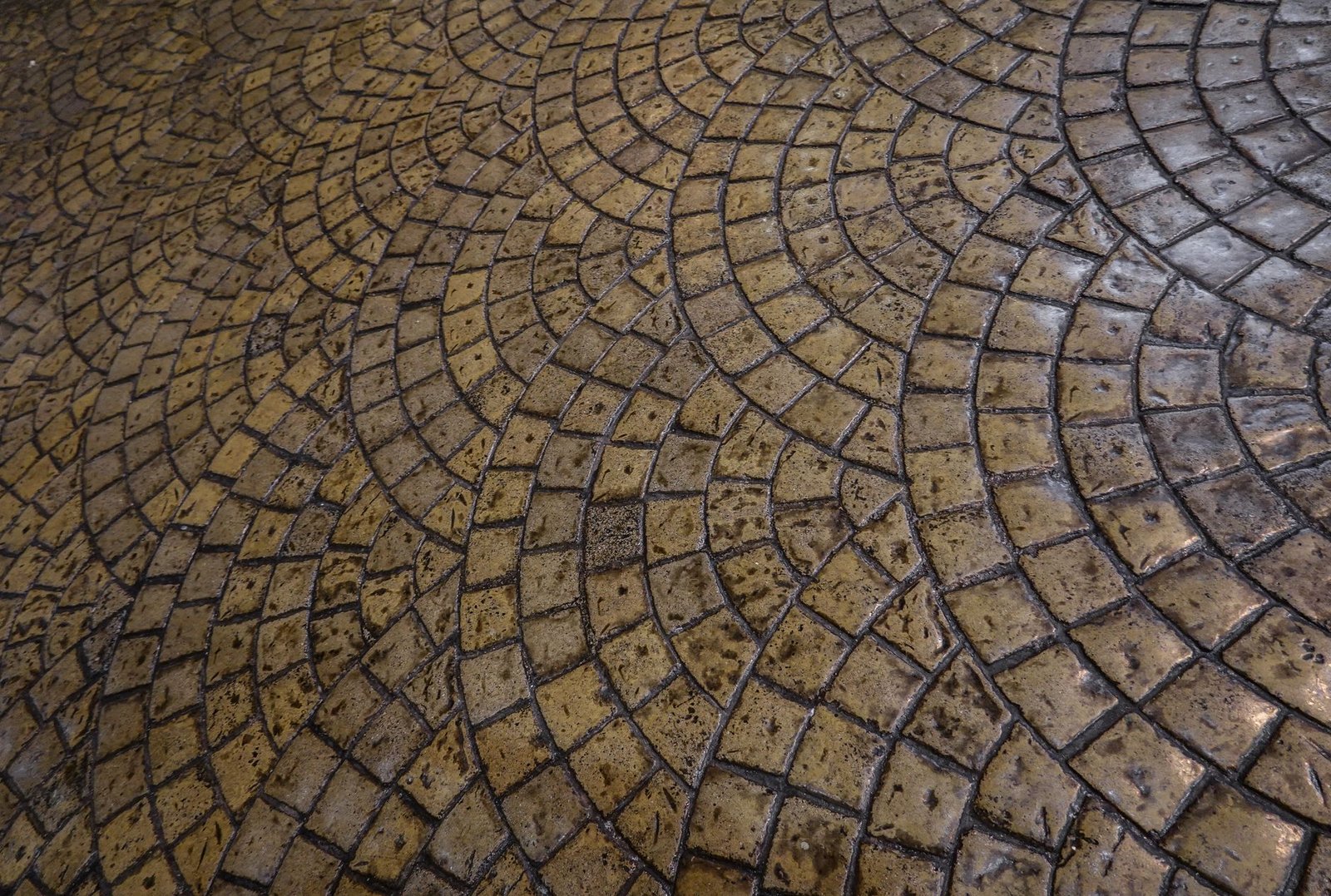
The easiest curve to cut is the one you never draw across a rigid pattern. I hoped one of the curve guides would name a layout that bends with zero cuts. None did, but some come close:
| Pattern or unit | How it handles curves | Cuts needed |
|---|---|---|
| Small cobble or setts (about 4 × 4 in) | Joints flex a little at each unit, so courses follow a curve | Very few, mostly at the ends |
| Circle and fan kits | Tapered units built to form arcs and circles | Few; only where the circle meets the square field |
| Running bond laid along the path | Courses can gently follow a wide curve | Some, on the inside of the bend |
| Herringbone at 45 or 90 degrees | Rigid; the curve must be cut through the pattern | Many |
| Large-format slabs (24 in and up) | Rigid, and each cut is long | Many, and long |
Keep walkway bends wide. A radius of several feet cuts easily; a tight dogleg needs a cut on nearly every paver. The rest of the build is in our paver walkway installation guide.
Plan the curve around the pattern, then cut in facets
Most of the work of cutting pavers for curves happens before the saw starts. Lay past the line, mark with a hose, and shift it so no piece is under a third of a paver. Cut in short wet facets, then lock the edge with a border and a flexible restraint. If the hose keeps creeping while you mark, pin it again; it's the only thing on the job that wants to be straight.
FAQ
What is the best tool to cut curved pavers?
A wet masonry saw, or a gas cut-off saw fitted with a diamond blade and a water feed. For tight radii, a grinder's smaller blade follows the curve more easily. Splitters only break straight.
How do you mark pavers for a curve?
Lay the pavers past the edge, set a hose or bent PVC pipe on top in the curve's shape, and trace it with crayon or chalk. For a circle, swing a string from a center stake.
Can you make a curved paver walkway without cutting?
Mostly. Small units such as 4 × 4-inch cobbles, or a circle and fan kit, follow gentle curves with very few cuts. Standard rectangular pavers still need some cuts on the inside of a bend, but a wide radius keeps them few.
How small can a cut paver piece be?
About one third of a full paver. Smaller pieces crack or work loose. Move the cut back one course, or add a border row.