

Last Updated on October 20, 2026 by Umar Farooq
A dumpster on paver driveway surfaces is usually survivable, and sometimes expensive. The pavers themselves rarely break. What gives way is the stone under the two spots where the steel rails sit, and the damage shows up as shallow dips after the box is gone. Put boards under the rails, order the smallest box and the shortest rental that fits the job, and photograph the surface first. If the driveway already has dips, loose pavers or a base nobody can vouch for, the box goes on the lawn or the street instead.
I read what the dumpster companies say, what the paver industry says about trucks, and what these boxes actually weigh. They agree on more than I expected, and they never quite measure the thing everyone is worried about.
What a loaded roll-off does to a paver driveway
Dumpsters.com says an empty roll-off weighs 3,750 to 6,500 pounds depending on size, and lists 2 to 3 tons of included debris for a 20-yard box. My own arithmetic: a 20-yard box carrying that debris puts roughly 7,750 to 12,500 pounds on whatever it sits on. Heavy debris can go well past the included tons, and the same page says most roll-off trucks can legally haul up to 10 tons.
That weight does not spread out by itself. Panther Dumpster Rental points out that the truck touches the driveway for a minute or two, while the container's weight rests on two narrow steel rails for days. Scribby's, another rental company, says the weight under the wheels can make pavers shift or crack over a rental of about a week.
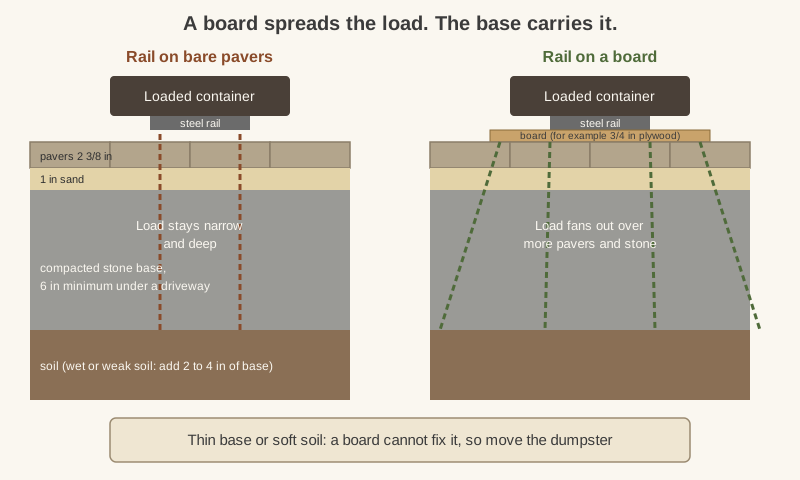
The paver industry explains why a heavy point load matters. ICPI Tech Spec 2 describes a residential driveway as limited vehicular use: pavers at least 2 3/8 inches thick over at least 6 inches of compacted base on well-drained soil. ICPI Tech Spec 4 adds that one pass of a fully loaded truck does more damage than several thousand cars, and that doubling an axle load multiplies the damage by 16. That spec is written for roads and parking lots, so treat the application to your driveway as my inference: a delivery truck carrying a full box is probably the heaviest thing your paver driveway will ever see.
I went looking for a measured study of dumpsters on paver driveways. I found rental-company blogs, every one selling the service, and not one with measurements. That is a rumour with a sales funnel. The mechanism is still sound, because a base compacted to car loads settles under a point load that is much heavier than a car's.
Green light, amber light, red light
Your driveway's condition matters more than the box size. Use this as a rough decision table (the thresholds are the ICPI minimums; the calls are my reading of them).
| What you know | What I would do |
|---|---|
| Built with at least 6 in of compacted base, pavers 2 3/8 in or thicker, no dips, tight joints | Boards under the rails, smallest box that fits, shortest rental |
| Inherited the driveway and nobody knows the base | Treat the base as unknown. Lawn or street first. If pavers are the only option, boards and a light load |
| Dips, rocking pavers, open joints or ruts in the wheel paths | Not on this driveway. Repair it first with driveway pavers rutting |
| Soft or wet ground | ICPI adds 2 to 4 in of base on wet or weak soil, so a minimum-depth base has less margin. Wait for dry ground or move the box |
| Pavers or a repair laid in the last few weeks | Wait. Techniseal's data sheet for one polymeric sand allows vehicles after 48 to 72 hours, which is a car, not a loaded box |
| Near the edge, a curb, a utility trench or tree roots | Keep the box toward the middle of the paved area and away from the edge |
The edge advice comes from Junk Rescue, another rental company, and it makes mechanical sense: the edge restraint holds the field in, and a heavy load near it asks the most of it. If you cannot tell what is under the pavers, lift one at an inconspicuous edge and measure the stone. That is my suggestion, not a rental-company rule. Paver driveway installation explains what that base should look like.
Boards under the rails, and who brings them

Panther says its crews lay 2-inch dimensional lumber or 3/4-inch plywood under the rails before the container is set down, and for pavers it recommends boards that span several pavers. Hook N Dump, a third company, adds a warning I liked: thin or damaged plywood can crack, split or slide, and boards do not guarantee that every paver stays put because the base still has to carry the load.
Three practical points:
- Ask on the booking call. Scribby's says boards have to be brought along, and are most useful on sealcoated or paver surfaces.
- Ask what they use. Thickness and length are not standardised. These are company practices, not a code, so you are checking the crew's habits.
- Put them under the wheel end and the rails. Scribby's says that is where the load concentrates.
Boards spread the load across more pavers. They do not add stone. If the base is thin, a board only moves the dip a few inches sideways.
Lawn, street or pavers: the cheaper spot comes first
Here is my one opinion, and it comes with a mechanism attached: if a dry lawn or a legal street spot can take the box, put it there and let the pavers sit this one out. Scribby's says lawn repair may cost less than repairing pavers, and Panther suggests a street spot where it is permitted. The ICPI's fourth-power rule means that the cheapest way to avoid heavy-load damage is to keep the heavy load off.
Both claims come from companies that rent dumpsters, so I would treat the cost comparison as a prompt to get your own quote, not as a fact. Street placement usually needs a permit, so check your city's rules before you book. A saturated lawn ruts too (my inference), so the same boards apply there.
If the pavers are the only option, shrink the load:
- Smaller box. Junk Rescue notes a smaller dumpster reduces the load on pavers in tight spots. Size matters less than the load itself, as Hook N Dump points out, so choose the size that fits the debris and not a bigger one as insurance.
- Shorter rental. Hook N Dump says a heavily loaded box sitting in one spot for several days carries more risk than a short, light one. Schedule the pickup promptly.
- Even loading. Hook N Dump says to spread dense material through the box rather than stacking it at one end. Concrete, brick, asphalt and soil can hit the weight limit long before the box looks full, so ask about a smaller container or a lower fill line.
If the heavy debris is your own old pavers, how to remove pavers covers hauling them away without overloading anything.
Shortcuts that do not protect pavers
- One thin sheet of plywood. See above: it can crack and slide.
- Trusting a "driveway-safe" promise. Panther itself says its crew prevents the "vast majority" of driveway issues, a self-reported claim, and admits that driveways already in poor condition carry residual risk.
- Moving the box yourself. Hook N Dump says not to, because it can shift the boards and scrape the surface.
- Sealing the pavers as armour. I found no source that says sealer protects a paver from a point load. A sealer is a surface film, not a base.
Photograph before, probe after
Take photos of the whole driveway before delivery, as Hook N Dump advises, and note any loose or sunken pavers. When the box leaves, compare. Junk Rescue says to check for sand displacement, surface marks and oil drips, and to wash stains with mild detergent and a soft brush. Oil stains are a separate cleaning job.
Then look for the dip. Lay a straightedge across the rail footprint. A depression of a few pavers is a local base failure, and the site's usual repair stands: lift the pavers in that area, fix the base underneath, re-screed the sand, relay and re-sand. How to fix sunken pavers walks through it. Do not top up the dip with extra sand; that just schedules next spring's dip. If a paver cracked, cracked pavers covers replacing it and finding what cracked it.
Report problems to the rental company promptly, and show them the photos. I am not giving legal advice, and what a rental agreement says about surface damage differs by company. Scribby's recommends confirming who pays for damage before booking, which is good advice to follow.
If the base would not carry the truck, the box goes elsewhere
Boards are the cheap insurance, and a smaller, shorter, evenly loaded box is the cheap prevention, but neither fixes a base that was thin to begin with. Put the dumpster on the pavers only if you would trust a loaded truck on them anyway. Otherwise, ask the driver whether the street or the lawn is available. Your pavers will not notice the difference, which is exactly how you want it.
FAQ
Will a dumpster damage my paver driveway?
It can. Rental companies say weight under the rails can make pavers shift, settle or crack, especially over several days. Damage depends on the base, paver thickness, joints and how long the box sits. Boards reduce the risk but do not remove it.
Can you put a dumpster on a paver driveway?
Yes, if the base is sound and you use boards. Tell the company about the pavers when you book so they bring protection. If the driveway has dips, loose pavers or an unknown base, use the lawn or a permitted street spot instead.
How long can a dumpster sit on a paver driveway?
I found no tested number. Scribby's mentions marks appearing over a rental of about a week, and Hook N Dump says longer stays with heavy loads carry more risk. Order the shortest rental that fits the job.
Should I put plywood under a dumpster on pavers?
Ask the rental company first. Panther uses 3/4-inch plywood or 2-inch lumber under the rails. Hook N Dump warns that thin or damaged plywood can crack or slide, so use the protection the company approves.
What if my pavers sink after the dumpster leaves?
Photograph the dip, tell the company, then lift the pavers, rebuild the base under them and relay. Topping up with sand will not hold.
Does a smaller dumpster put less weight on my pavers?
Yes, but the load matters more than the size. A small box packed with concrete can weigh as much as a big box of furniture.


