Last Updated on September 23, 2026 by Umar Farooq
Efflorescence on pavers is a white, chalky film of mineral salts. Water inside the concrete dissolves them and carries them to the surface, where the water evaporates and the salts stay behind, usually about a week after you've shown the new patio to the neighbours. It's common on new concrete pavers, it doesn't weaken them, and in most cases it fades on its own within a few months to a year as rain and foot traffic wear it away. If you don't want to wait, scrub it dry first and then use an efflorescence remover made for concrete pavers. Fix any water source that keeps feeding it, and don't seal until it's gone.
What efflorescence on pavers actually is
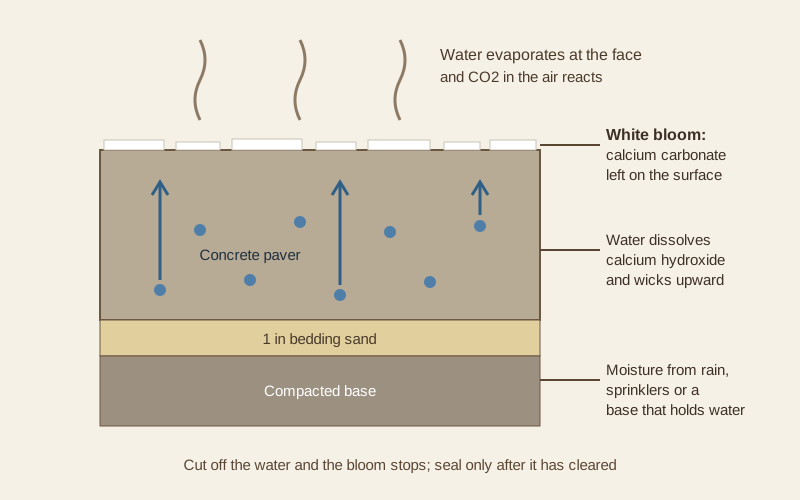
Concrete pavers are made with cement. When cement hardens, it produces calcium hydroxide as a by-product, and some stays free inside the paver. Water dissolves it, and as the paver dries that water moves to the surface and evaporates. Unilock's efflorescence explainer describes the last step: at the surface, the calcium hydroxide reacts with carbon dioxide in the air to form calcium carbonate, the white deposit you see.
It takes three things together:
- Soluble salts in the paver, the bedding sand, the base or the soil.
- Water to dissolve them: rain, irrigation, dew, or moisture rising from the ground.
- A path to the surface and evaporation at the face.
Take away any one of the three and efflorescence stops. You can't take the salts out of the concrete, so in practice you control the other two.
Why brand-new pavers bloom white
Most efflorescence shows up in the first year, and there are two kinds:
- Primary efflorescence comes from the pavers themselves. The free lime left over from manufacturing works its way out during the first months of wet-dry cycles. It's the bloom after the first rains, and it fades on its own.
- Secondary efflorescence appears later and keeps coming back. That points to an outside water source moving salts through the pavement: a downspout emptying onto the pavers, sprinklers hitting them every day, a low spot that holds water, or ground moisture wicking up through a base that doesn't drain. It can also bring salts in from the soil or from de-icers.
It's not a manufacturing defect. Even well-made pavers bloom. It shows more on darker colors, simply because white is very good at standing out against charcoal.
Efflorescence, poly haze or something else?
Several white problems look alike, and the fix depends on which one you have:
| What you see | Likely cause | Quick test |
|---|---|---|
| Powdery white bloom over whole pavers, patchy from paver to paver | Efflorescence | Wet it: it disappears while wet and comes back as it dries |
| Grey-white film that follows the joint lines, appeared after re-sanding | Polymeric sand haze | Visible when wet; stays where the binder dried on the face |
| Milky or cloudy patches in a shiny surface | Moisture trapped under a sealer | Only on sealed pavers; doesn't brush off |
| Hard white crust, often near a wall or step | Heavy efflorescence or mortar residue | Doesn't brush off; scratches rather than powders |
Haze from joint sand needs a different method; see the guide to polymeric sand haze. White patches in a sealer are a sealer problem that no efflorescence remover will fix.
Will efflorescence go away on its own?
Usually, yes. Primary efflorescence is self-limiting: once the free lime near the surface is used up, the bloom stops, and rain and traffic wear away what's left. I hunted for an exact timeline, and every manufacturer politely declines to give one. Cambridge's guide to managing efflorescence notes that it clears faster in rainy climates and more slowly in dry ones. Unilock suggests waiting 2 to 3 months, and sometimes up to a year, before sealing new pavers so the bloom has time to finish.
Two things point to a longer wait or a real problem:
- It keeps coming back in the same spot after cleaning. That spot is getting extra water.
- It's thickening into a hard crust instead of fading, which also means steady moisture, often by a wall, a downspout or a low edge.
How to remove efflorescence from pavers safely
If you want it clean now, go in this order and stop when it works:
- Dry brush first. Let the pavers dry completely, then sweep the powder off with a stiff nylon broom and bag it. Don't use a wire brush; broken bristles leave rust spots. Hosing the powder first just dissolves it and sends it back into the paver.
- Scrub with soap and water. Mild dish soap and a stiff plastic brush remove light blooms; Unilock suggests this first. Rinse and let it dry fully before you judge the result.
- Use an efflorescence remover. These are acid-based cleaners made for concrete pavers, with buffers and detergents. Unilock notes that they can shift the color slightly, so test on one paver in a corner first. Pre-wet the pavers, apply the diluted cleaner as the label directs, scrub, and don't let it dry on the surface.
- Rinse thoroughly. Flush with plenty of clean water so no acid is left in the pores or the joints. Keep runoff off plants and lawns.
- Wait and look again. A remover only takes off what's there now. If more salt is still moving up, a lighter bloom can return and need a second treatment.
Don't use straight muriatic acid; I didn't find a paver maker's care guide that recommends it. It's much stronger than a formulated remover, etches the cement paste, and can expose the aggregate and permanently change the color. A pressure washer alone isn't the answer either: water drives more salt into solution, and a narrow tip strips joint sand and scars the surface.
Stopping it from coming back
The salts aren't something you can control, but the water is:
- Redirect downspouts away from the pavers or into a drain line.
- Adjust sprinklers so they water the lawn, not the patio.
- Fix low spots where water sits. A patio needs a steady slope to shed water; the patio drainage guide covers grading and drains.
- Check the base. A base that holds water feeds efflorescence from below, and no amount of scrubbing on top fixes a wet base underneath.
- Seal once it's clean. A breathable sealer reduces how much water gets into the paver from above. Seal only after the bloom is gone and the pavers are fully dry, or you trap the salt under the film where it shows as a cloudy haze. The guide to paver sealing covers the prep and timing.
Sealing isn't a cure for active efflorescence. On pavers that are still blooming, it just seals the problem in.
My firm opinion here: a blooming patio is a reason to wait, not a reason to seal. Sealer over salts that are still moving traps the next bloom under a film you then have to strip, which turns a free, self-fixing problem into a paid one. Alliance Gator's Wet Look sealer data sheet says to seal concrete pavers 60 days after installation; Techniseal's Natural Look sealer says recoat only when worn, minimum 2 years.
Wait it out first, treat it second
Efflorescence on pavers looks alarming on a new patio, but it's cosmetic and usually temporary. Give new pavers a season of weather, dry brush and wash with soap, and use a proper remover only if the bloom persists. If it keeps coming back in one spot, find the water feeding it. The white will go; the pavers under it were fine all along, and so, for the record, was your choice of pavers.
FAQ
Is efflorescence on pavers permanent?
No. Primary efflorescence on new pavers is temporary and fades as the free lime near the surface is used up, usually within months to about a year. Efflorescence that keeps returning points to an ongoing water source, which you can fix.
Does efflorescence damage pavers?
No. It's a surface deposit and doesn't affect the strength or durability of concrete pavers. The damage risk comes from harsh removal methods, such as undiluted muriatic acid or high-pressure washing.
Does vinegar remove efflorescence from pavers?
Diluted white vinegar can dissolve light efflorescence, because it's a mild acid. It's less predictable than a buffered efflorescence remover, though, and it needs a thorough rinse. Test it on one paver first, and don't use it on natural stone.
Can you seal over efflorescence?
You shouldn't. Sealing over it traps the white deposit under the sealer film, where it's much harder to remove and can look cloudy. Remove the efflorescence, let the pavers dry fully, then seal.
Why does efflorescence come back after cleaning?
Because salts are still moving up through the paver with water. On new pavers, that tapers off on its own. If it keeps coming back in one spot after the first year, look for a downspout, a sprinkler, a low spot or a wet base feeding water into that area.