

Last Updated on October 20, 2026 by Umar Farooq
Interlocking pavers are paving units, usually concrete, laid tight together on a sand bed with sand in the joints and a fixed edge around them, so that no single paver can move without dragging its neighbours along. The "interlock" doesn't come from the pavers clicking together. It comes from four things working at once: sand packed into the joints, an edge restraint that stops the field spreading, a laying pattern that spreads sideways forces, and units thick enough and fitted closely enough that they can't tip. Take any one away and the pavers start to drift. The details are in our piece on ashlar paver pattern.
The Interlocking Concrete Pavement Institute puts it in one line in its Tech Spec 4: "Interlock is the inability of a paver to move independently from its neighbors." I read the whole document for this article, including the dowel tables for concrete road bases, which I mention only so you know someone did.
Three kinds of interlock, and what creates each one
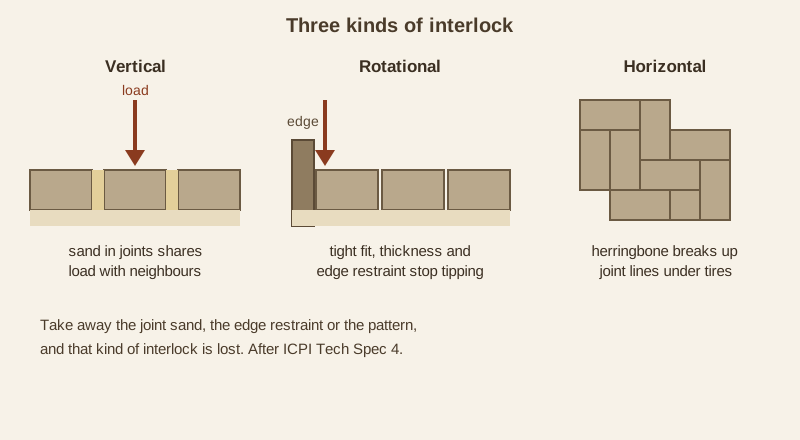
ICPI Tech Spec 4 splits interlock into three types, and each has a different source:
| Type | What it stops | What creates it |
|---|---|---|
| Vertical | One paver pushed down below its neighbours | Sand in the joints transferring load sideways by shear |
| Rotational | A paver tipping or rocking under a load at its edge | Enough thickness, a sound aspect ratio, tight joints and a restraint at the edge |
| Horizontal | Pavers sliding or creeping sideways under turning or braking | The laying pattern, with herringbone the most effective |
This is why a paver patio can carry a car on a few inches of gravel. No single unit carries the load. Each one hands part of it to the pavers around it through the sand in the joints, and those hand it on again. The field behaves like one flexible slab that still comes apart when you need it to.
Does the paver shape have to interlock?
No. This surprises people, because the word suggests jigsaw edges. Concrete pavers come in three families: shapes that key into each other on both axes (the wavy-edged "dentated" or zigzag units), shapes that key on one axis, and plain rectangles and squares. All three are interlocking pavers once they are laid properly.
The difference is where the horizontal interlock comes from. A dentated unit provides some of it through its own edges. A plain rectangle depends on the pattern, which is why rectangles meant for driveways are laid in herringbone. For a patio carrying only feet and furniture, plain rectangles in running bond interlock perfectly well.
Size and thickness matter more than outline. Nitterhouse's interlocking pavers are a typical everyday example: 4 x 8, 6 x 6, 6 x 9 and 8 x 8 inch units, all 2 3/8 inches thick. That thickness against a short length is what gives them rotational interlock. Stretch the same thickness over a long unit and it starts behaving like a lever instead.
Joint sand is the part that actually locks
My one opinion for this article: people spend weeks choosing a paver shape and about ten minutes on the joint sand, and it's the joint sand that does the locking. A dentated paver with empty joints has no vertical interlock at all. A plain rectangle with full, compacted joints has plenty.
How the joints get filled matters:
- Compact the laid pavers first. Running a plate compactor over the field vibrates the units down into the loose bedding sand, and some of that sand rises into the bottom of the joints. ICPI's spec describes the "sand migration upward into the joints during the initial compaction" as part of the locking-up action, which is one reason it wants a coarse ASTM C33 bedding sand and not stone dust.
- Sweep dry joint sand in and compact again. Repeat until the joints stay full. A single pass leaves the joints half empty, and half-empty joints let pavers rock.
- Keep them full. Sand washes out, especially at the edges and around downspouts. Topping up an inch-deep void of joint sand is a five-minute job; letting it go until the pavers rock is not.
Plain joint sand works. Polymeric sand adds a binder that resists washout, weeds and ants, and it still transfers load the same way once cured. Either one only works if it fills the joint top to bottom.
Edge restraint keeps the whole field in play
Interlock only works when the field has somewhere solid to push against. Every time a load lands, the pavers try to spread outward a tiny amount. A curb, a concrete edge or a spiked restraint on the compacted base stops that, and the pressure goes back into the joints where it belongs. ICPI Tech Spec 4 calls stable edge restraints "essential" and says they "provide better horizontal interlock among the units while they are subject to repeated lateral loads from vehicle tires."
Without one, the outer row rolls outward, the joints behind it open, the sand falls in, and the interlock unzips from the edge inward. Our paver edging guide covers the options, from plastic and aluminum strips to poured concrete.
Herringbone for anything with wheels
Horizontal interlock comes from the laying pattern. Tech Spec 4 is direct about it: "herringbone patterns are recommended in areas subject to vehicular traffic." In a herringbone, every joint line is interrupted within a paver or two, so there's no straight row for a turning tire to push along. Running bond has continuous joint lines in one direction, and pavers can creep along them under repeated turning and braking.
For foot traffic, choose any pattern you like; the loads are too small to care. For driveways, parking pads and anything a car turns on, use 45- or 90-degree herringbone. The full catalog of bonds and how to lay them is in our paver patterns guide. If this applies to your yard, our guide to driveway paver patterns goes into more detail.
Interlocking pavers vs slab pavers
The line between a paver and a slab is defined, not a matter of taste. CMHA's Tech Spec 10 defines a concrete paver as having a face area of 101 square inches or less, an aspect ratio (length divided by thickness) of 4 or less, and a minimum thickness of 2 3/8 inches. Bigger, thinner units are slabs.
| Interlocking pavers | Slab pavers | |
|---|---|---|
| Typical size | 4 x 8 to about 8 x 12 in | 12 x 12 in to 24 x 24 in and larger |
| Thickness | 2 3/8 in or more | thin relative to their length and width |
| Joints | many, sand-filled, carry load | fewer, mainly for drainage and fit |
| Where interlock comes from | joints, restraint, pattern | mostly the flat, stable bed under each slab |
| Driveway | yes, in suitable sizes and patterns | generally no |
| Look | traditional to modern | clean, modern |
A slab spans too much of its bed and is too thin for its size to rely on interlock the way a small paver does. It depends on a very flat base and bed instead, and on nobody driving on it. ICPI even has a separate Tech Spec 25 for installing slabs and planks in non-vehicular residential jobs. For a primer on concrete, clay and stone units in general, see paving stones.
Other things sold as "interlocking"
The word gets stretched a long way in store listings:
- Interlocking paving bricks. Usually clay or concrete brick-size pavers, which interlock exactly as described above.
- Interlocking stone pavers. Normally concrete made to look like stone. Natural stone laid tight on sand with filled joints interlocks too, but only if it's uniform in thickness.
- Brand names. Belgard interlocking pavers, Unilock and others use the phrase for their standard concrete paver lines. Unilock's interlocking driveway pavers guide describes them as "laid side-by-side, and 'locked' into place with sand."
- Interlocking deck tiles and plastic grids. These clip together with tabs. They are held by clips, not by sand, restraint and pattern, and they're a different product altogether. Useful on a balcony or over a hard surface, not a substitute for a paver base.
If a listing says "lock pavers" or "paving lock," read the specs. Usually it's an ordinary concrete paver with good marketing.
Signs the interlock is failing
Interlock rarely fails all at once. It lets go gradually, and the early signs are easy to spot:
- A paver rocks when you step on its edge. The joint sand around it has washed out, or the bed underneath has moved.
- Joints are open at the perimeter. The edge restraint has shifted or was never spiked properly.
- Pavers have crept. Joint lines that were straight now bow toward the lawn, or a driveway shows a wave where cars turn.
- Sand is sitting on top of the pavers after rain. That's joint sand leaving.
Most of these are fixed by resetting or re-spiking the edge, then refilling and compacting the joints. A local dip is a base problem and needs the pavers lifted and the base repaired.
Full joints, a fixed edge and the right pattern
Interlocking pavers lock because of how they are laid, not because of their outline. Fill the joints completely and keep them full, restrain every edge against something that can't move, and use herringbone anywhere a car turns. Do those three things and a plain rectangle interlocks as well as anything in the catalog. Skip them and the fanciest zigzag edge on the market is just a paver with ambitions.
FAQ
What are interlocking pavers?
Paving units, usually concrete, laid tight together on a sand bed with sand-filled joints and a fixed edge, so that loads spread from each paver to its neighbours. They can be plain rectangles or shaped units; the interlock comes from the joints, the edge restraint and the pattern.
Are interlocking pavers good for a patio?
Yes. They are the standard patio paver. For foot traffic, any pattern works, and they can be lifted and relaid if the base ever settles, which a poured slab can't offer.
Do interlocking pavers need sand in the joints?
Yes. Joint sand creates vertical interlock by transferring load between pavers. Empty or half-filled joints let pavers rock and sink. Use joint sand or polymeric sand and compact until the joints stay full.
What is the difference between interlocking pavers and slabs?
Size and thickness. A concrete paver has a face area of 101 square inches or less and an aspect ratio of 4 or less. Slabs are larger and relatively thinner, rely on a very flat bed rather than interlock, and generally aren't used where cars drive.
Which paver pattern interlocks best?
Herringbone, at 45 or 90 degrees. ICPI recommends it for areas with vehicle traffic because it breaks up the joint lines that turning and braking tires push along.


