

Last Updated on October 20, 2026 by Umar Farooq
Mixing paver colors works when one color does most of the talking: blend the field from three or four bundles, add a small share of a second color (one supplier's project examples run from about 5 to 25%), and put the real contrast in the border. Done the other way round, half of one color and half of another, it reads as a patchwork. The other half of the job is practical. Pavers are mixed on site, from different pallets, on purpose, and skipping that step is how a patio ends up with a big blotch in one corner.
Pull pavers from three or four bundles, not one
This is the step that matters even if you only use one color. ICPI Tech Spec 2 puts it plainly: paving units "should be taken from 3 or 4 bundles and not from a single one." Mixing the pavers "ensures a visually consistent blend of the colors," and with a single color, laying from several bundles at once "will diminish the appearance of slight variations in that color."
In practice:
- Open several bundles before you lay the first course.
- Take a few pavers from each as you go, rather than finishing one bundle and starting the next.
- Check the field every few feet from a standing position. Blotches are easier to spot at eye height than on your knees.
- If a pallet looks different from the others, scatter its pavers through the whole field.
It is the cheapest fix in the article, since it costs only a little patience (and the only tool is hands that are already dirty). Our guide to paver patterns covers how the layout affects what you see.
Mixing paver colors: how much second color looks planned
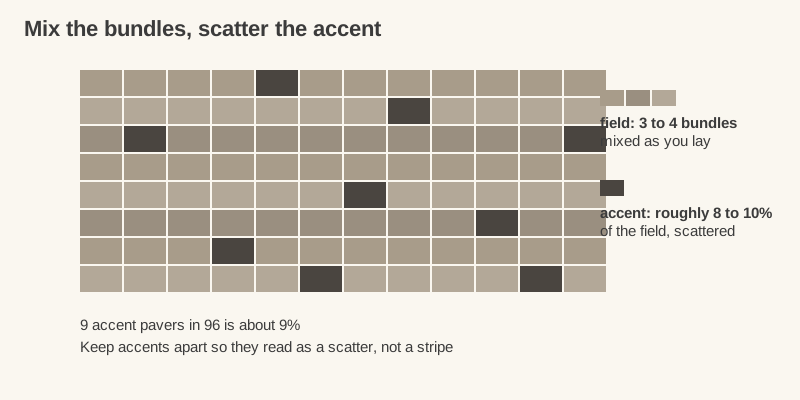
A second color works as seasoning. Kleinberg's paver color page lists project examples with the share of the accent color mixed into the center of the field, and the pattern is easy to see:
| Field | Accent mixed in | Share |
|---|---|---|
| Autumn Blend brickstone patio | charcoal brickstone | about 8% |
| Red brickstone patio | charcoal brickstone | about 10% |
| Pewter Blend brickstone walk | Harvest Blend | 5% |
| Harvest Blend patio | Dakota Blend | about 10% |
| Pewter Blend walk | Harvest Blend | 20% |
| Tan Colonial Stone | Harvest Blend | about 25% |
Most of those sit between 5 and 10%, with walks going to 20% and, in the busiest example, 25%. These are one company's project notes, not a rule, but they match common sense: 8% is a scattering, and 25% is a decision.
For a 12 x 16 foot patio (192 sq ft), 10% accent is about 19 sq ft of the second color. Scatter it. Placed in a clump, it becomes a stain that wasn't there before. Spread the pieces so no two accents touch, and rotate them through the field the way you'd distribute raisins in a muffin.
A border in the same color family
A border is where you can afford more contrast, because it frames the field instead of being mixed into it. Kleinberg's examples include a red field with a pewter blend border and a pewter blend walk with a 6-inch pewter border. Nicolock's advice on choosing a paver color is to pick colors "within the same color tone family rather than an exact match," and it warns that an opposite contrast, such as blue against orange, can be "too visually striking and distracting."
Two other notes from the same article. A darker border can fade into the lawn like a gradient, and a darker outline on a driveway can guide where to park. Our guide to the paver border goes through widths and layouts.
Your roof, your house and the colors you shouldn't fight

The color of a patio is mostly decided by what's around it. Nicolock's examples: red-toned pavers suit red roofs, grey tones suit charcoal ones. If you've already got a field color that works with the house, paver colors covers choosing it. The point here is that the second color should echo something that exists, such as the trim, the veneer stone or the front door, and not appear from nowhere.
Two quick tests:
- If you can't name where the accent color repeats on the house or in the yard, it's probably one color too many.
- If you can't tell the accent from across the yard, it's a blend and you've gone too subtle.
Order it all at once and check the sample wet
Kleinberg warns that "paver colors can be added and removed from production year to year," and that other manufacturers sell similar colors under different names. That matters if you plan to mix a color in later. A second pallet you buy next spring may not match, so order the field, the accent and the border in one go, and keep a few spare pavers for repairs. How many to order is in how many pavers do I need.
Look at samples in your own yard. Nicolock says the same color can "appear completely different in natural sunlight or when wet," and Kleinberg notes that its photos are "usually shown wet to bring out the colors." Splash the sample with a hose, then look at it dry. The dry version is what you live with 360 days a year.
Joint sand changes the overall color of the field too. If the joints are going to be gray against tan pavers, see gray vs tan polymeric sand before choosing.
Blend the bundles first, spend the contrast on the border
For mixing paver colors, the safe order is: mix the bundles, keep any accent to a scatter of about 5 to 10%, and put the strong contrast in a border from the same family. If you only do one of those, do the first. It costs nothing, and the other two are choices you can make on paper before a single paver is cut.
FAQ
Can you mix different colors of pavers in a patio?
Yes. The usual ways are to blend several bundles of the same color, scatter a small share of a second color through the field, or frame the field with a border in a different but related color.
How much accent color should I mix in?
One company's project examples run from about 5% to 10% for most patios and walks, and up to 20 to 25% when the second color is meant to show. Start at about 10% and scatter it.
Do I need to mix pavers from different pallets?
Yes. ICPI Tech Spec 2 says to take pavers from 3 or 4 bundles, not one, so the color variation spreads through the whole field.
What colors go together for a paver border?
Choose colors in the same tone family as the field, not an exact match and not a hard opposite. A darker border of the same hue is the safest pairing.
Will mixed paver colors hide stains?
A mix of tones is less likely to show a small splash than a single flat color, but it will not hide a stain you leave alone, so clean spills early.


