

Last Updated on October 20, 2026 by Umar Farooq
Parking pavers need three things a patio paver doesn't: a paver shape that tires can't crack or rock, a base built for vehicles, and a pattern and edge that hold up to turning wheels. For a home parking pad, that means concrete pavers at least 2 3/8 inches (60 mm) thick, and no longer than about three to four times their thickness. Lay them in herringbone on at least 6 inches of compacted crushed stone, and lock them in with a solid edge restraint. If you park there only now and then, or need to manage runoff, permeable pavers or grass pavers are the alternatives.
The most common mistake is treating a parking pad as a patio because it's about the same size. It isn't. A pad is a small driveway, and every rule that follows comes from that.
Which pavers can carry a parked car
CMHA's Tech Spec 10 application guide sets out the two numbers that matter for vehicle areas:
- Thickness. 2 3/8 inches (60 mm) is recommended for pedestrian areas and residential driveways. 3 1/8 inches (80 mm) is typical for pavements with regular vehicle traffic.
- Aspect ratio (length divided by thickness). At 4:1 or more, keep the paver out of vehicle areas. Between 3:1 and 4:1 suits limited car use such as a home driveway. At 3:1 or less, it suits all vehicle use.
Do the arithmetic before you buy. A 4 x 8 inch holland paver at 2 3/8 inches thick is about 3.4:1, fine for a home pad. A 12 x 12 inch patio slab at the same thickness is about 5:1, and it'll crack or rock under a tire. A 6 x 9 inch paver at 3 1/8 inches thick is under 3:1 and suits a pad that sees daily turning or a light truck.
Where people go wrong: they choose the patio paver so the pad matches the patio. Match the color instead, and buy the driveway-rated unit from the same line. (Tires have no interest in whether the pad matches the patio.) For the full picture, see ac unit pad pavers.
A 6-inch base is the minimum for parking pavers
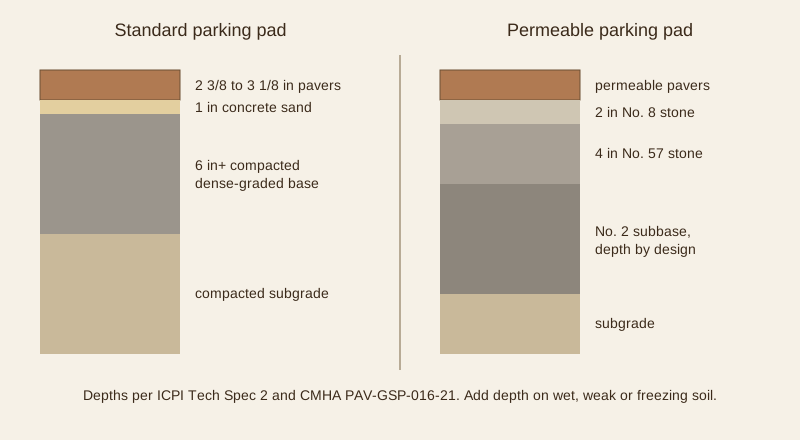
ICPI's Tech Spec 2 puts the minimum compacted base under a residential driveway at 6 inches on well-drained soil. On wet, weak or frost-prone ground, add another 2 to 4 inches. A parking pad gets the same numbers.
For a standard pad:
- Excavate to the paver thickness, plus 1 inch of sand, plus the base depth. For 2 3/8-inch pavers on a 6-inch base, that's about 9 1/2 inches below the finished surface.
- Compact the subgrade. Dig out soft spots and replace them with base stone.
- Place the base in lifts. Compact each layer damp. Thin lifts matter more with the smaller plate compactors homeowners usually rent. ICPI's lift guidance assumes a heavy reversible plate.
- Extend the base past the edges. CMHA's guide spec wants the base to run past the restraint by about its own thickness, so a 6-inch base runs about 6 inches beyond the pavers.
- Screed 1 inch of loose concrete sand, lay the pavers, cut the edges, install the restraint, then compact and sand the joints.
The full driveway process, with the equipment and timing, is in our paver driveway installation guide.
Herringbone and edges for turning tires
Parked cars are easy on pavers. Cars turning in and out are not. A tire turning on the spot twists the pavers under it, and a running bond pattern lets whole rows slide along their long joints.
- Use a 45° or 90° herringbone. Tech Spec 10 recommends either one for areas with continual vehicle traffic, for maximum interlock.
- No slivers. The same guide says cut pavers exposed to vehicles should be no smaller than a third of a unit.
- Restrain every edge. Where the pad meets the lawn, use a concrete curb, a buried concrete edge, or a heavy-duty spiked restraint rated for vehicles. The edge nearest the street, where tires climb on and off, takes the most abuse.
- Match heights at the transitions. Set the pad flush with the driveway it joins, or a hair above, so tires don't hammer the first row.
Permeable pavers for parking pads and lots
Permeable pavers let rain drain through wide joints filled with small stone into an open-graded base that stores water. They suit a pad where runoff would otherwise head for the house, a neighbor or a storm drain. They can also help where a town counts paved area against a lot-coverage limit.
The build is different from a standard pad. CMHA's permeable guide specification calls for 2 inches of No. 8 stone as bedding, over 4 inches of No. 57 stone, over a No. 2 stone subbase whose depth is set by design. There's no fine sand anywhere in it. That design depends on your soil and rainfall, so permeable parking lots and larger pads are usually engineered. Our guide to permeable concrete pavers explains how the layers work and where they are the wrong choice.
For occasional parking, grass pavers are the lighter option. Open-cell concrete grids, plastic grid pavers or, at the rough end, cinder block pavers laid cores up are filled with soil and grass or with gravel. They look like lawn most of the year and take a car on weekends. They don't like daily traffic in the same tire tracks, which wears the grass out of the cells.
Zoning, permits and front-yard limits
A parking pad changes how much of your lot is paved and where cars park, and many towns regulate both. I read the City of Wheaton, Illinois rules on driveways and extra parking as an example. Extra parking there must connect to the driveway and be paved to its standards, which list concrete or clay brick pavers installed to the manufacturer's specifications. The driveway plus the extra parking can't cover more than 33.3% of the required front yard.
Your town will have its own version. Check before you dig:
- whether front-yard parking pads are allowed at all
- lot-coverage or impervious-surface limits
- setbacks from the side lot line
- permits for any new curb cut or work in the right-of-way
Parking lot pavers are a different project
Commercial parking lot pavers carry more traffic, more turning and sometimes trucks. They are designed to a pavement engineer's thickness calculation, usually with 3 1/8-inch (80 mm) pavers or thicker. Many use permeable systems to meet stormwater rules. If you're paving a lot for a business, a church or a multifamily building, hire the design out. The paver is the smallest part of that decision.
Build it like a driveway, even if it's small
Pavers for parking succeed on three choices: a thick enough paver with a safe aspect ratio, at least 6 inches of compacted base (more on poor soil), and a herringbone pattern held by a solid edge. Get those right, and a paver parking pad will outlast the car on it. And if you're weighing a narrower, cheaper layout, a pair of wheel tracks can work; see our sibling guide to strip paver driveways.
FAQ
What pavers are best for a parking pad?
Concrete pavers at least 2 3/8 inches (60 mm) thick with an aspect ratio under 4:1, such as 4 x 8 or 6 x 9 inch units. Use 3 1/8-inch (80 mm) pavers where there's heavy daily turning or light trucks. Avoid large, thin patio slabs.
How thick should the base be under parking pavers?
At least 6 inches of compacted crushed stone on well-drained soil, per ICPI Tech Spec 2, and 2 to 4 inches more on wet, weak or freezing ground. Compact it in thin, damp lifts.
Can I use patio pavers for a parking pad?
Only if they meet the vehicle rules. Most standard patio pavers are 2 3/8 inches thick, which is fine, but large square patio slabs have an aspect ratio over 4:1 and crack under tires.
Are permeable pavers good for parking?
Yes, and they're widely used for parking lots. They need an open-graded stone base instead of dense gravel and sand, and larger areas are usually engineered for your soil and rainfall.
Do I need a permit for a paver parking pad?
It depends on your town. Many regulate front-yard parking, lot coverage and new curb cuts. Check zoning and ask the building department before you start.


