


Last Updated on October 20, 2026 by Umar Farooq
Paver edges sinking nearly always means the perimeter lost its support. Either the edge restraint moved or was never anchored into compacted base, or water got in at the edge and washed or softened the stone underneath. The outer row dips first because it has the least holding it up. The fix is to lift the edge rows, repair the base and restraint, and relay the same pavers.
A sunken edge is annoying because it is usually the row you see every day. It also tends to be the row that tells you the most.
Why the outer row goes first
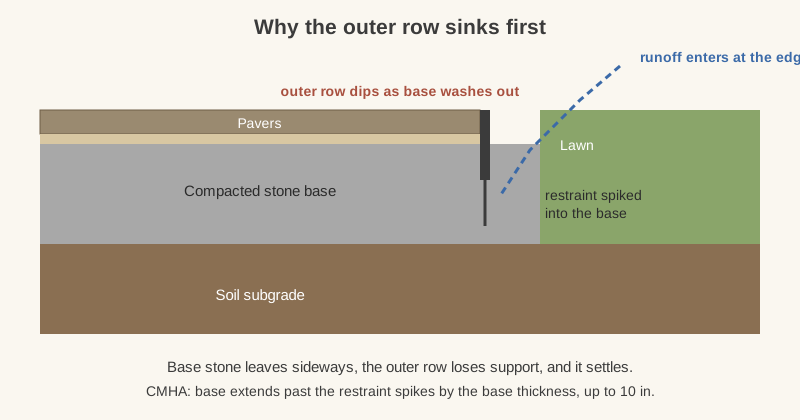
Pavers hold each other up through interlock, but the field is only as good as its boundary. The outer row sits next to lawn or a bed, has nothing beyond it, and is the first place runoff reaches. If the restraint shifts, the outer pavers settle. If water finds the edge, it can wash stone and sand out sideways.
CMHA's guide spec says the distance from the base edge to the restraint spikes should equal the base thickness, up to 10 inches (CMHA PAV-GSP-011-21). In plain words: the base must run past the restraint, so the edge sits on stone and not on soil. When it does not, the outer row is perched on the very edge of the base and has nowhere to go but down.
Rochester Concrete Products describes a typical failure in stages: the perimeter loses confinement, joints widen, bedding and base are exposed, the border course deforms, and movement spreads inward. Its warning signs include edge pavers that rock or feel soft, joint sand disappearing faster at the edges, and water pooling along the edge. For the restraint types themselves, see paver edging.
Four causes, with how to tell them apart
- Restraint not anchored in compacted base. Rochester says restraints sitting on topsoil or bedding sand are more prone to failure, and that concrete toes and curbs should bear on compacted base. Test: pull a spike. If it came out of loose soil, there is your answer.
- Water at the edge. Roof runoff, a downspout or a slope that sends water toward the edge. Boggy ground or a dip that deepens after rain points here. Western Interlock's sinking-pavers guide calls uneven soil drainage the most common cause of sinking in general.
- Too much sand in the base, or a restraint too light for the traffic. Western Interlock's failed-edge repair says loose edge pavers usually come from too much sand in the base, improperly installed restraint, or restraint that does not suit the traffic. Its example edge, which failed under heavy equipment, had about 2 inches of concrete sand, which the article calls twice as much as you need.
- Root growth, freeze-thaw or movement from beside the edge. Rochester lists freeze-thaw cycles and shifting soil among the causes. This one is harder to prevent. My guess from the pattern: uneven dips along the edge, not one even sag.
If the sinking is spreading inward from the edge across the patio, treat it as a base problem and read how to fix sunken pavers and how to keep pavers from moving as well.
Reset the edge, row by row
The repair method below is Western Interlock's failed-edge procedure, with my notes where it differs from other sources on this site.
- Assess. Pull up a few stones to check the base depth and whether the restraint is loose.
- Lift the nearby pavers. Remove stones to about 16 inches from the failed area so the new base matches the rest of the surface. The sinking-pavers guide says 12 to 16 inches past the sunken area. Putty knives work for the first stone.
- Clear the old edge. Scrape out excess bedding sand, leaving a 2-inch border of bedding as a depth reference. Cut the old restraint free with snap-edge cutters or a hacksaw.
- Fix the base. Deal with the cause, such as tree roots. Add or remove stone as needed, hand tamp it, then add concrete sand so the bedding is level and about 1 inch deep.
- Relay. Knock stones together to dislodge debris, then set them with the click-and-drop method.
- Reset the restraint. Put the new restraint tight against the pavers and nail it every second hole, then cover it with soil or sand to stop it warping.
- Tamp and sweep. Compact the pavers and sweep joint sand into the joints until they are full.
One difference to flag: my paver edging article gives 12 inch spike spacing for a patio and 8 inches for a driveway, while this guide says every second hole. Plastic edging holes are spaced differently by product, so follow the restraint maker's spacing. On a driveway, edge restraint matters more still (see paver driveway installation), and Rochester recommends professional planning for driveways, slopes and complex designs. The same article notes that installing the correct restraint during construction is far easier than repairing it later.
Stop the water before you relay
A reset edge on wet ground sinks again. Redirect downspouts, fix a grade that tips water into the edge, and check that the base runs past the restraint. The cost of this check is one afternoon and a garden hose. The cost of skipping it is doing steps 1 to 7 twice.
My opinion, stated with the mechanism: spiking new edging into the same loose soil is the most common way to waste a weekend. Interlock only works when the field cannot spread, and a restraint is only as firm as the base it is nailed into. If you cannot hammer the spike into stone, the edge is not restrained.
Fix the base under the edge, not just the pavers
Sunken edges are a base-and-water problem wearing a paver costume. Find out whether the restraint, the stone beneath it or the water around it failed, repair that, reset the edge into compacted base, and relay the same pavers. Then watch the first heavy rain from the porch. If the outer row stays put, you can stop thinking about it.
FAQ
Why are the edges of my pavers sinking?
Usually because the edge restraint is loose or not anchored into compacted base, or because water is washing out or softening the stone at the perimeter. Too much bedding sand and heavy traffic at the edge also contribute.
How do you fix sunken paver edges?
Lift the pavers about 12 to 16 inches past the sunken area, fix the base and any drainage problem, reset the restraint tight against the pavers, relay with click-and-drop, then compact and sweep in joint sand.
Do paver edges need edge restraint?
Yes. Interlock needs a contained field, and without a restraint the outer row can shift, open joints and settle. See the edging article on this site for the types.
How far should the base extend past the edge restraint?
CMHA's guide spec says the distance from the base edge to the restraint spikes should equal the base thickness, up to 10 inches.
Can I just add sand to the sunken edge?
Adding sand to a dip is a short-term cover. Bedding sand should stay about 1 inch thick, and a dip means the base below has moved, so the base needs repair.
Can I fix sunken paver edges myself?
Often yes, for a short section. A section of edge is a manageable weekend job. Driveways, slopes and complex layouts are where one source recommends professional planning.


