


Last Updated on September 27, 2026 by Umar Farooq
The right paver sealer sprayer depends on the sealer. For water-based sealers, an ordinary 1- to 3-gallon garden pump sprayer with a flat fan tip does the job, provided you rinse it the moment you finish. For solvent-based sealers, you need a sprayer with Viton seals, o-rings and a solvent-rated hose, because xylene softens standard rubber within a job or two. I read the UK paving industry's sprayer advice, a Chapin spec sheet and Techniseal's rules; all three point to low pressure and a fan tip.
Two sprayers, depending on the sealer

Interpave, the UK precast paving association, says in its guide to choosing a sprayer that most sprayers are fine for water-based sealers. For solvent-based sealers, the seals, gaskets and piping must withstand solvents that would otherwise "corrode, dissolve or simply melt" them.
| Sealer | Sprayer | Why |
|---|---|---|
| Water-based (acrylic, siloxane) | Standard poly garden pump sprayer, 2 to 3 gallons | Cheap, light, and water doesn't attack the seals |
| Solvent-based acrylic | Sprayer sold with Viton seals and a solvent-rated hose | Xylene swells and softens standard rubber |
| Large jobs, either type | Battery pail or bucket pump | Constant pressure, no pumping; brand-specific in some cases |
A standard sprayer fed solvent sealer tends to fail mid-patio: the shutoff drips, the lid gasket leaks pressure, the hose goes soft. With solvent sealer, that means kneeling in a flammable puddle.
What each part of a paver sealer sprayer has to survive
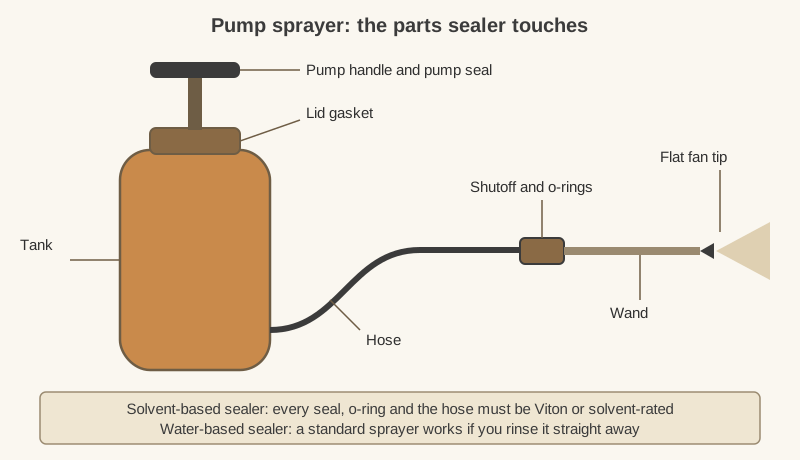
A sprayer for paver sealer is a chain of seals, and it's only as good as the weakest one. The Chapin 1949 concrete sealer sprayer listing is a good example of what a solvent-rated sprayer includes:
- Tank: 3.5 gallons of coated steel, with a 4-inch mouth for pouring
- Seals: Viton o-rings and gaskets throughout
- Hose: nylon-braid reinforced with a vinyl core
- Wand and tip: a 24-inch brass wand with a brass fan tip at about 0.5 gallons per minute
- Pressure: 40 to 60 psi
Already own a poly sprayer? Check whether its maker sells a Viton seal kit before buying a second sprayer.
Tip, pressure and tank size
Tip. Use a flat fan tip, not the adjustable cone most garden sprayers ship with. A fan lays an even band; a cone lays a heavy ring with a light middle, which dries as blotches.
Pressure. Keep it low. Techniseal's Natural Look (iN) data sheet specifies a pump sprayer or an airless one under 50 psi. High pressure turns sealer into mist that settles on the siding, the car and the neighbor's car.
Tank size. Two to three gallons suits most patios; at roughly 100 to 200 sq ft per gallon per coat, one fill covers a decent section. A 1-quart hand sprayer means an afternoon of pumping.
Setting it up so the finish looks even
- Strain the sealer into the tank. One grain of grit ruins the fan.
- Test the pattern on cardboard: a flat, even band, no spitting.
- Keep the tip about 12 to 18 inches up and move steadily. Overlap each pass by about half.
- Pump back to pressure often. As the pressure drops, the fan narrows and the sealer lands heavier.
- Back-roll puddles with a roller: 3/8-inch nap for smooth pavers, 1/2 to 3/4 inch for textured ones. That's Black Diamond's advice, and Techniseal's data sheet does the same thing with a dry roller.
- Skip windy days. Techniseal says so outright, and the wind will say it louder.
Section sizes, wet edges and the whole application process are in our paver sealing guide.
Rinse it before you take a break
The sprayer usually dies in the clean-up, not the job. Interpave's advice is to rinse water-based sealer out immediately, before it dries inside, and to flush solvent sealer with white spirit, acetone or xylene straight after use.
- Water-based: release the pressure, empty the tank back into the pail, then pump clean water through until the tip runs clear.
- Solvent-based: release the pressure, then pump a quart of the label's solvent through outdoors, wearing a respirator. Store the tank open to vent.
- Soak the tip either way.
Buy the cheap sprayer, unless the sealer is solvent
My view: most people sealing a patio need nothing fancier than a basic poly garden sprayer and a fan tip, as long as the sealer is water-based, which is the likelier choice anyway, as our water-based vs solvent-based paver sealer comparison explains. Spend on Viton only if the sealer is solvent-based. Spend on a battery pail pump only if the area is large. Either way, rinse it before you even admire the patio.
FAQ
Can I use a garden sprayer for paver sealer?
Yes, for water-based sealers. Fit a flat fan tip and rinse it immediately afterwards. For solvent-based sealers, use a sprayer with Viton seals and a solvent-rated hose, because solvents attack standard seals.
What tip should I use to spray paver sealer?
A flat fan tip. It lays an even band that overlaps cleanly, while the cone nozzles supplied with garden sprayers leave a heavy ring and a light center.
How do you clean a sprayer after solvent-based sealer?
Release the pressure, empty the tank, and pump xylene or the product's recommended solvent through the hose and tip until it runs clear. Do this outdoors, wearing a respirator, and never leave solvent sealer sitting in the sprayer overnight.


