

Last Updated on October 20, 2026 by Umar Farooq
The main paver shapes are rectangles, squares, dentated (interlocking-edge) units, hexagons, octagons with small square fillers, diamonds, triangles, trapezoids or wedges, keystones, planks and irregular flagstone-style units. Rectangles and squares suit almost any patio, walkway or driveway and need the fewest cuts. The angled shapes (hexagons, octagons, diamonds, triangles) are mostly for patterns, borders and inlays, and every angle that isn't 90 degrees adds cutting at the edges. Wedges and keystones exist to make circles and curves.
Shape also decides strength under cars, which is the part the catalog photos never mention.
Paver shapes chart: what each one is for
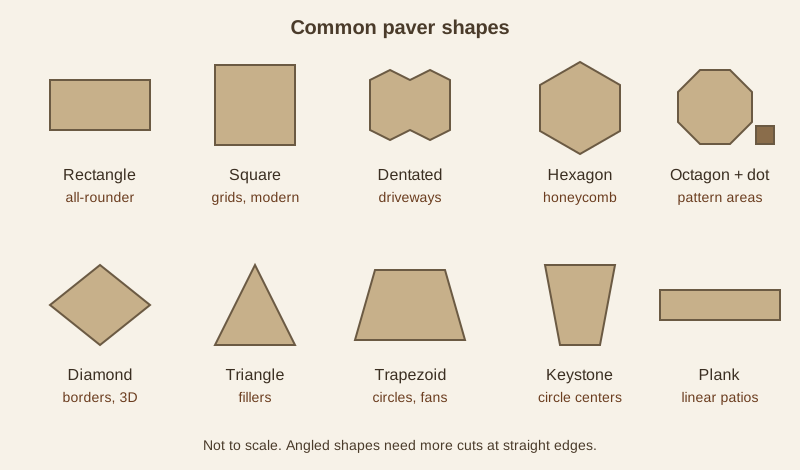
| Shape | Typical size | Best use | Edge cuts | Cars? |
|---|---|---|---|---|
| Rectangle (2:1 brick) | 4 x 8 in, 6 x 12 in | Patios, walks, driveways | Few | Yes, in the usual sizes |
| Square | 6 x 6 to 24 x 24 in | Patios, modern walks | Few | Small squares only |
| Dentated / zigzag | about 4.5 x 9 in | Driveways, heavy use | Some | Yes |
| Hexagon | 8 to 12 in across | Patios, accent areas | Many, unless half-units exist | Depends on thickness |
| Octagon + square dot | 8 to 12 in octagon | Pattern areas, pool surrounds | Many | Rarely |
| Diamond | varies | Borders, inlays, 3D patterns | Many | Rarely |
| Triangle | varies | Fills, fans, accents | Many | No |
| Trapezoid / wedge | circle-kit sizes | Circles, fans, curves | Few in the kit | Some |
| Keystone | kit piece | Circle centers, arches | Kit only | No |
| Plank | 6 x 24 in and longer | Modern patios | Few | No |
| Irregular | multi-shape sets | Flagstone look | Many at the edge | Some products |
The sizes are typical, not fixed. The car column follows the aspect-ratio rule below, which is why "depends" appears so often.
Rectangles, squares and dentated units: the workhorses
A rectangle twice as long as it is wide (the classic 4 x 8 inch brick size) lays in running bond, basketweave and herringbone without changing units. That flexibility is why it's the most common paver on earth. For the full picture, see basketweave paver pattern.
Squares lay in stack bond or as a grid with a contrasting border. Big squares (16 inches and up) read as modern and have fewer joints, and they need a flatter base because a long unit shows every bump.
Dentated or zigzag pavers have wavy edges that key into each other. Tile Tech's guide to concrete paver shapes sorts all shapes into three groups: interlocking on both axes, interlocking on one axis, and plain squares and rectangles. The dentated units are the "both axes" group, and they're the ones you see on busy commercial pavements for a reason: they resist creeping in every direction.
Octagon pavers and the square dot

An octagon can't tile a surface on its own. Lay octagons edge to edge and you get a small square hole at every four-way meeting point. So octagon pavers are always sold with small square "dot" units that fill those holes, often in a contrasting color. The result is the old-fashioned tiled-courtyard look.
Two practical points:
- Count both pieces. You need roughly one dot for every octagon in the field. Running out of dots halfway through is a special kind of Saturday.
- Edges are fiddly. The perimeter cuts octagons at odd angles. Some systems include half-octagon edge units; check before you choose.
A misspelling note, because search boxes see it often: "octogon pavers" are the same thing.
Hexagons, diamonds and triangles

A hexagon tiles perfectly on its own, with three units meeting at every joint. It looks organic, suits honeycomb and modern layouts, and has a full article of its own in hexagon pavers.
Diamond shaped pavers (rhombuses) do two jobs. Laid in three shades, they make the "tumbling blocks" 3D cube pattern. Used as a single row, they make a border or inlay. Belgard sells geometric shapes including hexagons, diamonds and parallelograms specifically for borders and inlays that pair with its main lines. "Diamond pattern pavers" often means something else: ordinary squares turned 45 degrees to the edge, which gives the same look with no special units, just more cuts.
Triangle pavers mostly exist as fillers. They close the gaps in fan and circle designs and finish the edges of diamond or hexagon fields. Their sharp corners are their weakness: a narrow point has little concrete behind it and chips when a wheel or a dropped planter finds it.
Trapezoids, wedges and keystones for curves
Trapezoid pavers (four sides, two parallel) are the building block of circles. Each ring of a circle kit uses trapezoids a little wider than the ring inside it, so the joints stay even all the way round. Fan patterns work the same way.
Key pavers, or keystones, sit at the center of a circle kit or the top of an arch, shaped to lock the pieces around them. A "keyhole" paver, in the shape lists manufacturers publish, is a unit with a notch that locks into its neighbour. If you want a circle without buying a kit, our circle pavers guide covers both routes.
L-shaped, plank and irregular units
L-shaped pavers interlock on two sides and lay in a staggered pattern that looks random from a distance. They're less common in stores now but still turn up in older patios and in some commercial lines.
Planks are long, narrow rectangles, often 6 x 24 inches or longer, used for linear modern patios. Their length makes them the most demanding shape on the base; see plank pavers for the bond patterns that stop them bowing.
Irregular shaped pavers imitate flagstone with a family of angular pieces.
Novelty shapes, like leaves, animal silhouettes and the occasional cat, are stepping stones, not pavers. They are cast singly and aren't meant to be laid edge to edge. (I did not find a single driveway-rated cat. I looked.)
Shape and strength: the aspect ratio rule
This is the part of shape selection that decides whether a paver cracks. CMHA's Tech Spec 10 uses aspect ratio, length divided by thickness:
- 4:1 or more: not for areas where vehicles drive.
- Between 4:1 and 3:1: fine for limited car use, such as a home driveway.
- 3:1 or less: suitable for all vehicular use.
Do the arithmetic. A 4 x 8 inch brick at 2 3/8 inches thick is 8 ÷ 2.375, about 3.4, which is why it's a driveway staple. A 6 x 12 inch unit at the same thickness is about 5, so it stays on the patio unless you buy the thicker driveway version. A 24-inch plank at 2 3/8 inches is past 10. Long, pointy and angular shapes all push the ratio up, because it's the longest dimension that counts.
Choose the shape by its edges, not its middle
Here's my opinion after going through Tile Tech's and Belgard's shape lists: judge a shape by what happens at the edge of your patio, not by how it looks in the middle. Every shape looks good in the field. At the perimeter, a rectangle meets a straight edge square-on and needs few cuts. A hexagon, octagon or diamond meets that same edge at an angle, and every perimeter unit gets cut, often to a slim, fragile sliver. On a 12 x 16 foot patio that is roughly 56 feet of edge, all of it cut work.
So the rule I'd use: if the patio has long straight edges, pick a rectangle or square and add the fancy shape as a border or inlay. If the shape is the whole point, choose a system that sells half-units or edge pieces, or let the edge go curved so the cuts at least look deliberate.
FAQ
What is the most common paver shape?
The rectangle, especially the 4 x 8 inch brick size. It lays in running bond, basketweave and herringbone, needs few cuts at straight edges and, at 2 3/8 inches thick, is suitable for home driveways.
Which paver shape is strongest?
Small units with a low aspect ratio, especially dentated or zigzag pavers that interlock on both axes. Long, thin shapes such as planks and large squares are the weakest under vehicles.
What shape pavers are best for a driveway?
Rectangles in the 4 x 8 inch family and dentated units, at 2 3/8 inches or thicker. Check that the length divided by the thickness is under 4, and ideally 3 or less.
Do octagon pavers need filler pieces?
Yes. Octagons leave a small square gap wherever four meet, so they are always laid with square dot pavers, roughly one per octagon.
What are trapezoid pavers used for?
Circles, fans and curves. Each ring of a circle kit uses trapezoids sized for that ring, so the joints stay even as the circle grows.


