


Last Updated on October 20, 2026 by Umar Farooq
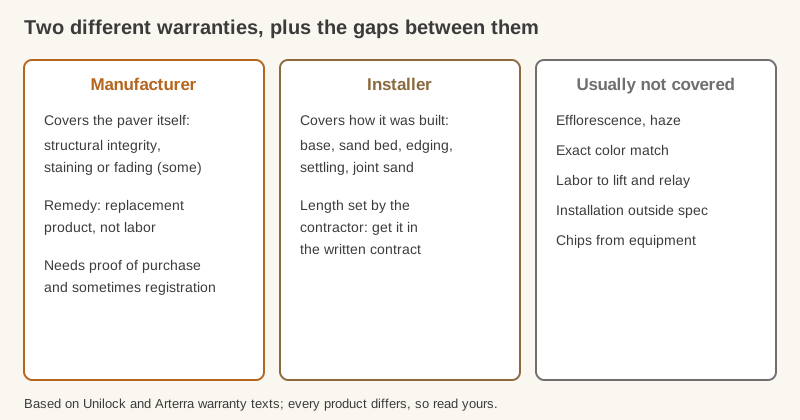
A paver warranty is two separate promises, and most homeowners only hear one of them. The manufacturer's warranty covers the paver itself, often described as "lifetime" but limited to specific defects. The installer's warranty covers how the patio was built, and its length is whatever the contractor writes down. Neither one pays you for a patio that sank because the base was thin, and the manufacturer's usually will not pay for the labor to swap a paver either.
I read the actual warranty texts instead of the marketing lines. The words "lifetime" and "limited" appear together every time.
What a manufacturer's lifetime warranty actually covers
Unilock's warranty page calls its coverage a Transferable Lifetime Guarantee on the structural integrity of its concrete paving stones and retaining wall units used in residential applications. It also covers structural failure from reasonable use of sodium chloride de-icing salt. That is the headline.
Arterra's residential pavers carry a Lifetime Limited Warranty that the surface will resist permanent staining and fading, if the care instructions are followed. It applies only to the original purchaser, and the commercial warranty is 10 years.
Notice that these are not the same promise. One guarantees structure. The other guarantees stain and fade resistance. Techo-Bloc's residential warranty is a third variation, a transferable lifetime promise that covers structural integrity and salt damage, as laid out in our Techo-Bloc pavers guide. Read yours for what it is, not for the word "lifetime."
The exclusions that decide a claim
The coverage is the short part. The exclusions are where claims go to be declined. These are the ones that recur in the texts I read.
- Efflorescence. Unilock says that because it does not compromise the structural integrity of the product, naturally occurring efflorescence is not covered. Our efflorescence on pavers guide explains the white bloom and the fix.
- Polymeric sand haze. Excluded by Unilock, and by Techo-Bloc per our guide. See polymeric sand haze.
- Scratching or chipping from snow removal or construction equipment. Unilock excludes it.
- Bad design or installation. Unilock excludes damage from poor design or installation that is contrary to CMHA specifications. Techo-Bloc's exclusions include base settling.
- Normal variation and small blemishes. Arterra excludes normal manufacturing variations and, for blemishes, spots smaller than a U.S. dime on single-color pavers or a quarter on multi-color ones.
- Chemicals and abuse. Arterra excludes chemical exposure, including chlorine and landscape treatments, and poor care. It asks that pressure washing stay at 1600 psi or less.
That fourth item is the one to understand. A manufacturer's warranty will not pay for a patio that sank because of the base. That is the manufacturer saying, in legal language, what this site keeps saying: the stone you bury matters more than the one you pick from the catalog.
The labor gap
Both warranties I read replace product and leave the labor to you.
- Unilock says replacement is free for the product, while labor costs for installing replacement product are not included. It also says color matching of replacement product cannot be guaranteed.
- Arterra says its replacement coverage covers only the product cost, FOB its facility, and that installation or removal costs due to defective product will not be considered.
So a "lifetime warranty" can leave you with a free pallet and a Saturday of digging. This is the cheapest way to see why the installer's warranty matters: it is the only one that can cover the work.
Claim rules to follow from day one
The paperwork is part of the warranty, and a missed deadline can end a claim.
- Keep the proof of purchase. Unilock requires it, and so does Arterra. A photo of the receipt and the pallet tag, kept with the contractor's invoice, is cheap insurance.
- Register in time. Unilock requires registration within 60 days of your dated proof of purchase.
- Know the deadlines. Arterra's text says legal action must be filed within 14 days from the date of the alleged breach. That is short, which is a good reason to read the text before a problem rather than after.
- Expect an inspection. Unilock says it may seek a professional diagnosis of the cause of failure before replacing product.
- Follow the care instructions. Arterra's coverage is conditional on them, down to cleaning spills promptly with soap and water.
(The warranty on the pavers is the one document that people file in the drawer with the grill manual. Put it in the folder with the contractor's invoice instead.)
The installer's warranty is the one that covers settling
The installer's warranty is a separate agreement, and the quote is where it should live. Cambridge Pavingstones recommends asking about both workmanship and product warranties, and Unilock says its authorized contractors carry a minimum two-year workmanship guarantee. There is no universal length, so get yours in writing: how long, what it covers (settling, joint sand loss, drainage) and who to call.
Our guide on how to hire a paver contractor has the full list of questions, and DIY vs contractor paver patio cost shows what the labor you would be hiring is worth. If you build it yourself, there is no workmanship warranty at all, and the base is your responsibility.
Treat the warranty as a paper trail
A paver warranty protects the paver, not the patio. The only thing that protects the patio is a base built to spec, written down, and warrantied by whoever built it. Keep the receipt, register on time, put the installer's workmanship terms in the contract, and clean and seal by the book. Do those things and the warranty will be a safety net rather than a surprise. If you do not, you own a lifetime guarantee on the pavers and a short list of reasons it does not apply.
FAQ
What does a paver warranty cover?
It depends on the product. Unilock's covers structural integrity of its pavers and retaining wall units, while Arterra's covers staining and fading. Both replace product and exclude installation labor.
Does a paver warranty cover efflorescence?
Generally not. Unilock states that naturally occurring efflorescence is not covered because it does not affect structural integrity.
Is a paver warranty transferable?
Some are. Unilock's is described as a transferable lifetime guarantee. Arterra's residential warranty is limited to the original purchaser. Check the text for your product.
Who pays to replace a defective paver?
The manufacturer typically supplies replacement product. Labor to install it is usually your cost, as both Unilock and Arterra state.
Does a paver warranty cover sinking or settling?
Not from the manufacturer. Unilock excludes installation contrary to CMHA specifications and Techo-Bloc excludes base settling. Settling is a workmanship issue, so it falls under the installer's warranty if you have one.


