

Last Updated on October 20, 2026 by Umar Farooq
Pavers on sand without base sink, tilt and lose their joints, usually within a season or two, because loose sand is a leveling layer, not a structural one. Sand on bare soil compresses unevenly under a chair leg, washes out in rain and moves when the ground freezes. The only places sand-only works are stepping stones and light garden paths you would happily reset. Under a patio, a grill or a car, you need compacted crushed stone first. I went looking for any paver maker's install guide that says you can skip the gravel on a patio. I found none. The Interlocking Concrete Pavement Institute's spec asks for at least 4 inches of compacted base under a patio or walkway on well-drained soil, with a bedding layer of "an uncompacted nominal 1 in." of sand on top (ICPI Tech Spec 2). Sand is the one inch. The base is the four.
Why a thick sand bed is not a base
The sand bed has one job: to give each paver an even seat. It is not designed to carry the load, and CMHA's guide spec is blunt about the thickness, calling for a nominal inch, screeded and left undisturbed (CMHA PAV-GSP-011-21). Make it thicker to compensate for the missing gravel and you have made the problem worse, because the thicker the loose sand, the more it can squeeze when something heavy lands on it.
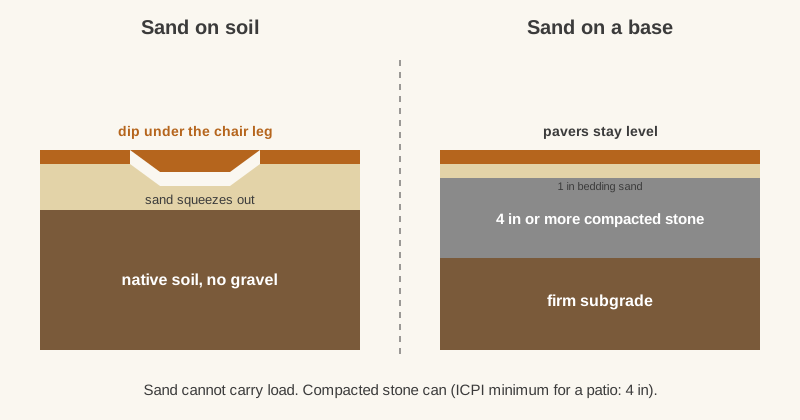
Stone fixes this with geometry. Angular crushed stone locks together when it is compacted in thin lifts and spreads the load across the soil beneath. Sand rolls and flows. If you want the compaction details, how to compact gravel covers lifts and moisture, and paver base material covers which stone to buy.
The four things that actually go wrong
Suppliers and installers all say the same thing in different words: without a base, pavers sink and shift. Here is what that looks like in order of arrival.
- Point-load dips. A table leg or a grill wheel concentrates weight on a few square inches. The sand and the soil under it give, the paver drops, and its neighbors tilt toward the hole.
- Washout. Rain runs along the joints and carries sand with it, and with no drainage layer beneath, water sits in the soil. Western Interlock lists poor drainage, trapped water, soft spots and erosion among the failures of a no-base build.
- Soil movement. Western Interlock's explainer notes that dirt swells when wet and shrinks and hardens when dry, and that trapped moisture can freeze and push pavers out of place (Western Interlock). Sand on top of that soil does not change what the soil does.
- Walking edges. With no compacted base to contain the sand, the outer pavers drift toward the lawn and the joints open across the whole field.
I could not find a single documented number for how fast a sand-only patio fails. The round percentages some blogs quote have no source I can open, so I will not repeat them. The mechanism is the useful part.
When pavers on sand alone is fine
There is a small honest exception, and it is worth knowing because it is the cheaper option. Large stepping stones, a short garden path, or a temporary pad on firm, well-drained soil can sit on an inch of coarse sand over tamped subsoil. Each stone carries one footstep at a time, and if it sinks you lift it and reset it. The full method, with a soil test and a table of what works where, is in lay pavers on dirt.
Anything with furniture, a daily walkway, clay soil or a car is a different job. The opinion I will defend is the one this whole site is built on: the pavers are the finish and the base is the patio. A mid-range paver on four inches of properly compacted stone will outlast a premium paver on sand, because pavers only spread the load and something underneath has to carry it.
The cheaper ways to get a base
If skipping the gravel is about cost or effort, shrink the job before you shrink the base.
- Make it smaller. A 10 x 10 patio needs less stone than a 12 x 16, and the base is where the tonnage goes.
- Rent the compactor. One day of rental for the base is cheaper than redoing the patio. Buying one for a single patio is the wrong direction.
- Use panels only within their limits. Base panels replace some stone on light-duty paths and patios, within the manufacturer's soil and load rules. See no-dig pavers for what they can and cannot do.
- Dig less where the soil is already firm. The minimum is still 4 inches of compacted base on well-drained soil, plus 2 to 4 more on wet, weak or freezing ground (ICPI Tech Spec 2).
Common paver installation mistakes shows where else the budget tends to leak.
Spend the effort below the sand
If you remember one number, make it four inches. Sand over soil is a patio waiting to find out where the chairs go. Sand over compacted stone is the same patio still flat when the novelty has worn off. Dig the extra inches, rent the plate, and let the gravel do the quiet work. It is the only layer of the patio that nobody will ever compliment.
FAQ
Can you lay pavers on sand without a base?
Only for light, low-risk jobs such as stepping stones or a short garden path on firm, well-drained soil. For a patio, walkway or driveway, the sources I checked all call for compacted stone under the sand. ICPI's minimum for a patio is 4 inches of compacted base.
Can you put pavers directly on compacted sand?
Compacting sand does not turn it into a base. ICPI says to screed the bedding sand to a nominal 1 inch and leave it uncompacted, and CMHA says not to disturb it. A compacted thick sand bed over soil still moves when water or load reaches the soil underneath.
What happens if you lay pavers on sand over dirt?
The pavers sink where weight concentrates, the sand washes out through the joints in rain, and wet or frozen soil moves the whole surface. The surface turns uneven, and the joints open.
How much sand goes under pavers?
About 1 inch of screeded, uncompacted concrete sand, laid over a compacted crushed-stone base. Thicker sand is not stronger. It compresses more.
Is gravel really necessary under pavers?
For anything that carries furniture, regular foot traffic or vehicles, yes. Crushed stone locks together and drains, which sand and soil cannot do. For stepping stones you can sometimes skip it.


